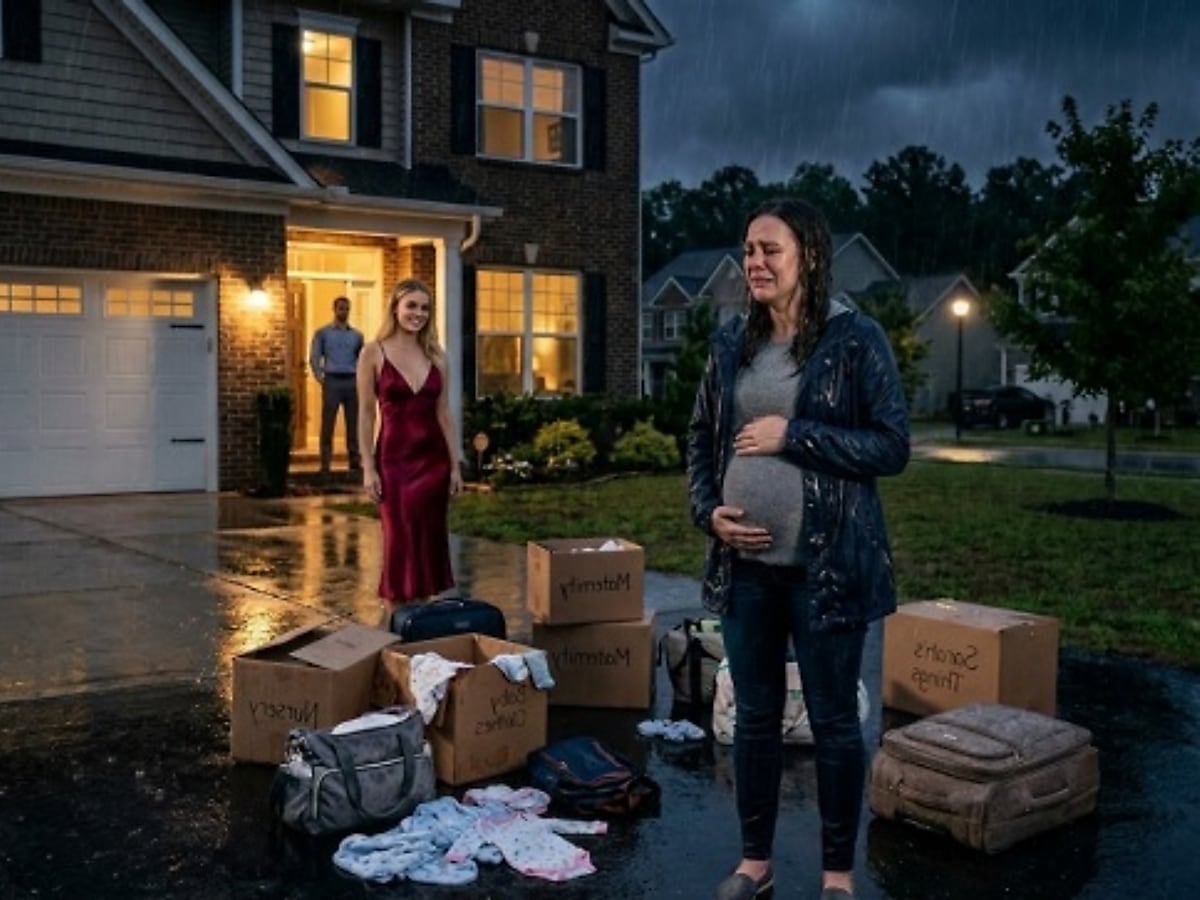
Part 1: The Boxes on Willow Creek Drive
By the time Amelia Hart turned onto Willow Creek Drive, the rain had turned the windshield into a sheet of trembling silver. Her hands were swollen around the steering wheel, her lower back throbbed from a full day of standing at the clinic, and her unborn son had been pressing hard beneath her ribs since lunchtime. At seven months pregnant, every small task felt like walking uphill with a backpack full of stones.
She had stayed late that evening because a patient named Mrs. Alvarez needed help finding a ride home and had nobody else to call.
Amelia could have walked past her.
She never had that in her.
The street looked like every other quiet block in that neighborhood, porch lights glowing behind curtains, lawns clipped short by a service Preston paid for even during months he swore money was tight.
Their house sat at the far end, two stories, gray siding, white trim, a place Amelia had once painted room by room, including the nursery she colored in a soft green with her own two hands.
Preston had complained about the paint fumes the whole weekend.
She had ignored him and kept painting.
At first the shapes near the driveway looked like landscaping debris left behind by mistake.
Then her headlights swept over a suitcase, a laundry basket, two flattened boxes, and her navy overnight bag lying sideways in a puddle.
One box had split open, spilling tiny clothes across the wet concrete.
Amelia stopped the car hard enough that the seatbelt locked across her stomach.
For a moment she just sat there, breathing, waiting for the picture outside to rearrange itself into something that made sense.
It never did.
Her scrubs, her nursing bras, her vitamins, the dinosaur pajamas she had folded that morning, all of it scattered like garbage at the edge of her own driveway.
She stepped out into ankle deep water at the curb, and the cold soaked through her clothes almost instantly.
The baby kicked hard, as though he felt the shock too.
Amelia pressed a palm to her belly and murmured something soft to him, though she barely believed her own reassurance.
The front door opened before she reached the steps.
Preston stood there in a pressed white shirt with his sleeves pushed up, looking like an advertisement for a man who had already decided he was right.
Warm light spilled out behind him from the entryway, and near the staircase stood a woman Amelia had never met in person but recognized instantly from the name that kept lighting up his phone screen for months.
Tessa.
She looked several years younger than Amelia, hair smooth, sweater cream colored, holding a wineglass she was careful not to lift once Preston glanced her way.
That tiny detail almost made Amelia laugh out loud.
Even this had a script.
“What is this?” Amelia asked, and her voice came out steadier than she expected.
Preston stepped onto the porch, leaving the door half open behind him like she was a stranger selling something instead of his wife.
“You need to calm down,” he said.
“My things are outside. In the rain.”
“You left me no choice.”
That line hit harder than the storm around her.
Preston had always carried himself with polish, square jaw, confident smile, the kind of man who sold reassurance for a living, but under the porch light he looked bored more than guilty.
“I live here,” Amelia said.
“Not anymore,” he answered.
The baby shifted inside her, and exhaustion from the whole day landed at once.
Behind Preston, Tessa studied her own nails, acting like this whole scene was awkward rather than shocking.
“You changed the locks?” Amelia asked.
“I had to protect myself.”
“From your pregnant wife?”
“From your instability.”
There it was, the word he had been rehearsing for weeks, the one he used when she cried over strange perfume on his jacket, or asked about $18,000 missing from their joint account, or wondered why a payroll company kept calling their landline.
He always blamed hormones.
Stress.
Overreacting.
Instability.
“You can’t just put me out of my own house,” Amelia said.
Preston smiled without warmth.
“Actually, I can. My name is on the deed.”
“That’s not how marriage works.”
“That’s exactly how money works.”
For most of their marriage he had controlled every account and password, claiming it was practical since he ran Sterling Custom Development, a construction firm handling commercial projects around Charlotte, and Amelia was, in his words, too generous and too emotional with numbers.
He forgot, conveniently, that before he talked her into leaving her career, she had worked as a financial operations analyst who understood spreadsheets, vendor contracts, and the difference between a random error and a pattern.
Tessa stepped forward and then stopped when Preston raised a hand.
“Maybe you should get a hotel,” Tessa offered quietly.
Amelia looked straight at her.
“Are you sleeping in my house tonight?”
Tessa’s cheeks reddened.
“This isn’t my conversation.”
“You’re standing right in the middle of it.”
Preston’s jaw tightened.
“Don’t talk to her that way.”
Amelia almost smiled, not from humor but from clarity, because the whole scene had suddenly stopped being confusing.
He wasn’t ashamed.
He was executing a plan and expecting her to crumble in the rain.
“You packed the nursery too?” she asked.
“Some of it. I’m not paying to store clutter.”
“Our son’s clothes are clutter now?”
“That baby is the only reason I put up with this as long as I did.”
That sentence cut through whatever patience she had left.
She thought of the man she had married three years earlier outside Asheville, the one who cried during the vows and promised her peace after years of dating men who thrived on chaos.
Now he stood on a porch he had let her maintain, beside another woman, calling their unborn child leverage.
Slowly, carefully, Amelia bent and lifted the soaked navy overnight bag.
Water ran off it in streams.
Tucked in the side pocket, still sealed in a plastic sleeve, was a folder Preston had clearly overlooked.
Bank statements.
Screenshots.
Insurance cards.
And one business card printed in dark blue lettering.
Julian Sterling.
Preston’s older brother.
Amelia lifted her eyes to him.
“You really think I have nothing?”
Preston laughed once.
“You have no money, no lawyer, no family nearby.”
“I have proof.”
“That’s not currency.”
“No,” she said quietly, “but evidence is.”
For a second his expression flickered, a tightening around his eyes, a man recalculating.
He stepped closer.
“What proof?”
Amelia backed toward her car.
“Enough.”
“Don’t make a scene.”
“You already made one.”
She got in, dragged the wet bag onto the passenger seat, and hit the lock before Preston could reach the door.
He stood outside knocking on the glass, mouth moving with words she couldn’t hear but already knew by heart.
You’re confused.
You’re embarrassing yourself.
You need me.
With shaking fingers, Amelia scrolled past every familiar name in her contacts and stopped on a thread she had never used.
Julian had slipped her his number at Thanksgiving after watching Preston mock her in the kitchen.
His father, Marcus Sterling, had scrawled his own number on the back of that same card and told her plainly, if you ever need anything at all, call before you decide you’re alone.
She had smiled politely back then and tucked it away.
Now, with rain pounding the roof of her car, she typed a single sentence.
Preston locked me out of the house while I’m seven months pregnant, moved Tessa in, and I have records showing he’s been moving company money.
Her thumb hovered over send.
Preston slammed his palm against the window hard enough to make her flinch.
She hit send anyway.
Dots appeared almost instantly, and Julian’s reply came through.
Do not get out of the car. Are you safe right now?
Before she could answer, Marcus wrote too.
I’m calling our attorney. Julian is calling you. Preston has no idea what he just started.
Amelia looked through the wet windshield at Preston standing soaked in his own driveway, his confidence draining fast.
For the first time all night, he looked unsure of himself.
And Amelia, exhausted, pregnant, sitting among the ruins of everything he had tried to throw away, felt the first flicker of something stronger than fear.
Part 2: A Family That Doesn’t Fold
Julian called back within thirty seconds, and Amelia answered on speaker since her hands were too cold and shaky to hold the phone properly.
His tone was quiet but firm, the kind of calm that comes from discipline rather than an absence of anger.
“Are you hurt?” he asked immediately.
“No,” she said. “I’m locked in the car.”
“Good. Stay there. Ten minutes.”
In the background she heard his truck door slam and the engine roar to life.
Unlike Preston, Julian had stayed close to their father’s original trade, running Sterling Millwork, a cabinet shop Marcus had started thirty years earlier out of a rented garage.
Preston liked to act as though Julian was the disappointing brother because he wore boots instead of leased cars, but Amelia had always noticed how differently subcontractors treated the two men.
Preston bought respect at expensive dinners.
Julian earned his on job sites before sunrise.
“Is he near the car?” Julian asked.
“Standing right outside it.”
“Do not roll the window down.”
“He says the house is legally his.”
“That doesn’t give him a right to dump your things outside and lock the door, especially in your marital home,” Julian said. “But don’t argue that in the rain. Let people with law degrees handle it.”
That single sentence nearly undid her, not because it solved anything, but because it was the first time in months someone had spoken to her as though Preston’s version of events wasn’t automatically the truth.
Meanwhile Preston had stopped pounding on the glass and started pacing near the garage with his phone pressed to his ear.
Tessa stood on the porch hugging her arms against the cold, looking less like a triumphant girlfriend now and more like someone who had walked into a mess she didn’t fully understand.
A second call came through from Marcus, and Amelia merged it with Julian’s line.
“I need yes or no answers,” Marcus said, his voice rougher than his son’s but just as steady. “Did he threaten you physically?”
“Not directly.”
“Did he keep you from entering the home?”
“Yes.”
“Are your things outside right now?”
“Yes.”
“Are you pregnant with his child, without your medication, without a safe place to sleep because of what he did tonight?”
Amelia swallowed hard.
“Yes.”
“Take pictures,” Marcus said. “From inside the car if you have to. The boxes, the porch, him, her if you can. Do not argue with him. Just document.”
That word grounded her instantly.
Documentation was something she understood.
She wiped condensation off the window and started snapping photos, then a short video of the soaked boxes, then a recorded voice memo with the date, describing everything in a flat, steady tone that surprised even her.
Preston noticed the phone raised toward him.
“Are you recording me?” he shouted, marching back toward the car.
He grabbed the handle and yanked.
Locked.
He pounded harder this time.
Julian’s voice hardened through the speaker.
“Point the camera at him and say, do not touch my car.”
She repeated the words exactly.
Preston froze mid motion.
There was power in a sentence that left no room for negotiation, no pleading, just a flat boundary spoken clearly enough to be recorded.
He stepped back, furious.
“This is insane,” he snapped. “You’re making yourself look unhinged.”
That word had lost its bite by now, dragged into the light where it looked cheap under all these witnesses.
Headlights swung into the cul de sac minutes later, a black Ford truck followed by a silver sedan.
Julian climbed out first in jeans and a rain jacket, looking like a man there to collect family, not debate anything.
Marcus followed more slowly, silver haired, broad through the shoulders, carrying an umbrella he didn’t bother opening for himself.
He tapped gently on the passenger window.
“It’s Marcus. Unlock just this side if you’re comfortable.”
She did.
He leaned in, his face softening the moment he saw her soaked scrubs and pale skin.
“Oh honey,” he said softly, and that was all it took for her composure to crack.
He handed her a towel, a bottle of water, and held the umbrella over the open door so the rain couldn’t reach her lap.
Preston approached trying to sound in charge again.
“Dad, this is between me and Amelia.”
“Not anymore,” Marcus said without turning. “You made it everyone’s business the moment you put her things in the driveway.”
Julian was already photographing the scattered boxes from several angles, setting the ruined ones under the garage overhang, lifting the tiny dinosaur pajamas with two fingers and placing them carefully on top of the pile.
His jaw was tight, but he said nothing.
Tessa stepped down from the porch.
“There’s been a misunderstanding.”
“I’m sure there has,” Marcus replied flatly.
“I didn’t know he was going to do all this tonight.”
Preston snapped at her to go back inside, and Julian turned toward him.
“That’s still Amelia’s home.”
The words landed heavy in the wet air.
Preston’s face went red.
“You’re taking her side over your own brother?”
Julian didn’t blink.
“I’m taking the side of the woman you threw outside while she’s carrying your kid.”
For a moment the storm was the only thing making noise.
Then Marcus held up his phone.
“I have Susan Markham on the line.”
Preston went completely still.
Susan handled compliance work for the family’s business interests, a woman Preston had once called sharp enough to draw blood while smiling.
Marcus put her on speaker.
“Preston,” Susan said, calm and even, “confirm for me whether Amelia has been denied access to the marital residence.”
“This isn’t a legal call,” he barked.
“No,” she replied. “It’s a record of your answer.”
He glanced toward Tessa, then back at his father.
“She left on her own.”
Amelia felt her chest tighten.
Julian raised his phone.
“I have video of her arriving to find her belongings already thrown outside.”
“Good,” Susan said. “Save it.”
Preston’s expression shifted again, calculation replacing fury.
“Fine, she can come inside and get whatever she needs.”
“No,” Marcus said. “She isn’t going in there with you tonight.”
“It’s my house.”
“It’s a scene,” Marcus said. “And you don’t get to run it anymore.”
Susan instructed that Amelia go to a hotel that night with Julian and Marcus, not because Preston had legal grounds to remove her, but because her health mattered more than proving anything at 9:30 p.m. in a storm.
Marcus would also start reviewing Sterling Custom Development’s books, since Preston’s company relied on family backed credit and shared vendors.
Preston’s face drained of color.
“You can’t audit my company.”
“I can audit every dollar I personally guaranteed,” Marcus answered.
Tessa had quietly set her wineglass down somewhere and stood with arms crossed, watching the scene unfold like a play she had walked into during the wrong act.
Marcus helped Amelia into his car while Julian loaded what could still be saved into his truck bed.
As they pulled away, Amelia looked back once.
Preston stood beneath the porch light beside Tessa, rain soaking his sleeves, watching the car carrying away the wife he had tried so hard to discard.
His mouth was a hard line, but his eyes told a different story.
He was afraid, not of losing her, but of what was about to be exposed.
Part 3: What the Numbers Remembered
The hotel Marcus chose was plain but warm, close to Amelia’s obstetrician, and by midnight Julian’s wife, Brooke, had arrived with dry maternity clothes, ginger tea, and a phone charger.
She hugged Amelia gently around the belly and said she didn’t have to explain a single thing that night.
But once Amelia sat wrapped in dry sweatpants, the words spilled out anyway.
She talked about the missing $18,000, about Preston pushing her to quit full time work right as he claimed money was tight, about invoices from vendors she was sure had never touched those job sites.
She talked about Tessa too, without theatrics, just the tired honesty of someone who had carried a secret alone for far too long.
Julian took notes while Brooke held her hand, and Marcus stood by the window looking older than he had that morning.
“I kept waiting for one perfect piece of proof,” Amelia admitted. “Something he couldn’t twist.”
“Patterns matter more than one document,” Julian said.
“He always tells me I misunderstand business.”
“He tells everyone a lot of things.”
Marcus turned from the window.
“You mentioned payroll calling the house?”
“Twice. He told me it was spam.”
Julian looked at his father. “Could be worker misclassification. Or ghost employees.”
“There was also furniture he charged for an apartment,” Amelia said. “He called it staging inventory.”
Brooke’s eyebrows shot up. “Apartment furniture?”
Amelia pulled up a receipt on her phone, a charge from a South End retailer for $7,842, delivered to an address that matched exactly where Tessa’s tagged photos placed her.
Julian muttered something under his breath, and Marcus took off his glasses to rub his eyes.
“I guaranteed part of his equipment line last year,” he said. “He told me it was paid off.”
“It was supposed to be.”
By morning the storm had passed, sunlight slipping through the hotel curtains in thin stripes across the beige walls.
Brooke drove Amelia to see Dr. Kendall while Marcus and Julian met with Susan.
Dr. Kendall checked Amelia’s blood pressure, listened to a strong steady heartbeat, and reminded her that stress wasn’t harmless, but neither was guilt.
Amelia cried at the sound, fast and alive, a baby who had no idea about locks, wine glasses, or missing money.
She placed both hands on her belly and promised silently that whatever happened next, her son would never learn that love meant obedience.
Back at the hotel, Julian was waiting with two untouched cups of coffee.
“Susan pulled some filings,” he said. “Dad’s credit guarantee is still active. Preston renewed it without telling him.”
“Can he even do that?”
“He apparently submitted numbers that might not match the real books.”
Over the following days, the quiet machinery of the Sterling family started moving.
Susan connected Amelia with a family law attorney named Rachel Kim, who explained plainly that Amelia had rights to temporary support and safe access to the home, without wild promises attached.
“Your name missing from a deed doesn’t erase your rights,” Rachel told her. “But we do this with paperwork, not shouting matches.”
Preston, of course, ignored that advice entirely and sent thirty-one texts before noon, ranging from accusations to guilt trips to outright threats.
Amelia forwarded every single one to Rachel and answered none of them.
By Friday, the accountant Marcus hired was combing through records Preston legally had to hand over, and a subcontractor named Dale Mercer called Julian out of nowhere.
Dale explained his company’s name had been attached to drywall invoices totaling more than $96,000 for jobs he had never touched, or had billed at nearly triple the honest rate.
“Who got paid then?” Susan asked on speaker.
“That’s exactly what I want to know,” Dale said. “Because it wasn’t me.”
That evening, while eating soup in Brooke’s kitchen, Julian mentioned a company called Magnolia Harbor Interiors, registered months earlier under an address that traced straight back to Tessa’s apartment.
Amelia closed her eyes, feeling less angry than embarrassed, embarrassed she had folded baby clothes in a nursery Preston was already treating like a bargaining chip.
Brooke reached across the table.
“None of his choices are your shame to carry.”
“I know,” Amelia said. “Knowing and feeling aren’t the same thing.”
The next day Tessa herself reached out through a text.
Rachel advised no direct calls, so if Tessa had something to say, it had to be in writing.
An email arrived hours later, long and messy, but with attachments that mattered.
Screenshots of Preston telling Tessa that Amelia had already left months earlier.
Screenshots suggesting the baby might not be his, though he knew that was false.
Photos of a furnished apartment paid for with a company card.
And one line that made Amelia’s blood run cold.
Once Dad signs off on the refinance, I’ll move the rest and she won’t have a dime to fight with.
The message was dated three weeks before he locked her out.
Amelia forwarded it immediately to everyone who mattered.
Marcus invited her to his shop the next afternoon, a place smelling of sawdust and coffee where nobody treated him like anything other than a man who showed up daily.
In his office he opened a cardboard box holding old business plans and early cash flow projections.
Amelia recognized her own formatting instantly, color coded tabs, careful revenue assumptions, notes scribbled in the margins.
“Your initials are on every page,” Marcus said. “He told me he did this alone.”
“Of course he did,” Amelia said with a tired laugh.
Marcus’s voice cracked slightly.
“I’m sorry,” he said. “That should never have been erased.”
Amelia folded the letter carefully.
“My next step,” she said, “is getting my house back.”
Part 4: In Front of the Judge
Rachel filed the paperwork fast, and the hearing landed nine days after that storm.
In that time Preston swung between rage and charm so predictably that Rachel started sorting his messages into folders labeled threats, guilt, money, and denial.
He sent flowers to Brooke’s house with a note saying let’s stop hurting each other, and Amelia photographed the card before throwing every stem in the trash.
He also emailed a spreadsheet claiming Amelia had voluntarily left and drained their household funds, a document Rachel found riddled with mistakes within the first two lines.
The morning of the hearing, Amelia wore a navy maternity dress and kept her makeup light, wanting to look tired and honest rather than staged.
Marcus and Julian sat quietly toward the back at Rachel’s request, while Tessa’s attorney submitted a written statement in her place.
Preston arrived in a charcoal suit beside an unfamiliar lawyer, polished again, though his glance toward Amelia’s belly held irritation instead of any softness.
The judge asked practical questions, and Rachel answered with photos, timelines, and printed messages.
Yes, Amelia had lived there.
Yes, her belongings had been dumped outside in the rain.
Yes, she had been seven months pregnant at the time.
Yes, the locks had been changed without any court order.
Preston’s attorney tried to frame it as a heated disagreement, but Rachel called it plainly what it was, an unlawful attempt to force her out without notice.
The judge pressed Preston directly, and each answer chipped away at his composure.
Did you pack her belongings and place them outside?
Yes.
Did you change the locks?
For safety, he claimed.
Did you have any court order allowing it?
No.
Then Rachel introduced the refinance message, and Preston’s face changed the second it appeared on the screen.
His lawyer whispered urgently, and Preston shook his head too sharply.
The ruling came measured but firm.
Amelia would keep temporary exclusive access to the house, with a deputy present if needed during the transition.
Preston could not sell, hide, or damage marital property, and communication between them would run through a monitored app for anything necessary.
It wasn’t revenge.
It was structure, and structure felt like air after weeks of suffocation.
Outside the courtroom, Preston caught up to her before Rachel could step between them.
“You think you won something,” he muttered.
Amelia studied him for a long moment, thinking of coffee brought to bed, tears at a positive pregnancy test, hands resting on her belly at their first ultrasound.
“No,” she said quietly. “I think I finally got back through my own front door.”
That afternoon a deputy stood in the driveway while Julian changed the locks legally this time, with documentation to match.
Brooke walked room to room first, checking closets and drawers, while Marcus waited on the porch staring at the lawn like he could still see the storm sitting on it.
Inside, faint traces of Tessa’s perfume lingered in the hallway, and a strange mug sat in the sink that Amelia had never owned.
The nursery door was closed, and when Amelia opened it, half the drawers were empty, the bookshelf shoved aside, and a framed woodland print lying face down with cracked glass across a painted fox.
Amelia sat in the rocking chair and finally let herself cry, not the frightened tears from that first night, but older ones, full of every compromise she had made to keep peace in a house that never deserved it.
Brooke knelt beside her until it passed.
“I thought if I loved him calmly enough, he’d calm down too,” Amelia whispered.
“That was never how it worked,” Brooke said gently.
Within weeks the accountant’s report surfaced suspicious transfers from Sterling Custom Development into Magnolia Harbor Interiors, inflated invoices, and personal spending disguised as project costs.
Lenders began calling, vendors reached out to Julian instead of Preston, and one drunken voicemail arrived at 1:14 a.m. blaming Amelia and the baby for ruining everything he had planned.
Amelia saved it, forwarded it to Rachel, and never listened to it again.
Tessa sent one final message through her attorney, ending things with Preston and admitting quietly that she had believed his lies about Amelia already being gone.
By month’s end, Preston’s company accounts were frozen pending review, and he moved into a short term rental near the interstate while Amelia stayed in the house, rebuilding the nursery drawer by drawer, replacing the cracked frame, folding tiny clothes that had survived the rain after all.
Part 5: The Text That Started Everything
Weeks before her due date, a message arrived through the monitored app.
Preston wrote that he wanted to be present at the birth.
Rachel reminded her that labor was a medical event, not a negotiation, and Amelia’s reply through the app stayed simple and firm.
Preston fired back that she was being cruel, and Amelia didn’t bother answering.
Instead she asked Brooke to be her birth partner, and Brooke replied with a string of crying emojis and one very serious question about snacks.
That last month slowed Amelia’s body but sharpened everything else, appointments, parenting proposals through Rachel, groceries from Marcus every Sunday that he insisted were just extras.
Julian fixed the loose porch railing and built the stroller while muttering at the instructions, and Brooke filled the freezer with labeled meals for the newborn haze ahead.
Her water broke on a quiet Tuesday morning while she stood at the toaster.
Brooke arrived nine minutes later in two different shoes, breathless but calm at heart, as she put it.
Labor stretched long, hours blurring past monitors and gentle nurses, until at 2:46 a.m. her son arrived with a furious cry that startled the whole room, weighing 7 pounds, 2 ounces, dark haired and already stubborn.
When the nurse placed him against her chest, Amelia whispered hello and felt him quiet for a moment, as if deciding whether that greeting was acceptable.
She named him Elliot James Hart, choosing her own name as his, not as ownership but as a promise of steadiness.
Marcus held him the next day with trembling hands and quiet tears, and Julian teased that the poor kid was already too smart for the family he’d been born into.
Preston saw his son two days later under supervised terms, arriving thinner and angrier at the restrictions, but something human still crossed his face at the sight of the baby.
Amelia let both truths exist at once, that he could love his son and still have caused real harm.
Court proceedings dragged on, creditor claims piled against Sterling Custom Development, and Marcus refused to prop it up again, telling her plainly you don’t save a house by painting over rot.
Amelia eventually sold the Willow Creek Drive house and moved into a smaller townhouse in Matthews, twenty five minutes from Brooke and Julian, sunny kitchen, small fenced patio, a quieter version of everything she used to have.
One rainy evening months later, holding a milk drunk Elliot against her shoulder, a text buzzed through from Julian about Sunday chili at Marcus’s place.
Right after, a message came from an unfamiliar number, Dale Mercer, letting her know the claims were finally moving and thanking her for speaking up before more people got hurt quietly.
Amelia sat with that sentence for a long time, looking around a home that held nothing dramatic, just diapers, a coffee mug, and shoes by the door, and realized courage rarely looks like a speech.
Sometimes it looks like one text sent before fear can talk you out of it.
On Elliot’s first birthday, in Julian and Brooke’s backyard full of blue cupcakes and a banner Marcus insisted on hanging himself, Preston stopped by for one supervised hour, polite and brief, then drove away without incident.
Amelia felt neither triumph nor longing watching him go, only distance, which turned out to be its own kind of freedom.
Later that night Marcus handed her an envelope containing a letter on Sterling Millwork paper, formally recognizing her early unpaid work building the company Preston once claimed he started alone.
It wasn’t money, and it didn’t undo anything, but it named the truth plainly in black ink.
The next morning Amelia opened the box where she kept her important papers and found the old business card still tucked in its wrinkled plastic sleeve, Julian’s name on one side, Marcus’s scrawled on the back.
She placed it in a small frame on her desk, not as a monument to the men who rescued her, but as a reminder of the night she asked for help before shame could keep her quiet.
The message that changed everything had never been poetry or revenge, just one sentence typed with shaking, wet hands inside a locked car.
Preston locked me out of the house while I’m seven months pregnant, moved Tessa in, and I have records showing he’s been moving company money.
That was the whole of it, and it turned out to be enough.
Names have been changed and this story has been dramatized for entertainment purposes.
