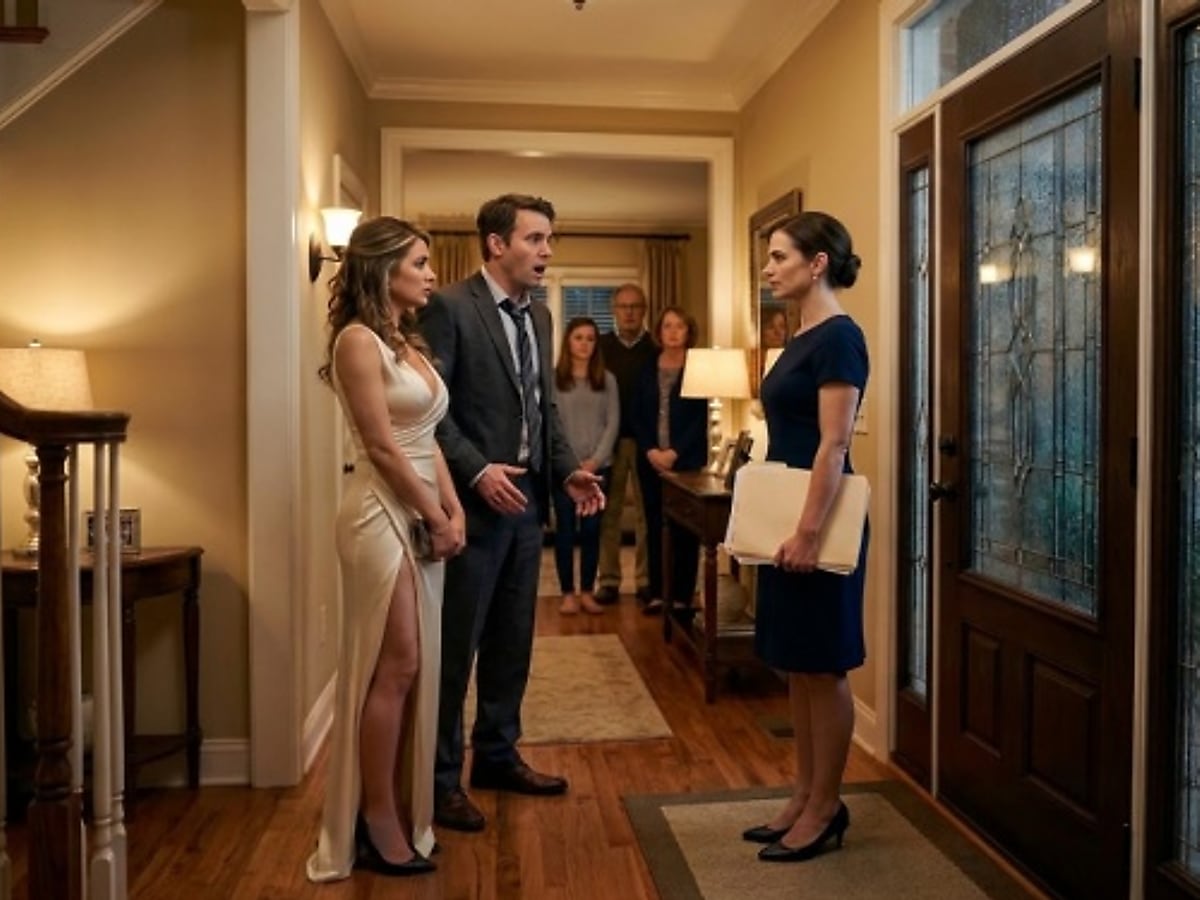
Part 1: The Woman Standing in My Doorway
My name is Rebecca Lawson, thirty-eight years old, and this all unfolded in Worthington, a quiet Columbus, Ohio suburb where neighbors wave from their porches and remember whose trash cans got left at the curb too long.
Our four-bedroom house held eleven years of what I believed was a marriage, complete with a white kitchen I’d saved for, a maple tree out front, a basement Andrew swore would be perfect for movie nights, and a blue front door I painted myself one Memorial Day despite his complaints that the shade was too bold.
Andrew Lawson was my husband when this story started, forty-one, a financial advisor at a downtown wealth management firm, polished in that tailored-suit way that made clients trust him instantly with money, which turned out to be deeply ironic.
For years I handed him everything, my time, my career flexibility, my belief that he was fundamentally decent underneath it all.
We met at Ohio State, me finishing a master’s in education, him wrapping up his MBA, driving a beat-up Civic and talking constantly about wanting a life that felt stable but never boring.
I married him at twenty-six. He cried during the vows, his mother cried harder, and my father shook his hand afterward saying take care of my girl, to which Andrew answered always, a word that means nothing until someone actually tests it.
Our early years felt genuinely good, not movie good, real good, splitting grocery bills to the penny in a tiny apartment near German Village, celebrating his first real planning job while I taught fourth grade and came home tired but proud.
Buying the Worthington house felt like arrival. Andrew said this is where our kids grow up.
We never had kids.
First by choice, then by timing, then endless hesitation dressed up as circumstance, his promotion, my curriculum opportunity, interest rates, his parents, my father’s surgery, always another after this.
By thirty-six, waiting stopped feeling like strategy and started feeling like avoidance.
Whenever I raised it seriously he changed topics, called me emotional if I pushed, called me unfair if I cried, and slowly I noticed the deeper pattern beneath the baby question entirely.
Andrew adored me most when I supported his life without asking much back, praised my competence only when it benefited him, called me strong when strength meant handling everything alone, and dramatic the moment strength meant demanding honesty instead.
By the time Lily Grant entered the picture, cracks already ran through the foundation.
Lily was twenty-nine, a client relations associate at his firm, someone I’d met once at a company picnic out at Scioto Audubon Metro Park, dressed in a white sundress, laughing at his jokes like each one had been written specifically for her, calling me so sweet three separate times within ten minutes.
I disliked her instantly, though disliking someone isn’t the same as suspecting them, and women get accused of jealousy long before anyone credits us with being observant, so I buried the feeling and told myself she was simply young and overly friendly.
Andrew mentioned her constantly after that, casual references at first, Lily caught something in a file, Lily knows a spot in Short North, Lily thinks our office layout is depressing.
Our.
That pronoun arrived long before I understood its weight.
Then he stopped mentioning her entirely, and that silence is what actually made me start paying attention.
His phone became an extension of his body, taken into the bathroom, flipped face down at dinner, guarded by a new passcode after a decade of using our anniversary date, explained away as some updated company security policy.
Reasonable sounding lies are still lies.
Late nights multiplied, client dinners stretching past midnight, weekend portfolio reviews, sudden networking events requiring new shirts and a gym membership untouched since 2018.
He grew meaner too, subtly at first, criticizing my clothes, asking if I was still dressing like a teacher despite my new administrative role, calling our house heavy, saying he needed more energy around him.
One October dinner stands out clearly, salmon and roasted potatoes and asparagus because he’d complained about eating out too much, and he sat down, sighed, said nothing felt wrong exactly, just that things felt routine, and when I pointed out it was literally dinner, he accused me of making him sound ridiculous whenever he tried being honest.
That became his signature move, saying something vague and cutting, then blaming my confusion when I asked what he meant.
By November I knew someone else existed, not through dramatic discovery, but because my husband had started acting like a man rehearsing an exit while still relying on my labor to run the household he claimed suffocated him.
He mocked my cooking yet ate every bite, mocked the house yet slept soundly in it, called marriage suffocating yet still let me book his dental cleanings, buy his mother’s gifts, and organize a Thanksgiving he wanted to invite coworkers to.
Lily came to that Thanksgiving, the first time he brought her into my home, though not officially as his mistress, claiming her family lived in Arizona and flights were too pricey.
I didn’t want her there but was still trying to be generous, which is usually the exact moment right before a woman is forced to become sharp instead.
She arrived with pumpkin cheesecake and wine pricier than my shoes, hugged Andrew a beat too long, complimented the house like she was already redecorating it in her head, and asked me over dinner if administrative work felt emotionally draining, watching Andrew’s reaction to my answer like my marriage was a case study.
He watched her carefully all night, the kind of careful meant to look accidental.
Later, loading the dishwasher, I overheard him tell her quietly that she doesn’t get me anymore, and Lily answered you deserve to be understood, and something in me went completely still.
I didn’t confront him. I finished the dishes, said goodnight to guests, smiled when Lily thanked me for making her feel welcome, then locked myself in the pantry at 11:30 p.m. and pressed both hands over my mouth so no sound escaped.
The next morning I called an attorney named Marianne Brooks, twenty-two years of family law experience downtown near the courthouse, calm in the exact way that unnerves unreasonable men.
I told her I thought my husband was cheating, and she asked simply if I wanted a divorce.
I cried, not from confusion but certainty.
Yes, I said, but I need to do this right.
Then we start with information, she told me.
That sentence rearranged everything, because from that point forward I stopped trying to make Andrew tell the truth and started collecting it myself.
Part 2: Building the Record He Never Saw Coming
There’s a particular loneliness that only exists inside a marriage, different from being single or simply alone, the loneliness of standing beside someone who knows precisely where to cut and then tells everyone else you’re bleeding because you’re fragile.
Andrew started calling me fragile that December, not to my face, to everyone else.
I learned this from my sister Megan, who called one Friday night while I sat in a grocery store parking lot holding a receipt for chicken broth and laundry detergent, asking if I was okay.
Andrew told mom you’ve been emotionally unstable, she said.
I froze completely.
He said you’ve been suspicious of everyone, worried about your anxiety, she continued, and I felt shame before anger, the old instinct kicking in to defend my own credibility.
I’m not unstable, I said.
I know, Megan replied instantly, that’s why I’m calling you and not him.
I cried quietly in that Kroger parking lot while a woman loading her minivan glanced over politely and looked away.
That’s when I understood he wasn’t only cheating, he was constructing a narrative in advance, positioning himself as reasonable no matter which direction I moved.
If I confronted him, jealous. If I cried, unstable. If I left, impulsive. If I exposed him, vindictive. If I asked for fair finances, greedy.
Marianne had warned me about exactly this during our second meeting, explaining that people rarely betray only once, they lie again to protect the first lie, then recruit sympathy as a shield against consequences.
So what do I do, I asked.
Document, she said. Stay calm. No threats, no posting, no contacting the other woman, no draining accounts, no destroying anything, nothing recorded without discussing Ohio law first. Keep everything clean.
Clean became my private word, not soft or passive, just precise.
I built a secure folder of financial records I legally had access to, bank statements, credit cards, mortgage paperwork, tax returns, retirement summaries, insurance policies, household expenses, photographing receipts that surfaced in his pockets or car cup holders.
I tracked marital spending, not for revenge but because money reveals what people try to edit out of their own stories.
Restaurant charges appeared for places he’d never taken me, $286.40 at The Guild House, $197.22 at Lindey’s, $512.09 at a downtown hotel bar, a weekend charge at a resort near Hocking Hills the same Saturday he claimed to be handling a client’s estate planning.
A jewelry receipt for $1,250 surfaced from an Easton shop, and I’d received no jewelry that year.
Three days later Lily posted diamond hoop earrings online with a caption about unexpected gifts hitting different.
I screenshotted it quietly.
He never once noticed me noticing, believing my silence meant surrender, when really every quiet evening gave me room to become exact.
I opened a separate account at a local credit union, redirected my paycheck, reviewed my credit report, froze an unused card, changed passwords everywhere, and inventoried my jewelry and family heirlooms.
Ohio splits marital property equitably rather than automatically equally, Marianne explained, meaning separate contributions and documentation genuinely matter, and misuse of shared funds can factor in too.
Don’t assume fairness happens on its own, she told me, build the evidence that makes fairness possible.
So I built it.
Andrew grew bolder at home, taking calls in the garage, buying new shirts he called work clothes, replacing the guest bathroom soap with an unfamiliar jasmine brand, and when I asked why, he looked at me like I’d questioned the moon’s existence.
It’s soap, Rebecca, he said.
I didn’t buy it.
Maybe I did.
You don’t buy soap.
Do you hear yourself, he laughed.
That became his favorite trick, shrinking anything suspicious down to something too small to mention, a hotel charge became work, a hidden phone became security, unfamiliar perfume became a coworker’s hug, mysterious soap became proof I’d lost perspective.
By January, Lily’s presence became impossible to ignore, texting through dinner, him glancing down smiling, flipping the phone, sometimes stepping outside for a client call and returning smelling like winter air and guilt.
One Saturday I found a receipt from a Grandview Heights furniture store, a velvet accent chair, delivered to an apartment near Short North, customer name Andrew Lawson.
I remembered Lily’s story two weeks earlier about finally making her place feel like home.
Home. That word again, the one that should have belonged to me.
I sent the receipt to Marianne, who told me to save it, avoid confrontation, since it might factor into a dissipation of marital assets claim depending on total amount and strategy.
I started a spreadsheet, date, amount, vendor, claimed explanation, likely actual purpose, supporting proof.
Ugly, but clear.
By mid-February, Andrew had spent roughly $18,700 connected to Lily or otherwise unexplained, not counting cash withdrawals I couldn’t yet verify.
Meanwhile he lectured me about cutting back, citing property taxes, retirement contributions, calling my laundry room remodel idea financially irresponsible, suggesting I skip ordering lunch at work, though my monthly lunches cost far less than his wine tabs with Lily.
I remember watching him lecture me over the kitchen island, holding a mug I’d bought him at a Christmas market, wearing a sweater I’d picked out, standing inside a house I helped fund, telling me to show discipline while funding someone else’s apartment décor.
That was the first moment I felt insulted rather than heartbroken, and insult, unlike heartbreak, starts calculating instead of begging.
Marianne filed nothing yet, choosing preparation instead, drafting the petition without submitting it, requesting financial disclosures, briefing me on temporary orders and what to do if things turned hostile, telling me to have somewhere safe to go even without expecting violence.
Andrew had never hit me, but she was clear that leaving is exactly when unpredictable behavior can emerge, so we plan for calm without relying on it.
My sister Megan lived twenty minutes away in Dublin and offered her guest room, though I wanted privacy instead, renting a small two-bedroom apartment in Clintonville under my maiden name, Rebecca Monroe, funded through my separate account.
Hardwood floors, old windows, a tiny balcony overlooking an alley, more charming than practical.
I loved it instantly.
I moved things slowly, winter coats first, then books, documents, family photos, professional clothes, my grandmother’s jewelry, Megan helping on Wednesdays during his so-called client dinners, my brother-in-law hauling heavier boxes once without saying much, which I appreciated deeply.
By March, half my life had already left that house, and Andrew never noticed, or if he did, assumed I was simply organizing, since men like him rarely question disappearing objects when a wife has spent years making order invisible.
Then came the night he brought Lily home, not to confess or apologize, but to humiliate me, believing the sight of her in our hallway would shatter whatever dignity remained.
He’d prepared his performance.
I’d prepared an audience.
Part 3: The Hallway He Thought He Controlled
It was a rainy Friday in April, Columbus damp with that spring chill that smells like wet pavement and thawing dirt.
I’d spent the day reviewing district literacy reports, trying not to think about Marianne’s confirmation that the divorce petition would be filed the following Monday.
I got home at 5:40 p.m. Andrew’s car wasn’t in the driveway, which had become ordinary by then.
I changed clothes, made tea, and walked slowly through rooms that looked almost untouched unless you knew exactly where to check, drawers lighter, the linen closet half empty, the basement filing cabinet cleared, my closet still full enough to appear normal but light enough to leave quickly.
At 6:12, Marianne called confirming everything remained on track for Monday morning.
Are you safe tonight, she asked. As far as I know, I said. Any sign he suspects? No.
If anything happens, don’t escalate, she reminded me, call me or leave if unsafe.
I almost mentioned a bad feeling, but bad feelings had turned into background noise by then.
At 7:03, Andrew texted, we need to talk tonight, be home.
No greeting, no question, just a command.
I forwarded it to Marianne, who told me not to engage, and to have someone present if he arrived hostile.
Someone was already arranged, Megan, my parents, and at Marianne’s suggestion, a private process server named Thomas Reed, originally scheduled Monday but willing to come sooner if Andrew forced a confrontation that evening, serving him at home in a controlled setting to prevent any later claim of surprise, handled properly and legally, nothing theatrical.
At 8:15, Megan came through the back door with my parents, my mother hugging me hard enough to squeeze my breath out, my father, a retired firefighter, scanning the kitchen like he was inspecting a structure before entry.
Where do you want us, he asked. In the den. You sure? Yes.
Megan set a folder on the counter, extra copies, my documents, financial summaries, screenshots, receipts, statements, not everything, just enough to prove Andrew’s version wouldn’t be the only one in that room.
At 8:47, Thomas Reed arrived, polite, plain, wearing a rain jacket, carrying a sealed envelope, confirming quietly he’d serve Andrew only once I gave the word, my family staying in the den unless called.
Not a trap. A boundary with witnesses.
At 9:26, headlights swept the front windows, my stomach dropping from the body’s memory of fear rather than fear itself.
Andrew’s black BMW pulled in, another door opened seconds later, heels clicking on the wet walkway.
Megan muttered from the den, you have got to be kidding me.
I stood in the foyer, hands at my sides, as the blue front door opened.
Andrew entered first, charcoal suit, no tie, collar open, hair damp, wearing the confidence of a man walking into a room he assumed he still controlled.
Lily followed in a cream coat and fitted black dress, wearing those same diamond hoop earrings, essentially bought with my marriage.
She stepped inside with cautious arrogance, the kind people carry when they know something is wrong but convince themselves fate makes it brave anyway.
Andrew shut the door.
Rebecca, he said.
I looked at Lily, then back at him. What is this?
This is Lily, he said, rehearsed.
I know who she is.
We’re not going to keep pretending anymore, he continued.
We. As though I’d been the one lying.
Pretending what, I asked.
That this marriage is working.
My father shifted in the den, floor creaking, Andrew too absorbed in his speech to notice.
I know this is painful, he said, without an ounce of actual pain on his face, but Lily and I are together, we’re in love, I didn’t plan it but it happened, and I think it’s time everyone acted like adults.
Lily gazed at him like this was courage.
You brought her into our home to tell me that, I asked.
Our home is part of what needs discussing, he said.
There it was, the real motive, not honesty, property.
I don’t want this to get ugly, he added.
Then why bring her, I asked.
Because I want you to understand this is real, I’m not going to let you manipulate me with tears or guilt.
I laughed once, unable to stop myself.
You think this is funny, he snapped.
No, I said, I think it’s familiar.
Lily spoke up. Rebecca, I know this is hard, but Andrew has been unhappy a long time.
I turned to her. Lily, you’re standing in my hallway wearing earrings bought with marital funds. This isn’t the moment to explain my marriage to me.
Her face reddened.
Andrew stepped slightly in front of her. Don’t attack her.
I stated a fact.
You always do this, he snapped, twist everything, this is exactly why I couldn’t talk to you.
Megan appeared in the den doorway. Andrew froze. My parents stepped into view behind her. Lily’s eyes widened.
What is this, Andrew asked.
I said nothing.
Thomas Reed stepped forward last, holding the sealed envelope.
Andrew’s face cracked slightly, confidence fraying.
Rebecca, he said slowly, what did you do?
I took a breath. Exactly what you should have expected from a woman who stopped asking questions because she already knew the answers.
Thomas approached. Andrew Lawson?
Yes.
You’ve been served.
The envelope touched his hand. Nobody moved. Rain tapped the windows. Lily looked ready to disappear into the floor.
Andrew looked down, then at me. You filed for divorce?
Not yet, I said, the petition goes in Monday morning. These are your copies and notice from counsel. Read them carefully.
His face flushed dark. You embarrassed me in front of her?
That’s when I realized he still didn’t understand, having brought his mistress into my home to announce his affair, implying he wanted to discuss the house, and somehow believing himself the injured party.
No, Andrew, I said, you embarrassed yourself. I only made sure there were witnesses.
Lily whispered, Andrew, you said she didn’t know.
My eyes moved to her. The first fracture.
Andrew shot her a look. Not now.
But Lily was already staring at him differently, since if he’d told her I was clueless and fragile, nothing in this room made sense, not my calm, not my silent family, not the paperwork already in his own hand.
His story to her was collapsing in real time.
You’re making a mistake, he said.
No, I answered, I made mistakes for years, this is the correction.
Part 4: What the Folder Proved
Andrew tore into the envelope with shaking hands, and I won’t pretend that didn’t satisfy something small and unkind in me.
For months I’d watched him glide through lies believing consequences belonged to less charming men, and watching his fingers fumble a paper seal felt like reality finally demanding identification.
He skimmed the first page, then the second, and stopped. What is this financial attachment?
My attorney’s preliminary summary.
You had no right.
I had every right to access records tied to my own name and our shared finances.
You’ve been spying on me.
No, I’ve been reading our credit card statements.
Megan made a sound like a stifled cough. Andrew looked furious. Lily looked worried now, not heartbroken, worried, and there’s a real difference between the two, heartbreak concerns love, worry concerns what promises might now be legally complicated.
He flipped pages faster. This is ridiculous.
Which part?
All of it.
Be specific.
He hated specifics, since fog let him shuffle blame around and call it truth, while details demanded accountability.
I walked to the console and picked up Megan’s folder, a curated set, clean copies, dates, amounts, nothing illegal or exaggerated. I held it out. Andrew wouldn’t take it.
So Lily did, surprising everyone including herself.
She opened it slowly, a timeline first, then charges, then screenshots of public posts matched against receipts, the earrings, the Hocking Hills resort, the Grandview furniture delivery, the restaurant tabs, the hotel stay, the jasmine soap shipped to our house but billed under his card and her name.
Lily’s face drained of color. You told me you were separated, she whispered.
I looked at Andrew. His jaw tightened. We were emotionally separated.
I laughed again, and this time my mother did too, sharp and involuntary.
Stay out of this, Andrew snapped.
My father took one step forward. Careful.
One word, and Andrew’s anger redirected elsewhere, since bullies excel at finding safer targets.
He turned back to me. You brought your family here to gang up on me?
No, you brought your mistress here to intimidate me. I brought my family because I’m done being alone in rooms where you rewrite reality.
Silence. Even Andrew had nothing immediate to say.
Lily kept reading, hands trembling. This says you bought the chair for my apartment with a joint card.
Lily, not now, he said.
You said it was your personal card.
It is.
My name is on that account, I said, it’s a marital account.
And the resort, she asked.
I can explain, he said.
That sentence rarely helps as much as people think.
She closed the folder. You told me Rebecca refused to discuss divorce.
I raised my eyebrows. Andrew said, she did.
I never knew you wanted one, I said, you were too busy calling me paranoid.
Lily looked at me, uncertainty finally replacing arrogance. I thought, she began, then stopped.
I didn’t rescue her from that sentence. Not my job.
Andrew had likely painted himself as trapped and noble, finally finding someone who understood him, a familiar story precisely because it’s convenient.
Convenient stories collapse under documentation.
You’re trying to destroy my reputation, he said.
No, I said, your behavior may damage it, that’s separate.
You’ll regret this.
Marianne had prepared me for that exact line, since threats rarely announce themselves early, sometimes dressed as warnings, sometimes worn like a husband hoping fear still works because it worked before.
I kept my voice level. Any further communication goes through my attorney.
This is still my house.
Our house, I said, for now.
You can’t kick me out.
I’m not, I’m leaving tonight.
That shocked him, his confidence finally faltering completely. What?
I’ve already moved what I need.
He glanced toward the stairs, then the hallway closet. You moved out?
Most of what matters.
Memory caught up on his face then, the lighter drawers, missing boxes, half-empty closet, everything he’d failed to notice because he wasn’t watching the life he was dismantling.
When, he asked.
While you were busy.
Lily stared at him. The room shifted again, Andrew no longer the man making a grand announcement, now the man discovering he was late to his own consequences.
You planned this, he said.
Yes.
For how long?
Long enough.
You lied to me.
That sentence hung so absurdly in the air that even Lily looked down.
No, Andrew, I said, I stopped volunteering information to someone who had weaponized mine.
Megan whispered, damn. My mother touched her arm.
Andrew ran both hands through his hair. This is insane, we can handle this like adults.
You had that option before you walked in with her.
I brought Lily because I wanted honesty.
You brought Lily because you wanted leverage.
He didn’t deny it, the closest he came to truth all night.
Lily suddenly moved toward the door. Where are you going, Andrew asked. I need air. Lily. She looked at him, tears rising. You said she was falling apart. She is, this is all an act, he told her.
Lily shook her head. No, this looks like a woman who knew everything.
Then she opened the front door and stepped into the rain.
Andrew stared after her, panic flickering, not because he’d hurt me, but because he was losing control of her too.
He turned back, voice low. You’re enjoying this.
No, I said honestly, I’m not.
I wasn’t. There was no joy standing in the wreckage while my parents watched, my sister held back tears, and my husband realized his mistress might no longer trust him. Satisfaction, yes. Relief, yes. Joy, no.
Joy belongs to clean beginnings. This was still demolition.
I loved you, I said.
His face shifted, maybe from the softness in my voice, maybe glimpsing the woman beneath the strategy for one second.
I built a life with you, defended you, believed you, waited for honesty, and tonight you brought another woman into our home thinking my pain would make you powerful.
You don’t understand, he started.
I understand perfectly.
I picked up my coat. My attorney will contact yours. I’ll be elsewhere. Don’t come to my apartment, don’t contact my job, don’t involve my parents or Megan. Anything urgent about the house goes through counsel.
He laughed bitterly. So that’s it?
I looked around the foyer, the blue door, the wedding photo, the console table, the man I’d loved standing there holding divorce papers.
No, I said, that was it months ago, this is just the part where you noticed.
I walked past him. My father opened the door. Cold rain blew in.
Lily stood near Andrew’s car under a useless umbrella, crying into her phone, looking up when she saw me.
Neither of us spoke for a second. Then she said, I didn’t know everything.
I believed her, not fully, but enough.
Now you do, I said.
Then I walked to Megan’s car and didn’t look back.
Part 5: The Ending He Never Got to Write
Andrew controlled the story for exactly nine days, longer than I expected and shorter than he wanted.
His first version claimed I’d ambushed him, that he’d come home for a respectful conversation and I’d staged a humiliating scene with family and legal paperwork, conveniently skipping the part where he brought his mistress into our home to help announce our marriage’s end like a product launch.
His second version claimed I’d secretly planned divorce for months while pretending to work on things, partly true, I had been planning, but I’d stopped pretending. He simply hadn’t noticed when.
His third version painted me as financially vindictive, which collapsed during the first attorney conference once Marianne presented a clean, organized summary of questionable spending, no accusations, just numbers.
Andrew hated the numbers most, since numbers don’t respond to charm or sighing or accept it’s complicated as currency.
His attorney apparently told him to stop texting me directly after one message at 1:13 a.m. read, you are going to regret trying to make me look like the bad guy.
Marianne filed it alongside everything else. He later claimed it wasn’t a threat, and maybe legally it wasn’t, but emotionally it was familiar, the difference now being I no longer had to absorb it alone and call it marriage.
Lily disappeared for a while, then two weeks after the hallway confrontation emailed me with the subject line I’m sorry.
I didn’t want to open it. Megan said I didn’t have to. Marianne said if I did, don’t respond without discussing it first.
I opened it anyway.
She wrote that Andrew told her we were separated in every meaningful sense, that I refused counseling, was emotionally volatile, and that he only stayed in the house because I couldn’t handle the transition. She admitted she should have asked more questions, and said that night in the hallway forced her to see he’d lied to both of us, though not equally.
Not equally. That phrase stayed with me, and I appreciated that she understood the distinction.
She closed by saying she knew she’d been part of something that hurt me, that she was sorry, ending things with Andrew and leaving the company, expecting no forgiveness, only wanting to acknowledge the truth.
I forwarded it to Marianne, then sat on my Clintonville balcony wrapped in a blanket, watching rain drip off the railing, feeling nothing as dramatic as triumph.
Just tired. But lighter.
That’s the part people misunderstand about leaving a dishonest marriage, the first feeling isn’t always happiness, sometimes it’s exhaustion without fear, silence without dread, a locked door that belongs entirely to you.
The divorce took eight months. Ohio doesn’t hand out clean endings overnight, and there were temporary orders, disclosures, appraisals, and arguments over property Andrew suddenly cared about only once fairness became the goal, fighting over a dining table he once called too rustic, framed prints he never liked, a kitchen mixer he’d used zero times.
Marianne called it control through objects. I called it embarrassing.
Eventually we settled. The house sold, proceeds divided according to separate contributions and marital equity, Andrew reimbursing part of the documented spending connected to Lily as part of the broader agreement, though packaged in far less satisfying legal language than anyone would want.
No movie moment, no judge calling him shameful, no courtroom applause.
Real justice often looks like a signed document, a wire transfer, and a woman finally sleeping eight full hours without checking the driveway.
I reclaimed my maiden name, Rebecca Monroe. The first time I signed it again, my hand shook, not from sadness, but from the feeling of returning something stolen to its rightful owner.
Andrew stayed in Columbus, changing firms after what a mutual acquaintance called reputational complications. Lily moved to Cincinnati for a new job. I never saw her again.
He emailed once after everything finalized. I hope someday you understand I never meant for things to happen the way they did.
I stared at that sentence a long while, then deleted it, not from anger, but because I finally understood intent is the least interesting part of harm.
Whether he meant to humiliate me mattered less than the fact he tried. Whether he meant to spend marital money on another woman mattered less than the fact he did. Whether he meant to rewrite me as unstable mattered less than the fact he rehearsed that story with people who loved me.
I didn’t owe him a conversation about his intentions. I owed myself peace.
My life now is smaller in certain ways, two bedrooms instead of four, a balcony that barely fits two chairs, no more big holiday dinners or lawn maintenance or paint color debates with a man secretly resentful of the life he benefited from.
But it’s also wider. I say yes to things without calculating anyone’s mood. I spend money without justification. I visit Megan on Sundays while her kids call my apartment Aunt Becca’s city house.
I joined a hiking group, badly, discovering I’m outdoorsy in the complains uphill but loves snacks at the top sense, which still counts.
I mentor new school administrators now, especially women carrying too much at home and calling it partnership, never telling them to leave their marriages, just urging them to know their finances, keep copies of important paperwork, maintain their own credit, and notice when someone benefits from their silence.
Some lessons shouldn’t require a hallway to learn.
A year after that night, I drove past the old house without planning to, taking the long way home from a meeting nearby. The maple tree stood full and green. The new owners had painted the blue door black. Bikes leaned in the driveway, a basketball hoop stood near the garage.
Grief rose briefly, not for Andrew, but for the woman who painted that door believing boldness could brighten a marriage.
I wanted to tell her she wasn’t foolish, only hopeful, and hope only becomes dangerous when it’s asked to do the work evidence should be doing instead.
I parked down the street a minute, remembering the good years, the laughter, the Thanksgivings, the way he once looked at me like home.
Then I remembered the hallway, Andrew standing there with Lily beside him waiting for me to break, my family behind me, the process server holding that envelope, the folder full of truth, my own voice saying this is just the part where you noticed.
That memory doesn’t hurt the same way anymore. It became a doorway, not into bitterness, but clarity.
Andrew believed bringing his mistress home would break me down, that I’d scream or collapse into the version of myself he’d been describing to everyone else, that my pain would serve him, that enough public humiliation would shrink me down to survive it.
Instead he exposed everything he was trying to hide, the affair, the spending, the lies told to Lily, the lies told about me, his certainty that I was too dependent to resist, his failure to notice I’d already moved half my life out from under his roof.
The real surprise was never Lily standing beside him. It was my family standing behind me, my attorney’s card on the table, the documents ready, the apartment waiting, the quiet strength he mistook for numbness the entire time.
If other women take anything from this, let it be that you don’t need to match someone’s cruelty to reclaim your own life, don’t need to scream to hold power, don’t need to burn everything down or become the villain they already told everyone you were.
Sometimes power looks like a folder. A separate bank account. A sister waiting in the den. An attorney telling you to stay clean. A calm voice in a hallway. A front door closing behind you while the person who underestimated you finally realizes you’d stopped waiting for permission.
I was never weak. I was gathering strength quietly.
And when Andrew finally brought his secret into my home, he discovered I had already brought the truth.
Names have been changed and this story has been dramatized for entertainment purposes.
