Part 1: The Night the Tile Turned Cold
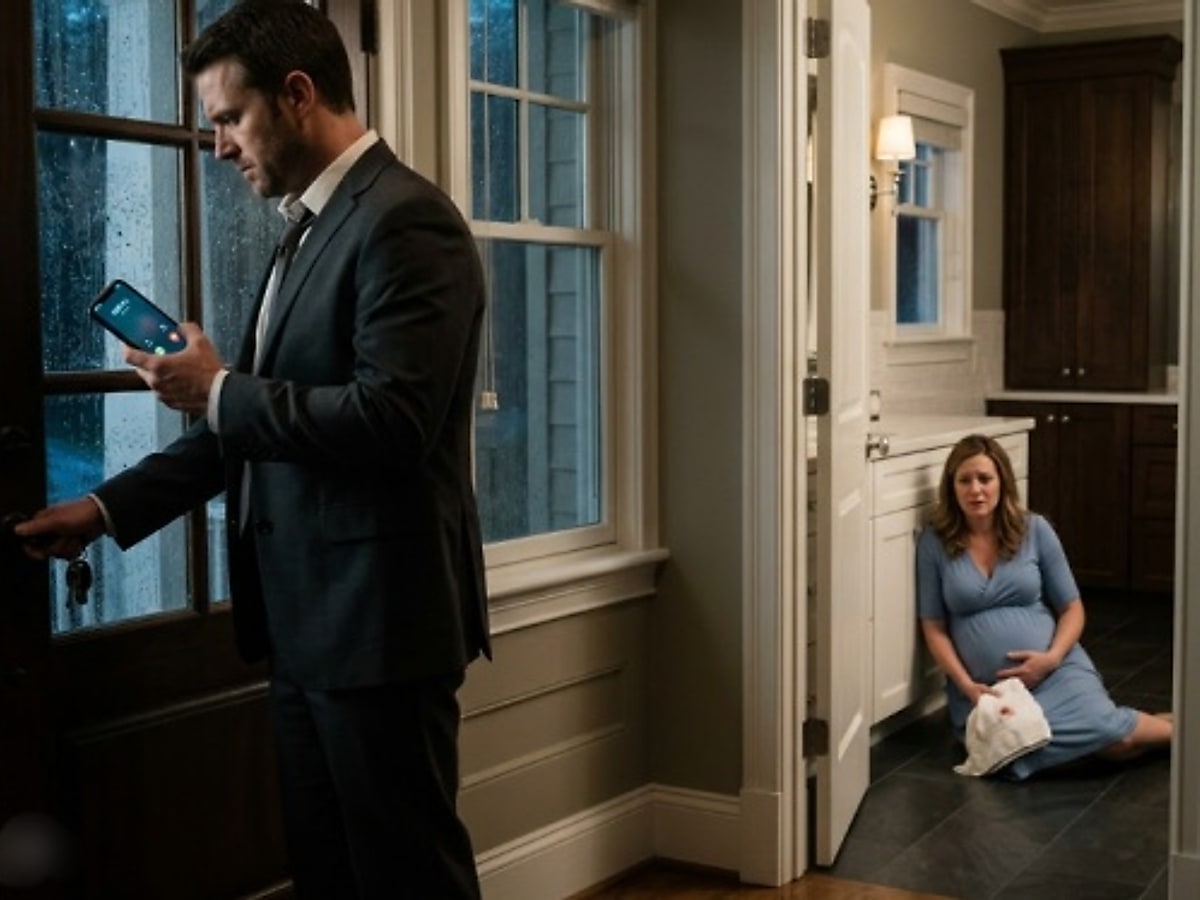
I was twenty-one weeks pregnant when I learned that love can leave the room quietly, without slamming a door. It can stand in the hallway with car keys in one hand and a phone in the other, deciding which emergency matters more. Mine happened on a rainy Thursday evening in Portland, Oregon, while I was sitting on the cold tile of our upstairs bathroom, staring at a thin line of blood and trying not to scream.
Downstairs, Ethan was making my favorite comfort food that week, grilled cheese with canned tomato soup.
The kitchen smelled like melted butter.
I remember thinking about the toast, not the baby, right before the pain hit.
It came fast and low, nothing like the stretching aches my doctor had warned me about. I gripped the sink with one hand and covered my belly with the other, like pressure alone could keep her safe.
Then I saw the blood.
My mind did not jump to fear first. It jumped to Ethan, because for years he had been the person I trusted to fix broken things.
“Ethan!” I shouted, and my voice cracked in half.
He came up slowly, footsteps heavy on the stairs, rain drumming against the small window above the tub. When he reached the doorway, I was already on the floor, back pressed to the cabinet, shivering.
“What’s going on?” he asked.
“I’m bleeding,” I said. “We have to go now.”
For a heartbeat, he looked like the man I married. His color drained, his eyes dropped to my stomach, and he leaned forward like he was about to scoop me up.
Then his phone lit up on the hallway table.
I have replayed that buzzing sound more times than I want to admit.
He glanced at it the way people check notifications without thinking, except his face changed the second he read the name.
Lauren.
His former wife.
I knew before he opened his mouth. Guilt moved across his features faster than worry did.
“Don’t pick that up,” I whispered.
He hesitated, and that hesitation told me everything I needed to know about where I ranked that night.
“She’s having a rough night,” he said quietly.
I stared at him, waiting for a sentence that made sense.
“Ethan,” I said, “I am bleeding on the floor.”
“I hear you,” he said, dragging a hand across his jaw. “But she called earlier, said she was scared to be alone. She’s slipping again.”
Again.
That single word carried years of history behind it. Lauren crying again, drinking again, unraveling again, and somehow needing him more than the wife carrying his child.
“Call an ambulance,” I said. “Or drive me. I don’t care which. Just help me.”
His phone buzzed a second time.
“You’re tough, Maya,” he said, as if that softened the blow. “Lauren isn’t built like you. If I don’t go, I’m scared what she’ll do.”
Behind him, my reflection in the foggy mirror looked like a stranger. Messy hair, an old University of Oregon sweatshirt, bare feet, a face gone gray.
“Our daughter could be in trouble,” I said.
He flinched but did not change course.
“I’ll order you a ride,” he said.
The rain outside seemed louder than my own pulse.
“You’ll do what?”
He was already tapping his screen. “It’s fifteen minutes to Providence if the roads are clear. I’ll meet you as soon as I can.”
I told him no.
He was already backing toward the stairs.
Jacket in hand, he was calling Lauren back before he hit the bottom step, his voice shifting into that gentle tone he saved for her. The front door opened, cold air rushed in, and then it shut behind him.
I sat there alone.
The driver who picked me up was named Marcus, driving a quiet silver sedan with a couple of tree-shaped fresheners swinging from the mirror. He took one look at my face, asked nothing extra, and drove like every red light was personally against him.
I rode in the back with a towel folded beneath me, whispering to my belly the whole way. My phone buzzed once.
Heading to Lauren’s. Keep me updated.
Keep me updated, like I was picking up a prescription.
At the emergency doors, Marcus offered to walk in with me. I said I was fine, because pride survives even disaster.
Inside, a nurse moved quickly once she saw me, and within minutes I was hooked to monitors while a doctor spread cold gel across my stomach. I didn’t cry until the sound came through the speaker, fast and strong, our daughter’s heartbeat racing like a small animal running from something.
The doctor mentioned a possible issue with the placenta, something they would watch, but for now there was movement, there was rhythm, there was life. I recorded twelve seconds of that sound and sent it straight to Ethan’s phone.
His answer came forty minutes later.
Thank God. Lauren’s better now. I’ll get there when I can.
Something inside me went silent then, not shattered, just quietly closing, like a door in an empty house nobody planned to live in again.
Part 2: The Shadow That Never Left Our Marriage
Ethan had been divorced from Lauren for four years by the time we met at a backyard cookout in Beaverton. He stood by the grill in a navy hoodie, flipping burgers with total focus, and when I dropped a plate of potato salad he just laughed and helped me clean it up.
I liked him right away.
He was witty, easy to talk to, and paid attention when I spoke. When I told him I worked as a reading specialist, he joked that teachers should earn lawyer money, and I thought he had good instincts.
He mentioned Lauren on our third date, eating tacos off a curb near Hawthorne because every bench was taken. He said the marriage had been hard, that she battled anxiety and drinking, and that he had spent years trying to rescue someone who did not want the same future he did.
“I don’t hate her,” he told me. “I just can’t keep being her safety net.”
Back then, that sounded mature.
Now I understand that some people claim they’ve let go while quietly holding one end of the rope, calling it kindness so it doesn’t look like guilt.
For the first year, Lauren barely registered, just occasional texts on holidays or calls when her car wouldn’t start. I told myself I wouldn’t be the jealous girlfriend turning an ex into a monster.
Then we married.
Lauren sent a card with no return address, and inside she wrote that she hoped I understood what loving him meant. Ethan tucked it into a kitchen drawer instead of the trash, and when I asked why, he said it was harmless.
It wasn’t harmless.
It was a flag she’d planted in our kitchen.
After the wedding, her crises grew louder. Her rent jumped by $200 and she called him about it. Her mother needed surgery in Seattle and she called him about that too. She saw a photo of us at Cannon Beach and had a panic attack in a parking lot.
Ethan always picked up.
At first he answered in front of me, then he started stepping outside, then he started calling it work even when her name flashed across our microwave screen.
We argued about it on a Sunday morning in October, two months before I got pregnant. I was folding laundry while he paced by the window, phone buzzing six times before nine.
“She needs a therapist,” I told him.
“She has one.”
“Then she should call that person.”
“It’s not that simple, Maya.”
“It’s exactly that simple,” I said. “You are not her husband.”
His jaw tightened. “You don’t get what she’s like when she feels left behind.”
Left behind.
She felt left behind when he didn’t answer instantly, left behind when he tried to build a life that didn’t circle her pain. Meanwhile I sat through dinners alone while he talked her through another meltdown, and somehow I was the understanding one.
When I found out I was pregnant, Ethan cried real tears, holding the test like a photograph before sliding down to sit on the bathroom floor laughing. For a while I believed our baby had pulled him fully into our house.
He painted the nursery a soft yellow, downloaded a pregnancy app, and once bought three limes because the app said the baby was that size, calling it emotional support produce.
I loved him in those weeks.
Stories like this skip that part because it’s easier if the husband is a villain from page one. But Ethan brought me coffee some mornings, warmed up my car seat, rubbed my feet during old sitcom reruns, talked to my belly in a ridiculous sports voice, and argued fiercely against baby names he thought sounded trendy.
Lauren remained anyway.
At sixteen weeks she called during our ultrasound, and even though he silenced it, his focus had already drifted from the screen. At eighteen weeks she texted at midnight saying she had nobody, and he spent an hour talking to her in the garage while I lay awake with a hand on my stomach.
“She’s struggling,” he said when he came back in.
“And what about me?” I asked.
He looked confused, like the question didn’t compute.
The night before I bled, we fought about a $486 charge on our joint card for brake repairs in Vancouver, Washington. He admitted he’d paid because Lauren said she couldn’t drive safely otherwise.
“That was our baby fund,” I said.
“It was just once.”
“With her, it’s never just once.”
He told me I was being harsh. I slept in the guest room that night, and less than twenty-four hours later he proved every fear I had.
At the hospital, once the doctor said they wanted to keep me overnight, I finally called my sister Natalie in Eugene. When she asked where Ethan was and I said with Lauren, the silence on the line felt sharper than any scream.
She arrived past midnight in mismatched shoes, climbed carefully into the hospital bed beside me, and held on tight, telling me I wasn’t crazy or dramatic or alone.
I finally broke down completely, not from the bleeding, but from remembering what it felt like to be chosen without competing for it.
Part 3: Six Seventeen in the Morning
Ethan showed up at the hospital at 6:17 the next morning holding a coffee I had no interest in and an apology that sounded practiced. His hair was wet from the rain, and Natalie sat in the corner chair with her arms crossed like she was weighing consequences.
“Hey,” he said quietly.
I said nothing.
He set the cup down. “I’m sorry. Lauren had an emergency and I thought—”
Natalie cut in. “Pick your next words carefully.”
He glanced between us. “I panicked, Maya.”
“No,” I said, my voice rough but steady. “I panicked. You chose.”
His eyes closed like he’d been struck.
The doctor entered before he could respond, repeating instructions about rest and reduced stress, and Natalie repeated the phrase back at him like a warning label.
He sat too close on the bed’s edge. “I’ll fix this.”
I nearly laughed at how familiar that line had become, the anthem of our marriage. I’ll fix it, I’ll talk to her, I’ll set limits, said the way people promise to start the gym on Monday.
“What does fixing mean this time?” I asked.
“It means never again.”
“It shouldn’t have happened once.”
“I know,” he said, but I wasn’t sure he did. Did he know what it felt like to hear our daughter’s heartbeat alone because he was busy comforting someone else’s crisis?
“I need you to go,” I told him.
“Maya, please.”
“Just for now,” I said, though I wasn’t certain that was true. “I need quiet.”
Natalie held the door open like a bouncer at the saddest club in town, and he left.
For weeks afterward he tried in visible ways, cooking dinner, driving me to appointments, blocking Lauren’s number in front of me like a student showing homework.
I wanted that to be enough.
I wanted to believe fear had woken something real in him, that our daughter would grow up with two parents under one roof.
But trust isn’t a vase you glue and set back on a shelf. It’s a floor, and once it caves once, you test every step after.
Three weeks later I woke up and he wasn’t in bed.
I found him in the dark kitchen, whispering into his phone near the sink.
“I can’t come over,” he said. “I told you that already.”
I stood frozen in the doorway.
“I know you’re scared,” he continued, “but call your sister or your sponsor. I can’t keep being that person.”
A pause, then his voice dropped further. “Lauren, don’t say that.”
My hand tightened on the doorframe.
He turned and saw me.
Guilt swallowed his expression whole, and I understood instantly that the number had never really stayed blocked. He followed me upstairs, explaining that she’d emailed from a new account, that the subject line sounded urgent, that he was only trying to help her stop the pattern.
“Helping who, exactly?” I asked.
He had no answer.
The next morning I packed a bag and drove to my late grandmother Evelyn’s house in Astoria. She had passed the year before, leaving me the old gray two-story near the Columbia River with its sagging porch and wild hydrangeas.
It had sat empty eleven months.
Walking in, the air smelled like dust and cedar. Furniture wore old sheets, the hallway mirror was cloudy, and the floorboards groaned like the house was clearing its throat after a long silence.
Reading glasses still sat on a side table.
A grocery list clung to the fridge under a lighthouse magnet.
I stood there, one hand on my belly, and felt the smallest flutter of movement, like a tiny fish flicking its tail.
“We’re staying here,” I whispered.
I texted Ethan that evening instead of calling, because I didn’t trust my own voice around him yet.
I’m safe. I need space. Please don’t come.
He called fourteen times.
I didn’t answer once, and that silence became the beginning of something I hadn’t expected to need so badly.
Part 4: Building a Life Behind a New Door
Leaving sounds heroic when someone tells the story afterward, but living it mostly meant paperwork, nausea, and crying over a forgotten debit card PIN in a bank parking lot. It meant switching insurance, finding a new doctor, and filling out forms with a blank line labeled spouse.
I didn’t feel brave.
I felt embarrassed, which surprised me, since Ethan was the one who’d left me bleeding on a bathroom floor.
Standing alone in a baby aisle at Target, surrounded by couples debating stroller brands, I felt like I’d failed some invisible test everyone else passed.
A woman near my mother’s age helped me lift a heavy box into my cart, then smiled and asked if this was my first.
“Yes,” I said. “A girl.”
“You’re going to do great,” she said.
I nearly told her the whole story, but instead I just thanked her and cried the rest of the way to checkout.
Ethan kept reaching out with flowers, handwritten letters, and voicemails that opened with apologies and closed with old memories, as if nostalgia counted as evidence in his favor.
He said he’d started therapy.
He said he finally understood he’d confused guilt with love.
Maybe that was true, but understanding something after the damage isn’t protection before it.
I agreed to meet him once at a coffee shop downtown, near the river, choosing a public place because pregnancy had sharpened my instincts in ways I couldn’t fully explain. He wore the green flannel I’d given him our first Christmas, and his eyes landed on my belly before my face.
“You look good,” he said.
“Don’t,” I answered.
We sat mostly in silence while the espresso machine hissed and rain streaked the window.
“I cut off contact with Lauren,” he said eventually.
“You’ve said that before.”
“This time I meant it. I emailed her sister, gave her crisis resources, told her I couldn’t be her person anymore.”
“And if she calls from a hospital, or worse?” I asked.
He looked down at his hands and didn’t answer right away.
“I honestly don’t know,” he admitted. “I’d want to say no, but I’m scared I’d still feel responsible.”
That, at least, was honest.
“Ethan, I can’t build a home inside your maybe,” I told him.
His eyes filled. “I love you.”
“I believe that part.”
“Then why isn’t it enough?”
Because love that can’t choose isn’t shelter. Because our daughter would learn from whatever I accepted as normal, and I refused to teach her to wait quietly on a cold floor for proof she mattered.
I told him simply that I didn’t trust him to come when we needed him.
He cried without sound, and I looked away because pity still tugged at me even then.
When I stood to leave, he asked if he could attend appointments.
“We’ll handle that through email,” I said, and left before he could argue.
Back in Astoria, the house slowly became mine. I painted the back room a soft green, since yellow no longer felt like it belonged to me. Natalie’s husband installed a new deadbolt, and my friend Priya drove down from Seattle with a trunk full of clothes her twins had outgrown.
My grandmother’s sewing room turned into the nursery, her wooden rocking chair staying right by the window with an old quilt draped over the back.
Sometimes I talked to Evelyn while folding diapers, telling her she’d probably scold me for crying and hand me soup instead.
The house creaked in response, and I chose to call that agreement.
At twenty-eight weeks I had another scare, gripping the kitchen counter through sharp pain that sent me to the clinic. My first instinct was still to call Ethan, which made me furious at my own body for remembering a man my mind no longer trusted.
I called Natalie instead, and she was in her car before I finished the sentence.
The pain turned out to be Braxton Hicks contractions from dehydration and stress, easily managed but exhausting to face alone in an old house with a baby coming.
That night Ethan emailed, asking to be part of the next appointment, saying he didn’t want to fail our daughter the way he’d failed me.
I wrote back that being her father started with respecting her mother’s peace, and that any invitation would come from health, not guilt.
A few days later, a letter arrived from Lauren, postmarked Vancouver, her handwriting slanted and heavy on the page.
She apologized, admitting she leaned on Ethan because he always answered, and that she’d told herself I was stronger and needed less.
Part of me wanted to hate her completely, and part of me recognized the trap all three of us had built together, one person mistaking access for love and another mistaking endurance for maturity.
I threw the letter away, deciding some ghosts only stay if you give them a room to sit in.
Part 5: The Phone That Finally Stayed Dark
Our daughter arrived on a clear morning in March, the kind Oregon offers after months of gray just to remind you the sun never actually left. Labor started at 4:30 a.m. during a windstorm, because apparently she wanted a dramatic entrance from day one.
Natalie drove me in, one hand on the wheel and the other guarding the radio from my contractions.
Ethan arrived two hours later, pale, carrying a backpack stuffed with things nobody asked for, including a tiny hat covered in yellow ducks.
He paused at the doorway and asked if he could come in.
That single question mattered more than he probably realized.
Months earlier he would have walked in assuming his feelings gave him automatic entry. This time he waited, and I nodded after glancing at Natalie.
Labor was nothing like movies show, just hours of sweat, fear, ice chips, and a body doing ancient work without asking permission. Ethan stood near the wall until a contraction hit hard enough that I reached blindly for his hand, and pain has never cared much about pride.
“I’m here,” he said quietly.
“Be specific,” I managed.
“For both of you,” he said. “I know I should have been from the start.”
That wasn’t forgiveness, but it was something real.
Our daughter arrived at 11:42 a.m., seven pounds and two ounces, with dark hair and a furious cry that filled the whole room. When they placed her on my chest, everything else disappeared, just warmth and tiny fists and the impossible fact that something this small could reorganize the universe.
“Hi, Nora,” I whispered.
We’d landed on the name separately, mine found scrawled beside a poem in one of Evelyn’s old books, his connected to a great-aunt he’d loved. For once, the overlap felt like a bridge instead of a trap.
We didn’t bring her home to Portland.
We brought her to the gray house in Astoria, where Ethan carried the car seat up the porch steps slowly, like the house might reject him if he rushed.
“You fixed it up,” he said, looking around.
“I had help,” I told him.
“It feels different in here.”
“It is different.”
For six weeks he visited every other day, not by court order, but by a schedule we built to protect Nora’s routine and my recovery. He washed bottles, brought groceries, and left when visiting hours ended.
At first I hated how relieved I felt watching him go, then I stopped judging myself for it, because peace is information too.
One afternoon when Nora was five weeks old, I found him in the nursery humming off key while holding her against his chest, sunlight cutting gold lines across the floor.
“She smiled,” he said.
“That’s gas.”
“I’m choosing to believe otherwise.”
Then his phone buzzed, sharp and sudden in the quiet room.
He froze, and so did I, though Nora slept right through it.
He turned the screen and I saw Lauren’s name, this time a text instead of a call.
I need you. Please. I don’t know who else to call.
My whole body flashed back to the bathroom floor, tile and blood and rain and a door closing.
He looked at the phone, then at me, then at Nora sleeping in the crib.
He powered the screen off completely and set it face down on the dresser like it was something dangerous.
“I’ll call her sister on your landline if you want to watch,” he said. “But I’m not leaving either of you to go to her.”
The room stayed still for a long moment.
I wanted that single decision to erase every earlier one, but real life doesn’t work that cleanly, and one good choice doesn’t cancel one unforgivable night.
Still, it counted for something.
“Call her sister,” I said, and he did, right there on speaker, calm and brief, asking someone else to check on her without making himself the center of the story.
When he hung up, he sat heavily in the rocking chair. “I should have done that years ago.”
“Yes,” I said.
“Do you think you’ll forgive me?” he asked.
I looked at Nora’s small fist curled beside her cheek and realized forgiveness wasn’t a door I could just open or lock. It moved more like weather, slow and shifting, impossible to force on command.
“I don’t know,” I told him honestly. “But I’m not carrying anger for you anymore. I don’t have room.”
That summer, the hydrangeas along the fence turned a deep blue, and Nora grew round cheeked with his dimple and my stubborn chin. Ethan kept showing up, imperfectly but consistently, paying his share of bills, sitting through parenting classes, and never once asking me to move back in.
We tried counseling when Nora hit four months, meeting in a beige office with fake plants that looked calmer than either of us. In one session Ethan admitted he’d once thought I was strong enough not to need him, and when the counselor asked what that revealed, he said quietly that it revealed how selfish the thought had been.
I cried at that, because it was the first time he named it without wrapping it around Lauren’s pain.
Months passed, and the old house kept changing with us. I fixed the cracked front steps, planted rosemary by the kitchen window, and learned that love and clutter aren’t the same thing.
One rainy evening in September, Ethan came by to hang shelves in Nora’s room, and afterward we sat on the porch with tea.
“I sold the Portland house,” he said.
“Where will you live?” I asked.
“Ten minutes from here,” he said. “Two bedrooms, one for her. Not to pressure you, just to be close enough to be her father.”
I believed him, though belief and trust are not the same thing either, one a window and the other a house I was still deciding whether to build.
On Nora’s first birthday, we gathered in the backyard with cupcakes from Natalie, a lopsided balloon arch from Priya, and Ethan grilling under a canopy because Oregon skies can’t be trusted even in spring. Nora smashed cake into her hair and looked personally offended by the laughter that followed.
Lauren never called that day, or maybe she did and it simply no longer belonged at the center of our story.
After everyone left, Ethan helped fold the tables, picking up a stray tiny shoe from the grass.
“She’s happy,” he said.
“We had help,” I answered.
“I’d like to keep being part of that help,” he said carefully.
I took my time answering instead of rushing to comfort him the way I once would have.
“I’m not ready to be your wife again,” I said.
“Okay,” he said simply.
“But I’m willing to keep watching who you’re becoming.”
His eyes filled, but he smiled through it. “That’s more than I earned.”
“Yes,” I said. “It is.”
That night, carrying Nora through the quiet house, the floorboards creaked their old familiar creak, almost friendly now. In the hallway mirror I saw myself holding her, hair loose, shirt smudged with frosting, tired but clear eyed.
I thought about the woman who once sat alone on cold bathroom tile, and I wished I could kneel beside her and tell her the worst night of her marriage would eventually become the first night of her rescue.
I would tell her the heartbeat she heard alone would grow into a whole new rhythm for her life.
Nora stirred against my shoulder, warm and heavy with sleep, and I looked around at a house that no longer felt haunted, just full, full of proof that a person can be left behind and still refuse to stay lost.
Names have been changed and this story has been dramatized for entertainment purposes only.
