Part 1: The Sound That Stopped the Music
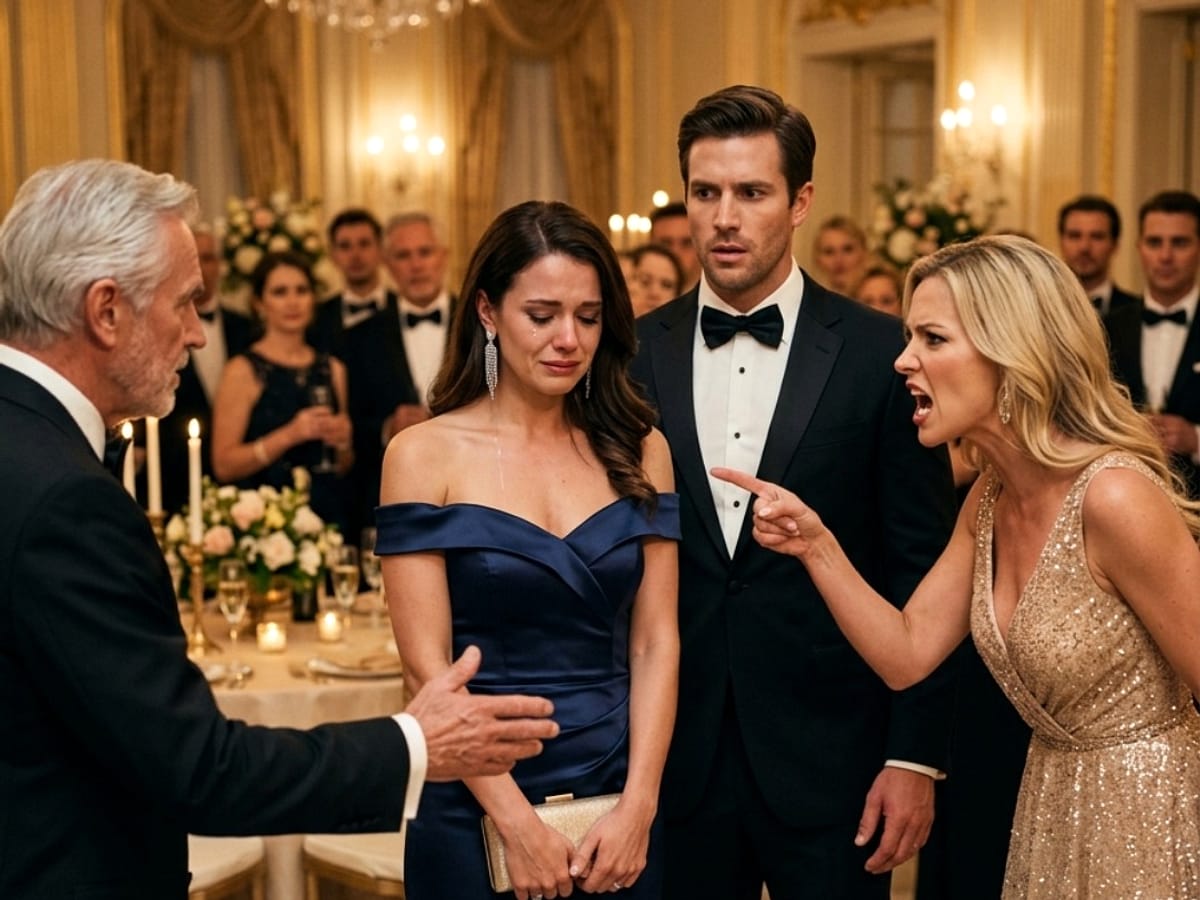
The string quartet had been playing something slow and forgettable near the base of the marble staircase — the kind of music chosen specifically so no one would have to listen to it. Crystal glasses caught the chandelier light.
Women in floor-length gowns leaned toward each other with practiced smiles. The Whitaker Hotel ballroom smelled of white roses and old money, and somewhere behind me, a man was laughing too loudly at something that probably wasn’t funny.
I had been standing beside the east window for six minutes, watching the room, when she found me.
I heard the heels first. Sharp, deliberate, the kind of stride that announces itself. Then I turned, and there was Vanessa Pierce in a red silk dress, her chestnut hair swept back, her chin lifted at an angle that told me she had rehearsed this moment at least once in a mirror.
On her left wrist, catching the light with every step, was a diamond bracelet I recognized before I recognized her face. I had seen the charge on Mark’s corporate card two months earlier — listed under “client entertainment,” sandwiched between a restaurant receipt and a car service invoice.
I had photographed it, forwarded it to my attorney Rachel Stein, and said nothing to Mark. Not yet.
“You have a lot of nerve showing up tonight,” Vanessa said.
Her voice was low but not quiet enough. A couple to my left shifted slightly. A woman in emerald satin turned her head a fraction of an inch.
I looked at her calmly. “I was invited,” I said.
That was apparently the wrong answer. Or maybe the right one.
Either way, what happened next happened fast — her right hand came up and cracked across my left cheek with enough force that the sound cut clean through the quartet’s melody, through the murmur of three hundred conversations, through the soft clink of silverware on china. A champagne flute somewhere behind me hit the floor.
The music stopped mid-phrase.
The silence that followed was the loudest thing I had ever heard.
I touched my face. Not because the pain was unbearable — it wasn’t — but because my hand needed somewhere to go while I decided what to do with the rest of my body. Around us, the ripple of stillness spread outward in rings, table by table, cluster by cluster, until the entire ballroom had gone quiet and still and was looking at me.
Mark was standing three feet to my right. He had been there the whole time, close enough that I could hear him breathing — that specific half-second pause before the slow exhale through his nose, the tell I had learned in the first year of our marriage and never forgotten.
Eleven years of that breath. Eleven years of knowing exactly when he was deciding how much of the truth to release.
He was doing it now. And he did not move.
His name was Mark Ellison. He was forty-four years old, managing partner of a mid-sized investment firm in the Loop, and for the past eighteen months he had been conducting an affair with the woman who had just struck me in front of every board member, donor, and local journalist in the room.
He stood there in his tuxedo with his hands loose at his sides and his eyes dropped to the floor, and in that moment I understood something I had been circling for a long time: he was not going to choose me. He had already chosen.
He had chosen the moment he signed the paperwork on the Nevada holding company last spring, the moment he wired the first $48,000 to a shell consulting firm that had no employees and no office, the moment he looked at eleven years of shared history and decided it was an inconvenience.
Vanessa stepped closer. The diamond bracelet swung.
“You think you can just walk in here and humiliate him?” she said, loud enough now that no one needed to strain to hear.
“You should be ashamed of yourself.”
A small sound moved through the crowd. Not quite a gasp. More like the collective intake of breath before a verdict.
I looked at her for a long moment. She was trembling slightly — not from guilt, I realized, but from the specific terror of someone who has built a life on a story that is starting to crack.
She believed every word Mark had told her. She believed I was the obstacle, the old contract, the woman who had trapped a man who deserved better.
She believed the house in Winnetka and the joint accounts and the Christmas cards and the decade of quiet mornings were all just furniture standing between her and something she had been promised.
I almost felt sorry for her.
“What exactly did he tell you about me?” I asked.
My voice came out steadier than I expected. Vanessa blinked.
The question seemed to confuse her — she had prepared for tears, or shouting, or the kind of dignified collapse that people later describe as “handling it with grace.” She had not prepared for a question.
“He told me the truth,” she said. “That you don’t love him. That you’ve been staying for the money for years.”
Somewhere near the bar, a man coughed. A woman whispered something I couldn’t make out.
For the money. I had met Mark Ellison when he was twenty-nine years old with $17,000 in student loan debt, a used Honda Accord with a cracked dashboard, and one good suit his mother had bought him for job interviews.
I was the one with the savings account. I was the one who paid our mortgage the year his firm nearly folded, who sat across from bank officers and smiled while they explained risk to me in slow, careful sentences as though I might not understand.
I had worked two consulting contracts simultaneously for fourteen months so he could build his client list without worrying about cash flow. I had done it quietly, the way women do things when they love someone and don’t need credit for it.
People mistake silence for emptiness. Mark had been making that mistake for years.
“Did he also mention,” I said, keeping my voice level, “that he moved marital assets into a Nevada holding company last spring?”
Mark’s head came up.
There it was. The first honest expression I had seen on his face all evening — not anger, not guilt, but the specific, cold alertness of a man who has just realized the ground beneath him is not where he thought it was.
Vanessa turned to look at him. “Mark?”
He took one step forward. “Claire,” he said, and my name in his mouth sounded exactly like it always had when he wanted me to be quiet in public — soft, warning, threaded with the implication that whatever I was about to do would embarrass us both.
“Don’t,” I said.
One word. The room heard it.
And then, from the foot of the grand staircase, a voice came that was not mine and not Mark’s and not Vanessa’s — deep and unhurried and carrying the particular authority of someone who has never needed to raise it.
“That is enough.”
Everyone turned.
Elias Whitaker stood with one hand resting lightly on the polished banister, silver-haired and straight-backed in a black tuxedo, looking at the three of us with an expression that was not angry so much as final. He was seventy-two years old.
He owned the hotel, the block around it, and enough of Chicago that the newspapers used the word “billionaire” without bothering to verify. He had built the Whitaker Foundation from a regional charity into a $186 million institution.
He was not a man who raised his voice because he had never needed to.
He was also looking directly at me.
Not at Mark. Not at Vanessa. At me.
Part 2: The Quiet Room Behind the Noise
The crowd parted for him without being asked — the way crowds always part for people who move as though they expect it. Elias crossed the ballroom floor slowly, his footsteps nearly silent on the marble, and when he reached me he stopped and looked at my face with something that resembled, of all things, regret.
“Madam,” he said, “I am sorry this happened in my house.”
The word landed in the room like a stone in still water. Not Mrs.
Ellison. Not Claire.
Madam — formal, deliberate, the kind of address that confers dignity in front of witnesses. Mark went pale.
Vanessa’s lips parted slightly. Several people near the front tables exchanged glances.
Elias turned to the room with the ease of a man who had been managing other people’s crises for fifty years. “Security will escort Ms. Pierce to the lobby,” he said.
“Excuse me?” Vanessa said.
“You are excused,” he replied.
Two officers appeared from the side doors. Vanessa looked at Mark — waiting, I think, for him to step forward, to say something, to be the powerful man she had believed him to be.
But Mark only stood there with his jaw tight and his hands useless at his sides, and the look on Vanessa’s face in that moment was something I recognized. It was the look of a woman realizing, too late, that the person she had trusted with her future had been lying about the size of his hands.
She left without another word. The officers were professional about it — no drama, no scene, just a firm and quiet escort through the side corridor while the ballroom watched in silence.
Elias turned back to me. “Would you come with me for a moment?”
he asked. “There’s a sitting room off the east corridor.
Quieter.”
I glanced at Mark. He was staring at the floor again.
“Yes,” I said. “Thank you.”
The corridor was lined with black-and-white photographs of Chicago in winter — the lakefront in snow, the elevated train against a gray sky, the old stockyards, the river. The noise of the ballroom fell away behind heavy oak doors and was replaced by the soft hum of central heating and the distant sound of the kitchen.
My heels were quieter here on the carpeted runner. My cheek had stopped stinging and started to ache in a deeper, duller way.
The sitting room was small and well-furnished — two leather chairs, a low table, a lamp casting warm light over a bookshelf that held actual books, not decorative ones. Elias gestured to a chair and I sat. He remained standing for a moment, then settled into the chair across from me with the careful deliberateness of a man whose knees had opinions.
“I met you three years ago,” he said. “The St.
Catherine’s fundraiser. You corrected a budget assumption in the proposal during the Q&A.”
I remembered. I had noticed an error in the projected cost-per-bed figure and mentioned it quietly after the presentation.
I hadn’t expected anyone to follow up. Two days later, a handwritten note had arrived at my office — cream stationery, blue ink, thanking me for the correction and noting that the board had revised the figure before submitting the grant application.
I still had it in my desk drawer at home.
“I remember,” I said.
“I also remember thinking,” Elias said, “that your husband spent the entire evening talking to the wrong people.” He paused.
“I should have introduced myself to you properly then. I’m sorry I didn’t.”
I wasn’t sure what to say to that, so I said nothing.
He leaned forward slightly. “Are you all right?”
“I will be,” I said. “I’ve been preparing for tonight for a while.”
He studied me for a moment. “The Nevada company,” he said. It wasn’t a question.
I nodded. “My attorney has the documentation.
Wire transfers, incorporation records, a consulting contract with a company that has no employees. The total is approximately $48,130 in diverted marital assets, not counting the personal charges on the corporate account.”
I paused. “Rachel — my attorney — received everything at 9:12 this morning.”
Elias was quiet for a moment. Then: “Mark Ellison has been pursuing a partnership with one of my subsidiaries for the past four months.”
“I know,” I said.
“He submitted a proposal in March. We were in the final review stage.”
He looked at me steadily. “I want you to know that what happened tonight — what I saw tonight — will be taken into account.”
I held his gaze. “I’m not asking you to do anything on my behalf, Mr. Whitaker.”
“I know you’re not,” he said. “That’s precisely why I’m telling you.”
We sat in silence for a moment. Outside the heavy doors, I could hear the ballroom beginning to recover — the murmur of voices resuming, the quartet starting up again, the cautious return to the business of a charity gala.
Someone out there was probably already texting about what they had witnessed. By morning it would be on three different social pages and at least one gossip column.
Mark had wanted me to smile tonight and not make anything awkward.
I almost smiled now, alone in this quiet room, at the specific irony of that.
Elias stood. “I’ll have someone bring you tea.
Take as long as you need.” He paused at the door.
“Mrs. Ellison — for what it’s worth, the woman I watched in that ballroom tonight was not someone who needed rescuing.
I simply wanted to make sure the room understood that.”
He left. I sat for a long time in the warm lamplight, listening to the muffled sound of the party continuing without me, and I thought about the $8,940 in the account I had opened in my name alone six months ago, and the $75,000 in consulting income I had kept separate for the past two years on Rachel’s advice, and the fact that at 7:30 in the evening I had walked into this ballroom already knowing how the story ended.
I just hadn’t known about Elias Whitaker.
Part 3: Eleven Years, Counted Backward
I did not go home that night.
Home was a six-bedroom house in Winnetka with a kitchen Mark’s mother had always called too modern and a master bedroom where I had slept on my side of the bed for the better part of a year, careful not to touch him, careful not to ask questions I already knew the answers to. My clothes were there.
My books were there. The framed photograph from our wedding was still on the dresser because I had not yet decided what to do with it — not out of sentiment, but because removing it felt like a declaration, and I had been waiting until I was ready to make declarations.
Tonight I was ready.
Rachel had booked me a room at the Whitaker — the irony of that was not lost on me — and I took the elevator up at 11:18 p.m. with my heels in my hand and my cheek still faintly tender and my mind running through the checklist I had been building for months. The room was on the fourteenth floor, quiet and clean, with a view of the lake that was just dark water and city lights at this hour.
I sat on the edge of the bed and thought about the first lie I had caught and let go.
It had been small. A dinner he said was with clients that turned out to be with no one I could verify.
I had asked once, lightly, and he had given me the look — patient, slightly wounded, the look that said: you’re doing this again — and I had backed down because I was tired and because I loved him and because I told myself I was being paranoid. That was the year we had talked about having children.
That was the year I had started to notice that the conversations about the future always seemed to end with Mark redirecting to something else.
The second lie had been a hotel charge in Miami. I found it on a statement I wasn’t supposed to see — he had accidentally left it in the printer tray.
I confronted him and he explained it so smoothly, so completely, with such specific and verifiable-sounding detail, that I had walked away from the conversation feeling guilty for asking. He was good at that.
He had a lawyer’s instinct for the structure of an argument — lead with the most credible detail, bury the weak point in the middle, end with something that makes the other person feel small for doubting.
I had spent two years doubting my own perception before I started writing things down.
The notebook was in my bag now. Fourteen months of dates, amounts, discrepancies.
Not because I needed it anymore — Rachel had everything she needed — but because keeping it had been the thing that kept me sane. Proof that I was not imagining it.
Proof that the woman who had built half of what Mark called his success was not, in fact, paranoid.
I thought about the $12,400 jewelry charge on Oak Street. I had found that one in November, and I had sat in my car in the parking garage for twenty minutes before I drove home.
I had made dinner that night. I had asked about his day.
I had watched him eat and talk and perform the ordinary motions of a husband and I had thought: how long has he been able to do this. Not how long has this been happening — I knew the answer to that by then.
But how long had he been able to sit across from me at our own table and feel nothing.
That was the night I called Rachel.
She had been methodical and calm in the way that good attorneys are calm — not cold, but organized, the kind of person who turns chaos into a filing system. She had told me to document everything and touch nothing.
She had told me not to close accounts, not to move money, not to say anything that could be characterized as provocation. She had told me that the most powerful thing I could do was wait.
Waiting had been the hardest part.
Harder than the hotel charges. Harder than the bracelet receipt.
Harder than the night I found the incorporation documents for the Nevada LLC and sat on the bathroom floor for an hour reading them on my phone while Mark slept ten feet away. Waiting meant continuing to be his wife in every visible way while building the case that would end the marriage on my terms, not his.
I had waited. I had smiled at corporate dinners.
I had attended galas. I had been, as Mark liked to say, a good partner.
And now it was 11:24 p.m. on a Thursday in November, and I was sitting in a hotel room with a view of Lake Michigan, and somewhere across the city a woman in a red dress was probably calling Mark and asking him to explain what I had meant about Nevada, and Mark was probably already composing the version of the story that cast him as the reasonable one.
Let him compose it. Rachel had the receipts.
I ordered room service — soup and bread, the kind of meal you eat when you’re too tired for anything complicated — and I sat by the window and watched the lights on the water until I fell asleep in the chair.
Part 4: The Man Who Believed Proximity Was Power
Rachel had predicted he would come in person.
“Men like Mark,” she had told me two weeks earlier, over coffee in her office on Michigan Avenue, “believe that being in the room is the same as being in control. He will want to see your face when he talks. He thinks he can read you, and he thinks that if he can read you, he can manage you.”
She had been right. Security called up from the lobby at 10:37 a.m. Mark Ellison, asking for his wife.
I told them to send him up.
Rachel was already in the room — she had arrived at 9:00 a.m. with a leather portfolio and two cups of coffee and the specific composure of someone who had done this many times and found it neither exciting nor distressing, just work. She sat in the chair by the window with her portfolio open on her knee and her pen ready and she said, “You don’t have to let him speak first.”
“I know,” I said. “But I want to hear what he’s decided to say.”
He knocked at 10:39. I opened the door.
Mark looked like a man who had not slept. His tie was loosened, his jacket slightly rumpled, and there were shadows under his eyes that told me he had spent the night in conversation — with Vanessa, probably, or with his own reflection, rehearsing. He looked at me, then at Rachel, and something shifted in his expression.
“I didn’t know you’d have your attorney here,” he said.
“I know,” I said. “Come in.”
He sat on the edge of the small sofa. I remained standing. Rachel did not look up from her portfolio.
“Last night got out of hand,” Mark said. He had chosen the conciliatory opening — I had expected that. “I want you to know that what Vanessa did was completely unacceptable and I told her so.”
“Did you,” I said.
“Claire, I know you’re angry. You have every right to be angry.
But I need you to understand that this — what’s happening between us — this doesn’t have to become a war. We can handle this quietly.
We can be adults about it.”
I looked at him for a long moment. He was still handsome.
That had always been part of the problem — not his looks specifically, but the ease they gave him, the way people extended good faith to attractive men in good suits as a kind of reflex. He had built a career on that reflex.
He had built our marriage on it too, in some ways.
“The Nevada LLC,” I said.
His jaw tightened. “That’s a business structure. It’s completely legal.”
“Rachel,” I said.
Rachel opened her portfolio and placed a single sheet of paper on the coffee table between us. “The transfers total $48,130,” she said, in the same tone she might use to read a grocery list.
“The LLC was incorporated eleven months ago. The sole director is listed as a Michael Hart — who is, as you know, Mark’s college roommate and current golf partner.
There is no operating business. The funds were transferred in six installments, the largest being $12,400 in October.”
She paused. “We also have the corporate card statements showing $8,940 in personal charges, including the bracelet Ms.
Pierce was wearing last night.”
Mark said nothing.
“The filing will include a motion to freeze the LLC assets,” Rachel continued. “We’ve already drafted the petition. The judge assigned to our docket has a reputation for moving quickly on asset dissipation cases.”
“You don’t have to do this,” Mark said. His voice had changed — the conciliatory warmth was gone, replaced by something harder and quieter.
“Claire. Think about what you’re doing.
Think about what this does to the firm. Think about what it does to us.”
“There is no us,” I said. “There hasn’t been for a long time.
You made that decision. I’m just filing the paperwork.”
He leaned forward. “I can give you $600,000 to walk away clean.
No court, no filings, no public record. You take the $600,000 and we settle this privately.”
Rachel’s pen moved slightly. I had told her he might offer a number.
“No,” I said.
“Claire —”
“No,” I said again. “Not because I need more money.
Because I’m not interested in a private settlement that lets you rewrite what happened. I want the court record.
I want the documentation. I want the judge to see the Nevada transfers and the corporate card and the $12,400 bracelet, and I want it to be public.”
I paused. “And I want the Whitaker Foundation board to see it too, since I understand they’re currently reviewing a partnership proposal from your firm.”
The color left his face.
“You wouldn’t,” he said.
“I already have,” I said. “Elias Whitaker asked me last night if I would be willing to share the documentation with his legal team.
I said yes. His office received the packet at 6:03 this morning.”
Mark stood up. For a moment I thought he was going to say something — something real, something that acknowledged what he had done and what it had cost.
I had imagined that moment many times in the past year. In my imagination, it had felt like something.
Closure, maybe, or at least the satisfaction of being seen clearly by the person who had chosen not to see you.
But he only straightened his jacket and looked at me with an expression I couldn’t quite name — not quite anger, not quite grief, something flatter than either — and then he walked to the door and opened it and left without another word.
Rachel closed her portfolio. “That went about as expected,” she said.
“Yes,” I said.
“The $600,000 offer is on record now. We’ll note it in the filing.”
She picked up her coffee. “He’ll come back with a counter through his attorney within forty-eight hours.
When he does, I’ll call you.”
I nodded. Outside the window, Chicago was gray and bright at the same time, the way it gets in November when the clouds are thin enough to let the light through without warmth. I watched a boat moving slowly across the harbor, unhurried, heading somewhere I couldn’t see.
“Rachel,” I said.
“Yes?”
“Thank you. For all of it.”
She looked at me over the rim of her coffee cup with the expression of someone who has heard that before and means it when she says: “That’s what I’m here for.”
Part 5: Madam
Three months later, I stood at the top of the marble staircase of the Whitaker Hotel and looked down at a ballroom that had been rearranged for a different kind of evening.
The chandeliers were the same. The marble was the same.
But the white roses had been replaced with blue hydrangeas, and the tables were set for a working dinner rather than a gala — no silver votive candles, no $5,000 plates, just good food and the kind of people who showed up to do something rather than be seen doing it. The Whitaker Foundation’s annual community health summit.
Sixty attendees, most of them clinic directors, hospital administrators, and public health researchers.
I had been invited as a consultant.
Elias had called me six weeks after the gala, on a Tuesday morning at 10:37 a.m. — I remembered the time because I had been in the middle of reviewing the draft settlement agreement Rachel had sent over, and I had almost let it go to voicemail.
He had asked if I would be willing to review the Foundation’s grant allocation model for the South Side clinic initiative. He had said he remembered my correction at the St.
Catherine’s fundraiser three years ago and that he had been meaning to ask me ever since.
I had said yes.
The work had been good. Genuinely good — the kind that required full attention and returned something real.
I had spent four weeks going through the Foundation’s funding structure, identified three areas where the allocation model was underserving the highest-need zip codes, and written a forty-page report that Rachel had proofread for clarity and Elias had read in full, margin notes and all. The summit tonight was partly to present the revised model to the clinic directors who would be affected by it.
The divorce had been finalized two weeks earlier.
Mark had countered Rachel’s filing through his attorney, as predicted. He had offered $2 million in a structured settlement — more than the $600,000 he had proposed in the hotel room, which Rachel said was a sign that his attorney had reviewed the Nevada documentation and understood the exposure.
We had negotiated for six weeks. The final agreement included the full value of the marital assets, a formal acknowledgment of the diverted funds, and a clause that Rachel had insisted on: a written record, sealed but existing, of the $48,130 in transfers and the corporate account misuse.
“Not for public consumption,” Rachel had explained. “Just for the record. So it exists somewhere that isn’t only your memory.”
I had signed on a Wednesday morning, in Rachel’s office, with a cup of coffee going cold on the table beside me. There had been no ceremony to it.
Mark had signed through his attorney without being present. Rachel had handed me my copy in a manila envelope and said, “It’s done,” and I had sat for a moment with the envelope in my hands, feeling not triumphant exactly, but solid.
Like a floor that had been soft for a long time had finally set.
The Whitaker Foundation had formally withdrawn from the partnership review with Mark’s firm the same week the divorce was filed. Elias had not made a public statement about it.
He hadn’t needed to. In the circles where Mark operated, the withdrawal spoke for itself.
I had heard, through a mutual acquaintance, that Vanessa had ended things with Mark sometime in January. I didn’t know the details and I didn’t ask.
Whatever story she had been told and whatever story she had told herself, that was between her and the version of Mark she had believed in. I hoped, in a distant and impersonal way, that she figured out what had actually happened before it cost her more than it already had.
I descended the staircase slowly, one hand on the banister, and Elias met me at the bottom.
He was in a dark suit tonight rather than a tuxedo, and he looked, if anything, more himself than he had at the gala — less formal, more present. He shook my hand and said, “The clinic directors have been looking forward to your presentation.”
“I’ve been looking forward to giving it,” I said.
We walked into the ballroom together. A few people looked up as we entered — not the frozen, rippling silence of three months ago, but the ordinary acknowledgment of a room noticing new arrivals.
Someone waved. A woman I had met at the first planning meeting smiled and pointed to a seat she had saved.
I thought about the night I had stood in this room with my hand on my cheek and the string quartet stopped mid-phrase and three hundred people waiting to see what I would do. I thought about Mark’s eyes on the floor. I thought about the word Elias had used — madam — and how it had moved through the room like something being corrected.
I thought about the notebook in my desk drawer at the apartment I had rented in Lincoln Park, fourteen months of dates and amounts and the careful, quiet work of a woman who had decided that the most powerful thing she could do was wait until she was ready.
I was ready now.
I took my seat at the head of the table, opened my folder, and looked out at the room full of people who had come to do something real, and I thought: this is what it feels like when the floor holds.
The work was good. The room was good. The evening light came through the tall windows at a low angle and caught the blue hydrangeas on the tables and made them look, for a moment, like something worth painting.
I had not expected to feel this. Not so soon, not so cleanly. But grief does have a strange clock, and mine had been running for a long time before that night in November, and somewhere between the signed papers and the forty-page report and the Tuesday morning phone call I had almost let go to voicemail, it had quietly, without announcement, run all the way down.
I picked up my pen.
I began.
Names and identifying details in this story have been changed. This is a dramatized account shared for entertainment and reflection, and any resemblance to real people is coincidental.
