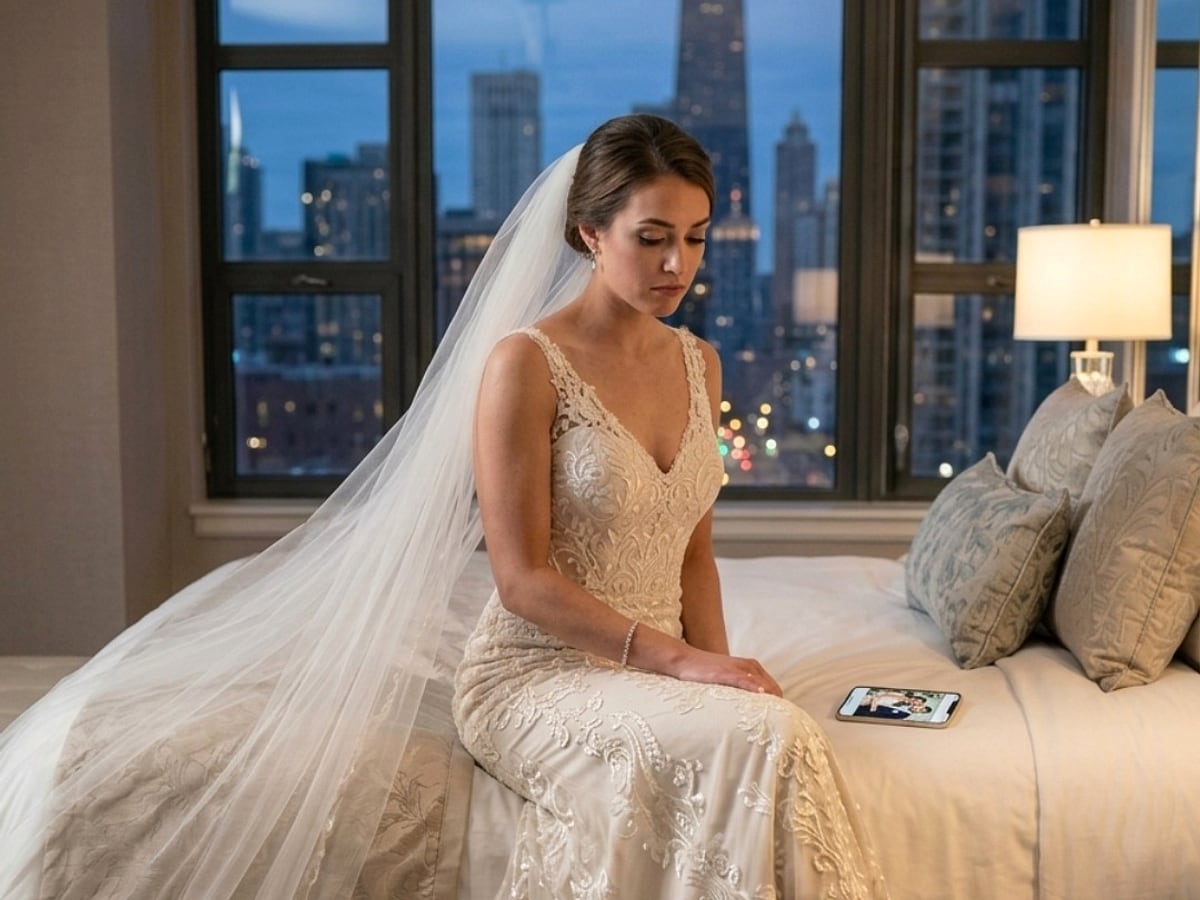
Part 1: What Arrived at 8:42 a.m.
The morning light through the Peninsula’s upper-floor windows was the kind of pale gold that makes everything look like a painting. I remember noticing it. I remember thinking, absurdly, that the light alone would make beautiful photographs.
My cathedral veil was draped across the bed like a sleeping ghost. The champagne bucket on the side table held a bottle we hadn’t opened yet, flanked by two crystal flutes etched with the words Emma & Michael — Forever Begins Tomorrow. Patrice, my wedding coordinator, stood near the door with her clipboard, asking whether the childhood photo montage should play before the officiant’s welcome or directly before the vows. She had the focused calm of a woman who had steered enough expensive weddings through enough invisible disasters to know that the real emergencies never announce themselves.
I was sitting on the edge of the settee in my robe, half-listening, when my phone lit up.
Megan’s name.
A photograph.
I opened it without thinking. That is the thing about a message from your best friend the morning before your wedding — you assume it is something sweet.
A throwback photo. A funny meme.
A voice note saying she loves you and she’s already crying and she hasn’t even put mascara on yet.
It was not any of those things.
The photograph showed Michael standing outside a civil office building in downtown Chicago. He was wearing a gray suit I recognized — the one he called his “serious meetings” suit.
Beside him stood Jessica Lane, strategic communications consultant, crisis messaging specialist, and apparently, as of two weeks prior, his legal wife. She was in a cream dress, holding a document against her chest.
He was looking down at her with an expression I had spent three years believing was reserved for me alone.
I stared at the screen for what felt like a very long time.
Patrice was still talking about the montage.
My mother, Helen, stood near the window reviewing the seating chart, a cup of tea cooling in her other hand.
Megan’s voice came through the speaker before I had decided to answer. “Emma.”
Her voice was careful the way voices get when the person speaking has been rehearsing the conversation for hours. “A private investigator confirmed it.
The marriage license was filed in Cook County. Two weeks ago.
They are legally married.”
Two weeks ago, Michael and I had been at our final menu tasting, debating between the herb-crusted halibut and the filet mignon. He had held my hand under the table and told the caterer, with that easy smile of his, that I had perfect taste and he simply showed up and agreed.
Everyone in the room had laughed. I had loved him for saying it.
That same week, he had married Jessica.
“Send me everything,” I said. My voice sounded like it belonged to someone standing slightly behind me.
“Already sent. Your personal email, not the wedding account.
The legal record is attached. The PI has the full file.”
My mother turned from the window. She read my face the way mothers read faces — not the surface expression but the thing underneath it. “Sweetheart.”
Patrice stopped talking mid-sentence.
I stood up. The room tilted slightly, then steadied.
“Michael is married,” I said. “He legally married Jessica two weeks ago.”
The silence that followed was nothing like the reverent quiet of a wedding morning. It was the silence of something structural giving way.
My mother set down her tea. Her face moved through confusion, then disbelief, then a cold, precise fury I had never seen on her before — the kind that doesn’t raise its voice because it doesn’t need to.
Patrice lowered her clipboard slowly. She did not ask me to repeat myself.
I walked to the window. Below, Michigan Avenue moved through its ordinary Sunday morning — taxis, coffee cups, people with nowhere urgent to be.
Somewhere in the ballroom downstairs, workers were unpacking forty thousand white roses. Forty thousand.
That number had sounded like romance when the florist first proposed it. Now it sounded like the opening line of a cautionary story.
Four hundred guests were flying in from six cities to watch me marry a man who was already someone else’s husband.
“Call your father,” my mother said.
“Not yet.”
She looked at me sharply. “Emma.”
“Five minutes,” I said. “I need five minutes that are just mine.”
My father, Richard Alden, did not process betrayal with grief. He processed it with attorneys and a tone of voice that made grown men suddenly remember other obligations.
He had built Alden Logistics from a single warehouse outside Indianapolis into a national operation worth more than most people could picture. He loved me completely.
He also loved control. If I called him in that moment, the wedding would become a corporate crisis before I had finished understanding the personal one.
I needed to think first. I needed to stand at this window and let the truth settle into my body before I handed it to anyone else to manage.
I texted Megan: Come up. Service elevator if you can. Don’t let Michael see you.
She replied in under ten seconds: Already treating him like federal evidence.
Despite everything, I almost smiled.
Patrice cleared her throat gently. “I need to ask something carefully. Are we canceling, postponing, or changing the nature of the event?”
The question was so professionally precise that it cut through the fog better than sympathy would have.
“I’m not marrying him,” I said. “But I need time before anything stops.
If the vendors go quiet now, Michael will know before I’m ready. Keep everything moving.
I want my attorney on the phone within the hour. I want to know exactly what he planned to do tomorrow.”
Patrice nodded once, the way people nod when they understand that the woman in front of them has just decided to be in charge of her own disaster.
My mother sat down on the edge of the bed, next to the veil, and pressed her hand over her mouth.
“He was going to stand beside you,” she said quietly. “Knowing he was already married.”
“Yes.”
The horror of that was not loud. It was architectural. It changed the shape of everything I thought I knew about the last three years.
Megan arrived fourteen minutes later, breathless, laptop bag over one shoulder, sunglasses still on indoors. The moment she saw me, her composure broke. She crossed the room and pulled me into a hug that smelled like her familiar perfume and the particular desperation of someone who had been carrying terrible news alone since before sunrise.
I cried. Not beautifully.
Not the kind of tears that photograph well behind a veil. The kind that come from somewhere below language, from the place where you kept the version of your life you thought you were living.
When I pulled back, she opened her laptop without a word.
“Facts,” she said, wiping her own eyes. “Let’s start with facts.”
That was when I understood that the morning before my $1.4 million wedding had become something else entirely — and that by the time it was over, Michael Brennan would discover that the woman he had planned to use had been paying closer attention than he ever imagined.
Part 2: The Man Who Came Upstairs at 10:15 a.m.
Megan had been my best friend since sophomore year at Northwestern, where she had a gift for finding the one document in a stack of boring records that changed everything. She was now an investigative journalist. She had disliked Michael from the beginning with the quiet, patient certainty of someone who has learned to trust her instincts about people who are too smooth in too many rooms.
She had never made her dislike my problem. Until this morning, when it became unavoidable.
She showed me the marriage record first. Michael Brennan and Jessica Lane.
Civil ceremony. Cook County.
Filed fourteen days before my wedding. Then the photographs — Michael and Jessica entering the building, leaving, Jessica holding the certificate with both hands like a trophy, Michael kissing her hand near the curb while a black SUV waited at the corner.
“Who took these?” I asked.
“The PI I hired three weeks ago,” Megan said. She looked at my mother and braced herself.
“I saw Jessica wearing a ring at the Brennan Capital spring reception. It wasn’t an engagement ring.
It was a wedding band. I didn’t say anything to Emma because I thought I might be wrong.
I wanted to be wrong.”
My mother’s expression was not forgiving. “You hired a private investigator and said nothing.”
“I planned to tell her after the wedding if I was wrong. I know that’s not a defense.”
“It is not,” my mother agreed.
“No,” Megan said. “But it is what happened.”
I stared at the photograph of Jessica’s ring. It was modest — a thin gold band, nothing elaborate.
That detail bothered me in a way I couldn’t immediately explain. Later I would understand why: a man who spends $1.4 million on a wedding for appearances gives his real wife a plain gold band.
The money was never about love. It was about the audience.
My attorney, Claire Weston, was on the phone by 10:05 a.m. She listened without interrupting while I explained the situation.
When I finished, she said, “Don’t sign anything, don’t speak to him alone, and don’t let him leave the hotel before we understand what he was trying to accomplish. I’ll have someone at the Peninsula within ninety minutes.”
Michael arrived at the bridal suite door at 10:15 a.m.
Patrice had quietly arranged for security to call before allowing him upstairs, but he was still technically listed on the wedding access schedule, and the staff — not yet informed of anything — let him through. He knocked twice, the confident knock of a man who has never had a door closed against him.
I opened it.
He was in a white dress shirt, collar open, the kind of effortless presentation he had spent years perfecting. He was carrying a small box — a gift, I realized.
A morning-of gift. He had planned this entrance.
He had probably rehearsed the smile.
“There she is,” he said. “The most beautiful bride in Chicago.”
I stepped back and let him in.
He noticed Megan immediately. His smile didn’t disappear — it recalibrated.
“Megan. Didn’t know you were up here already.”
“Wouldn’t miss it,” Megan said.
My mother stood near the window with her arms crossed and said nothing. That silence was its own language, and Michael had always been fluent enough to read it. Something shifted behind his eyes — a small recalculation, quickly covered.
He held out the box to me. “I wanted to give you this before everything gets loud.”
I didn’t take it.
He looked at my hands, then at my face. The recalculation happened again, faster this time.
“Emma.”
“I know about Jessica,” I said.
The room went very still.
Michael’s expression did something I had never seen it do before. It didn’t collapse into guilt.
It didn’t flood with panic. It went careful.
Measured. The face of a man who has prepared for the possibility of being caught and decided in advance how to handle it.
“That’s not—” he started.
“Cook County marriage license,” I said. “Filed two weeks ago. I have the record, the photographs, and an attorney who will be here by noon.”
He set the box down on the table near the door. He looked at Megan.
Then at my mother. Then back at me.
“It’s complicated,” he said.
My mother made a sound that was not quite a laugh.
“Complicated,” I repeated. “You legally married another woman and then came to this hotel to marry me in front of four hundred people. What part of that is complicated?”
He moved toward me. I stepped back. He stopped.
“Jessica and I — that was a business arrangement. A legal structure.
For the company. She needed to be on certain filings, and the fastest way—”
“Stop,” I said.
He stopped.
“I don’t want the explanation right now. I want you to leave this room.”
“Emma, if you would just let me—”
“Michael.” My voice was quiet.
That was the thing that surprised him, I think. He had expected tears, or shouting, or the kind of emotional scene he could navigate by being calm and reasonable in contrast.
He had not expected this — a woman who had already decided what came next and was simply waiting for him to catch up. “My attorney will contact yours.
Until then, you are not to speak to my family, my guests, or the hotel staff about the wedding. Do you understand?”
He looked at me for a long moment.
Then he picked up the gift box from the table, tucked it under his arm, and walked out.
The door closed behind him with a soft, expensive click.
Patrice, who had been standing just outside in the hallway, appeared in the doorway thirty seconds later. “He’s heading to the elevator,” she said. “Security is watching.”
My mother exhaled.
Megan looked at me with an expression I couldn’t quite name — something between admiration and grief.
“Are you okay?” she asked.
“No,” I said honestly. “But I know what I’m doing.”
I sat back down at the window and called my father.
He answered on the second ring, the way he always did when he recognized my number. “Good morning, sweetheart. Big day tomorrow.”
“Dad,” I said. “I need you to come upstairs. And I need you to bring whoever you trust most at the firm.”
A pause. Short, but significant.
“I’ll be there in ten minutes,” he said, and hung up.
He was there in eight.
When I finished explaining, my father sat in the chair by the window and was quiet for almost a full minute. That was how I knew he was furious — not because he raised his voice, but because he went completely still, the way a body of water goes still right before something large moves beneath the surface.
“He planned to marry you,” my father said finally. “Knowing he was already married.
In this hotel. In front of our family.”
“Yes.”
Another silence.
“Why?” he asked.
Not with anger. With genuine, cold curiosity.
That was the question I had been turning over since 8:42 a.m. Michael’s company, Brennan Capital Partners, had been in a quiet restructuring for months.
There were rumors — nothing public, nothing confirmed, but the kind of financial murmuring that travels through certain circles. My family’s name, my father’s network, the Alden foundation’s donor relationships — all of it would have been enormously useful to a man trying to stabilize a company under pressure.
A wedding at the Peninsula, four hundred witnesses, a marriage to Richard Alden’s daughter: that was not romance. That was a capital raise dressed in ivory.
“The company,” I said. “He needed what our name gives him.”
My father looked at me for a long moment. Then he nodded once, slowly, the way he nods when something confirms what he already suspected.
“Then let’s make sure he doesn’t get it,” he said.
And that was when the second part of the day began — the part that belonged to us.
Part 3: Four Hundred Guests and One Announcement
The official announcement went out at 3:10 p.m.
My mother drafted the language. Claire Weston reviewed it for legal exposure.
My father approved every comma with the focused attention he gives to contracts worth eight figures. I read it three times before I gave permission to send.
It was brief. Dignified.
It said that the wedding of Emma Alden and Michael Brennan had been canceled, that guests were welcome to remain for a celebration dinner in the renamed Grand Ballroom that evening, and that Emma was grateful for the love and support of everyone who had traveled to be with her. It did not explain why.
It did not need to.
Patrice sent it by email and text to all four hundred guests simultaneously at 3:10 p.m. By 3:14 p.m., my phone had received sixty-seven messages. By 3:30 p.m., it had received more than two hundred.
I did not read most of them that afternoon. I read the ones from people I loved, and I set the rest aside for later.
What I did not know until Patrice told me at 3:30 p.m. was that Michael had already been in contact with several guests — his side of the list, his colleagues, his mother — attempting to frame the cancellation as Emma’s decision, Emma’s instability, Emma’s last-minute panic.
He had been making calls since leaving the bridal suite. He had a story ready.
He had probably prepared it before he ever knocked on my door that morning, in case the conversation went badly.
He had not anticipated that my father’s attorney had already been in contact with the hotel’s legal team, or that Claire Weston had filed a formal complaint with the Cook County clerk’s office regarding the circumstances of the Brennan-Lane marriage, or that three members of Brennan Capital’s board of directors — two of whom were in Chicago for the wedding — had received a quiet, factual briefing from my father’s office at 2:45 p.m.
The briefing did not accuse. It simply presented the marriage record, the timeline, and the question of what Michael had intended to accomplish by proceeding with a second ceremony while legally bound to another person.
That question, once placed in the right rooms, answered itself.
By 4:20 p.m., two of those three board members had left the hotel. The third stayed for the dinner, sat at a table near the back, and did not speak Michael’s name once.
The ballroom, meanwhile, had been transformed.
Patrice had worked what I can only describe as a logistical miracle. The seating arrangements were reconfigured.
The head table became a buffet station. The floral arrangements — all forty thousand roses — remained, because there was nowhere to put them and because, frankly, they were extraordinary, and the people who had traveled from Dallas and San Francisco and Miami deserved to sit among beautiful things even if the occasion had changed.
The signage that had read Emma & Michael was replaced with a simple gold placard: The Alden Celebration Dinner.
My mother chose the name. She said it with a quiet satisfaction that I recognized as the sound of a woman reclaiming something.
I changed out of my robe at 4:00 p.m. I did not put on the ivory gown.
I wore a deep navy dress I had packed for the morning-after brunch — structured, simple, the kind of dress that says I am still here without needing to announce it. My mother fastened the clasp at the back.
She didn’t say anything. She just rested her hands on my shoulders for a moment, and that was enough.
Megan did my hair in the bathroom while we talked about nothing important — a podcast she’d been listening to, a restaurant she wanted to try in the West Loop, the inexplicable behavior of her upstairs neighbor. We talked about everything except Michael, because we had already said everything that needed to be said about Michael, and the rest of the day was not going to be about him.
At 4:42 p.m., I walked into the ballroom.
The room went quiet for a moment when I entered — not the awkward silence of people who don’t know what to say, but the warm, held-breath quiet of people who love you and are relieved to see you standing. My college roommate started clapping first.
Then my cousin from Indianapolis. Then, in a wave that moved through the room like something alive, nearly everyone followed.
I stood at the entrance of that rose-filled ballroom and let them.
I was not performing courage. I was not pretending to be fine. I was simply present — in a room full of people who had flown across the country for me, surrounded by forty thousand white roses that no one had asked to be repurposed but that had somehow become the most beautiful backdrop for the most honest evening of my life.
My father found me near the entrance and offered his arm.
“Ready?” he said.
“Yes,” I said.
We walked in together.
Dinner was served at 5:30 p.m. The jazz band Michael had insisted on — the one he said made the weekend feel like “old Chicago” — played through the evening, because they had been contracted and paid, and because the music was genuinely wonderful, and because there was no reason to let Michael’s choices ruin a good band.
I ate. I talked.
I laughed at a story my aunt told about the flight from Miami. I held the hand of my college roommate when she cried a little and told me she was so sorry and so angry and so proud of me all at once.
I did not think about Michael for most of the evening.
I thought about him at 5:12 p.m., briefly, when Patrice appeared at my elbow and said quietly, “He tried to come in.”
Part 4: The Tuxedo at the Door
He arrived at 5:12 p.m. in a tuxedo.
That detail traveled through the ballroom in whispers before security had even finished turning him away at the entrance. A tuxedo.
He had dressed for the wedding he no longer had, and he had come to the door of the celebration dinner that had replaced it, and he had expected — what, exactly? To be let in?
To make a scene? To stand in the doorway in formal wear and remind everyone that he existed?
I learned the details from Patrice, who delivered them with the precise, emotionless efficiency of a woman who has seen everything and judges nothing.
He had told the security staff at the ballroom entrance that he was a guest. The staff — who had been briefed — told him politely that his name was not on the evening’s list.
He asked to speak to the event coordinator. Patrice was summoned.
She met him in the corridor outside the ballroom, out of sight of the guests, and informed him that the event was a private family dinner and that his presence had not been requested.
He asked to speak to me.
Patrice told him that was not possible.
He asked to speak to my father.
Patrice told him that was also not possible, and that if he remained in the corridor, hotel security would assist him to the lobby.
He remained in the corridor for approximately four minutes. Then he left.
I sat with that information for a moment when Patrice told me. A man in a tuxedo, standing in a hotel corridor, having been turned away from the celebration dinner that replaced his own wedding. There was something almost Shakespearean about it — the kind of scene that would be darkly funny if it had happened to someone else.
It had happened to me, and I still found it, in a distant, exhausted way, almost funny.
What was not funny was what Claire Weston told me at 7:30 p.m., when she pulled me aside near the bar.
The financial picture, she said, was more deliberate than I had understood that morning.
Michael’s company, Brennan Capital Partners, had been operating under significant undisclosed debt for eighteen months. The restructuring was not a quiet adjustment — it was a managed crisis.
Several institutional investors had been quietly reducing their exposure. Two major clients had not renewed contracts.
The company needed either a capital infusion or a high-profile association with a name that would reassure the market.
The Alden name.
A marriage to Richard Alden’s daughter, announced at a $1.4 million wedding attended by four hundred people including board members, donors, political figures, and press contacts, would have generated the kind of social and financial credibility that cannot be purchased directly. It would have bought Michael at minimum six to twelve months of breathing room — long enough, perhaps, to close a deal or find a buyer for the firm.
The marriage to Jessica was a separate calculation. Jessica Lane was not just a communications consultant.
She was also, Claire had discovered that afternoon, a co-signatory on several of Brennan Capital’s most sensitive financial instruments. The civil marriage had made her a legal spouse, which under Illinois law gave their financial arrangement a different and more protected structure.
Michael had not been confused about two women.
He had been running two parallel strategies — one legal, one social — and he had intended to execute both simultaneously, with me as the centerpiece of the one that required an audience.
I stood at the bar with a glass of sparkling water and let that settle.
“How much did he need?” I asked.
“Our best estimate is $2.8 million to stabilize the company in the short term,” Claire said. “Possibly $3.2 million to make it viable long-term.”
I thought about the $1.4 million wedding. The forty thousand roses.
The custom ivory gown. The engraved champagne flutes.
The jazz band that was currently playing a very good version of “Autumn Leaves” twenty feet away.
He had spent $1.4 million on a performance designed to unlock $2.8 million.
“He thought I wouldn’t find out,” I said.
“He thought no one would look,” Claire said. “Marriage records are public, but most people don’t think to check them two weeks before a wedding. He was counting on the momentum of the occasion — the planning, the excitement, the social pressure — to carry everyone past the point where questions would be asked.”
I looked across the room at Megan, who was at a table near the window, laughing at something my cousin had said, her laptop bag still over the back of her chair like she’d brought it to a party and didn’t care.
She had looked.
She had looked because she saw a ring on Jessica’s finger at a spring reception and trusted her instincts enough to spend her own money on a private investigator, and then she had carried that information alone for three weeks because she loved me enough to be certain before she broke my heart.
I made a note to myself, standing at that bar, that I would spend the rest of my life being worthy of a friend like that.
“What happens to him now?” I asked Claire.
“The board is meeting Monday morning,” she said. “Two of the three members your father briefed have already been in contact with the firm’s legal counsel.
The Cook County clerk’s office has flagged the marriage filing for review given the circumstances. And—” she paused.
“Jessica Lane’s attorney called my office at 8:15 p.m.”
I looked at her.
“Jessica,” Claire said carefully, “may not have known about you.”
That landed differently than I expected.
I had spent most of the day thinking of Jessica as a co-conspirator. The woman in the cream dress, smiling like she’d won something.
But if she hadn’t known — if Michael had told her one story while telling me another — then she was not the villain of this story. She was another person he had used, just differently.
“What does she want?” I asked.
“Her attorney says she wants to talk,” Claire said. “Not today. When you’re ready.”
I nodded slowly.
“Tell them I’ll be in touch,” I said.
Across the room, the jazz band shifted into something slower and warmer, and my father appeared at my side with two glasses of champagne and the expression of a man who has done everything he can do for one day and is now simply present.
“How are you?” he asked.
“Tired,” I said honestly. “And strangely okay.”
He handed me a glass. “You handled today well.”
“Megan handled today,” I said. “I just stayed standing.”
He smiled — the real one, not the public one. “Sometimes that’s the whole job.”
We clinked glasses.
At 1:20 a.m., the last guests said goodnight. The ballroom was quiet.
The roses stood in the dark like a garden that had outlasted its occasion. Patrice found me near the entrance and handed me a single white rose from one of the arrangements.
“For what it’s worth,” she said, “this was the most graceful cancellation I have ever managed.”
“High bar,” I said.
“You’d be surprised,” she said, and smiled for the first time all day.
I took the rose upstairs. I set it in the champagne bucket, which still held cold water from the ice that had long since melted. I sat on the edge of the bed where my cathedral veil had been that morning, and I looked at the city through the window, and I thought about the version of my life I had believed I was living and the version that had actually been true.
Then I thought about tomorrow, and the day after that, and the fact that I was thirty-four years old and free in a way I hadn’t been three years ago when a charming man at a charity event had asked me what I actually cared about.
I cared about where the money went.
I still did.
That hadn’t changed.
I turned off the light and went to sleep.
Part 5: The Midnight Blue Dress
Two years after the canceled wedding, I wore the midnight blue dress again.
Not as a statement. Not as a reclamation ritual or a symbolic gesture or any of the things people write about in essays about moving on. I wore it because it fit perfectly and because the Alden Women’s Legal Resilience Initiative was hosting its annual benefit at the Art Institute of Chicago, and it was the right dress for the occasion.
The Initiative had been my mother’s idea, proposed quietly over breakfast about three months after that weekend at the Peninsula. She had said, simply, that there were women who found themselves in situations like mine — legally exposed, financially vulnerable, socially pressured — who did not have a father with attorneys on speed dial or a best friend with a private investigator’s number. She thought we should do something about that.
I agreed.
The Initiative provided legal consultation, financial literacy resources, and emergency support for women navigating the intersection of romantic betrayal and legal complexity. It was not a large organization. It was precise, well-funded, and staffed by people who understood that the most dangerous moments in a woman’s life are often the ones that look, from the outside, like celebrations.
Megan was on the board. Claire Weston served as pro bono legal counsel. Patrice had, improbably, become a donor — she had sent a check and a note that said simply, For the women who don’t have a Patrice. I had framed the note.
The benefit that evening drew two hundred and forty guests, which was smaller than a certain canceled wedding but felt, in every way that mattered, larger.
I gave a short speech. I did not mention Michael by name.
I did not need to. The people in that room understood what the Initiative was for and why it existed, and the ones who didn’t could read the mission statement on the program.
What I said was this: that the most important thing I had learned in the past two years was that clarity is not the same as coldness. That staying calm in a crisis is not the same as not feeling it. That the women who survive betrayal with their dignity intact are not the ones who feel less — they are the ones who feel everything and act anyway.
The room was quiet in the way rooms get quiet when something true has been said.
After the speech, Megan found me near the Impressionist gallery, where we had snuck away for five minutes of quiet the way we used to sneak away from parties in college.
“Good speech,” she said.
“You helped write it.”
“I edited two sentences.”
“Crucial sentences.”
She laughed. We stood for a moment looking at a painting — a woman in a garden, light falling through leaves, the whole scene suspended in that particular Impressionist quality of being both specific and dreamlike at once.
“Do you ever think about him?” Megan asked.
Not carefully, the way she had asked questions that morning two years ago. Just honestly, the way old friends ask things.
“Sometimes,” I said. “Less than I expected to.”
What I knew of Michael’s situation I knew through Claire and through the kind of information that circulates in certain professional circles whether you seek it out or not. Brennan Capital Partners had not survived the board meeting that Monday morning.
The restructuring had become a dissolution. Several civil matters were ongoing.
Jessica Lane had filed for annulment within six weeks of that weekend, and her attorney had been in contact with mine on two separate occasions regarding matters I was not a party to but had been asked to provide documentation for.
Michael had moved to a smaller apartment in Evanston. He was consulting, according to LinkedIn, which I had looked at exactly once and then closed.
He had not contacted me.
I had not expected him to.
“What about you?” Megan asked.
“Are you — I mean, are you good? Actually good?”
I considered the question the way it deserved to be considered.
I was running an organization that mattered. I had spent the past two years doing work that was harder and more honest than anything I had done before. I had a clearer sense of what I wanted from my life than I had possessed at any point during the three years I had spent planning a future with a man who had been planning something else entirely.
I had also, about eight months ago, started seeing someone — a structural engineer named David who had been introduced to me by my cousin at a dinner in Indianapolis, who had no idea who Michael Brennan was, and who had once spent forty-five minutes explaining the load-bearing principles of a particular bridge design with such genuine enthusiasm that I had thought, quietly, this is what it is supposed to feel like.
“Yes,” I said. “Actually good.”
Megan studied my face for a moment, the way she has always studied faces — looking for the thing underneath the surface expression.
Then she smiled. “Okay,” she said. “I believe you.”
We went back to the benefit. The evening continued. The Art Institute was beautiful in the way it is always beautiful — those grand rooms, that particular quality of light, the sense of being held inside something that has outlasted many individual stories and will outlast many more.
I thought, briefly, about a bridal suite at the Peninsula and a photograph that arrived at 8:42 a.m. and a woman sitting on a settee next to a cathedral veil, deciding in the space of a few seconds whether to collapse or to stand.
She had stood.
I was glad she had.
At the end of the evening, I walked out of the Art Institute into the Chicago night. The lake was somewhere to the east, invisible but present the way it always is in this city — you can feel it even when you can’t see it, a vast, cold, indifferent body of water that has been here longer than any of us and will be here long after we are gone.
I stood on the steps for a moment before my car arrived.
The city moved around me, ordinary and alive.
I was thirty-six years old. I was wearing a midnight blue dress. I had just given a speech to two hundred and forty people about clarity and courage and the particular kind of strength that looks, from the outside, like stillness.
The car arrived.
I got in.
I went home.
Names and identifying details in this story have been changed. This is a dramatized account shared for entertainment and reflection, and any resemblance to real people is coincidental.
