Part 1: The Shift I Felt Before I Could Name It
There is a particular kind of loneliness that lives inside a marriage that is already dying. It does not announce itself.
It does not arrive with slammed doors or raised voices. It seeps in slowly, the way cold air finds its way through a window you were certain you had closed, until one morning you wake up and realize the whole room has been freezing for months and you simply got used to it.
My name is Claire, and I had been married to Mark Ellison for twelve years when I finally admitted to myself that the man sleeping beside me had become someone I no longer recognized.
We lived outside Raleigh, North Carolina, in a house with white shutters and a deep backyard full of oak trees that dropped leaves every October in great amber drifts. It was the kind of house that looked like a family should live in it.
A tire swing. A garden bed.
A mudroom with hooks for small coats that never got hung there. We had picked it out together on a bright Saturday in April, eleven years earlier, and I remember standing in the empty kitchen imagining the noise it would eventually hold.
It never held that noise. What it held instead was the particular silence of two people who had stopped saying the thing that mattered most.
We had spent nearly seven years trying to have children. I will not dress that up.
It was one of the hardest stretches of my life, and I say that as a woman who has since survived a great deal. The early years were still lit with hope.
We tracked cycles, kept appointments, laughed nervously in waiting rooms, and held hands in the car on the way home from consultations. We argued once, memorably, in the middle of a Target aisle, about whether a nursery should be sage green or pale yellow, as if the color were the most pressing question we faced.
Then the appointments became tests. The tests became specialists. The specialists became a folder of results that I still remember holding in my lap on the drive home from the last clinic we visited, the pine trees along the interstate blurring past the window while Mark drove without speaking.
The diagnosis was his. Severe male-factor infertility, the kind the doctor described with careful, measured language that still landed like a stone dropped into still water.
There were options, she said. Donor sperm.
Adoption. Assisted reproduction.
Mark sat very still through the explanation, nodded once, and did not ask a single question.
In the car, he told me nobody needed to know about this.
I agreed. I told him it did not change who he was.
I told him there were many ways to become a father, and that biology was only one of them. I meant every word.
I was reaching for him the only way I knew how.
He looked at me with an expression I had not seen before and said, “That’s easy for you to say. You’re not the one who’s broken.”
I should have understood something essential in that moment. Instead, I told myself he was grieving, that grief makes people say things they do not mean, and that the right thing to do was give him time and space and patience.
Women are taught to absorb pain that does not belong to them and call it love. I was very good at that particular lesson.
In the years that followed, Mark’s diagnosis became a sealed room in our marriage. We did not discuss adoption again after he said he was not ready, and he was never ready.
We stopped going to fertility support groups because he said they made him feel like a patient. We stopped visiting friends with new babies because he always came home afterward withdrawn and sharp-edged, and I learned to make excuses on his behalf.
When my sister had her second child, I cried alone in the guest bathroom during the baby shower, then came back out smiling with a gift bag full of tiny socks and a card I had signed both our names to.
Meanwhile, the world around us drew its own conclusions. People assumed the problem was mine.
I was the one who looked strained at family gatherings. I was the one who sometimes left the room when pregnancy announcements were made.
I was the one who had “trouble conceiving,” as the polite phrase went. Mark never corrected anyone.
He let the assumption settle and harden like cement, and I let him, because I had promised him his secret was safe with me.
That promise cost me more than I understood at the time.
About eight months before everything came apart, Mark began coming home late. He said his firm had taken on a large healthcare client and the campaign was demanding.
I believed him at first because believing was less exhausting than suspicion. But then came the showers.
Mark had never been a man who showered the moment he walked through the door. He used to drop his keys in the ceramic bowl by the entrance, loosen his collar, find me in the kitchen, and ask what smelled good.
Now he came in through the garage and went straight upstairs, calling out that he needed to rinse off, that it had been a long day, that he would be right down.
One Thursday evening in October, he hugged me briefly before heading upstairs, and I caught it. A scent on his collar.
Light, floral, expensive. Nothing like the lavender candle I burned in the evenings or the lemon soap by the kitchen sink.
I stood in the hallway after he disappeared upstairs and held very still, the way you hold still when you hear something in the dark and are not yet sure what it is.
When I mentioned it later, he laughed. “You’re imagining things, Claire.”
That was when the second betrayal began. The first was the affair. The second was the slow, deliberate work of making me doubt my own senses.
Part 2: The Future He Was Building While I Wasn’t Looking
Mark did not leave immediately. Men like Mark seldom do.
They are not brave enough for clean exits. They prefer to keep one foot in the old life while quietly testing whether the new one will hold their weight, like a man stepping onto ice and pressing down gradually, listening for cracks.
I found her name in January. Tessa Monroe.
She was twenty-nine years old, worked as a social media strategist for a wellness company, and had the kind of curated online presence that made everything look effortless and golden. Her Instagram was full of rooftop bars, Pilates studios, smoothie bowls photographed in morning light, and captions about choosing joy and protecting your energy.
She was beautiful in the way that wellness culture produces: bright-eyed, unlined, radiating the confidence of someone who had not yet been asked to carry anything truly heavy.
Mark had a second account I had never known about. It was under a variation of his middle name. He had liked nearly every photo she had posted in the past year.
I did not confront him. Something in me had gone quiet and watchful, the way an animal goes still before it moves.
I had spent too many years managing Mark’s shame to rush into a conversation where he would simply redirect his guilt toward me. So I watched instead.
I watched him buy new shirts in colors he had never worn before. I watched him start using whitening strips and leave them on the bathroom counter without explanation.
I watched his location on the nights he claimed to be working late, and I watched it settle near North Hills, where Tessa lived in a building with a rooftop pool and a concierge desk.
By February, he had moved into the guest room. He called it a trial separation, a phrase he delivered with the careful neutrality of someone who had rehearsed it.
He said he needed space to think. He said our marriage had become “static.”
He said he felt like he had been standing still for years and needed to figure out who he was outside of our shared disappointments.
He did not say her name. He did not need to.
What he did say, on a cold Sunday afternoon when we were sitting at the kitchen island with two cups of coffee going cold between us, was that he had always wanted to be a father. That it was the one thing he had never stopped wanting. That he felt, at forty-three, like time was running out, and that he deserved the chance to have the family he had always imagined.
I looked at him across the island where the school backpacks had never been dropped and said nothing for a long moment.
“You deserve that,” I finally said. “I hope you find it.”
He seemed almost disappointed that I did not argue. I think he had been expecting tears, or accusations, or the kind of scene that would let him cast himself as the reasonable one. Instead, I picked up my coffee cup, walked to the sink, and rinsed it out.
What I did not say was what I knew. What I had always known, and kept, and protected, and carried alone for seven years while the world quietly assumed the failure was mine.
His sister Diane called me two weeks after he moved out. She had heard from their mother that Mark was “seeing someone new” and wanted to make sure I was all right.
Diane was one of the few people in that family I had ever genuinely liked. She was direct and warm and had always treated me like a sister rather than an accessory.
I told her I was managing. She told me that Mark had apparently told their mother the separation was mutual, that we had simply grown apart, and that he was “finally ready to start a family.”
I held the phone and breathed through that for a moment.
“Did he say that,” I said. “Finally ready.”
“His words,” Diane said. There was a pause.
“Claire. Is there something I should know?”
“Not yet,” I said. “But maybe soon.”
I had an appointment with my own doctor that week. A routine check, nothing dramatic.
But while I was there, I asked her to pull my full records, including all the documentation from our years of fertility treatment. I wanted everything in writing.
I wanted dates, diagnoses, lab values, and physician notes. My doctor, a steady woman named Angela who had seen me through some of the worst of those years, looked at me over her reading glasses and asked if I was preparing for something.
“I’m just being careful,” I said.
She printed everything and handed it to me in a sealed envelope. “Good,” she said simply, and left it at that.
In March, Mark told me Tessa was pregnant. He delivered this information by text message, which I thought said everything about the man he had become.
The message was three sentences long. He said he wanted me to hear it from him.
He said he hoped I could be happy for him. He said he knew the timing was difficult but that he felt this was the beginning of the life he was meant to have.
I read the message twice, set my phone face down on the kitchen counter, and stood at the window for a long time watching the oak trees in the backyard begin to bud in the early spring light.
Then I picked up the phone and called my attorney, Bennett, whose office was downtown and who had been waiting for my call for two months.
“It’s time,” I told him. “And I need you to understand something before we start.”
Part 3: The Morning She Smiled at Me Like She Had Already Won
The meeting at the OB clinic was not something I planned. It happened the way certain collisions happen, not because anyone arranged them, but because the geometry of a small city will eventually bring people into the same parking lot on the same Tuesday morning in April.
I was there to pick up the final set of records Angela had transferred to the specialist’s office on my behalf. Documents I needed for the legal proceedings. I had parked near the entrance and was walking toward the glass doors when I saw them coming out.
Mark was in a gray jacket I had never seen before. He had lost weight.
His hair was cut differently, shorter on the sides, the way younger men wore it. He looked like a man who had decided to become a different version of himself and was working hard at the costume.
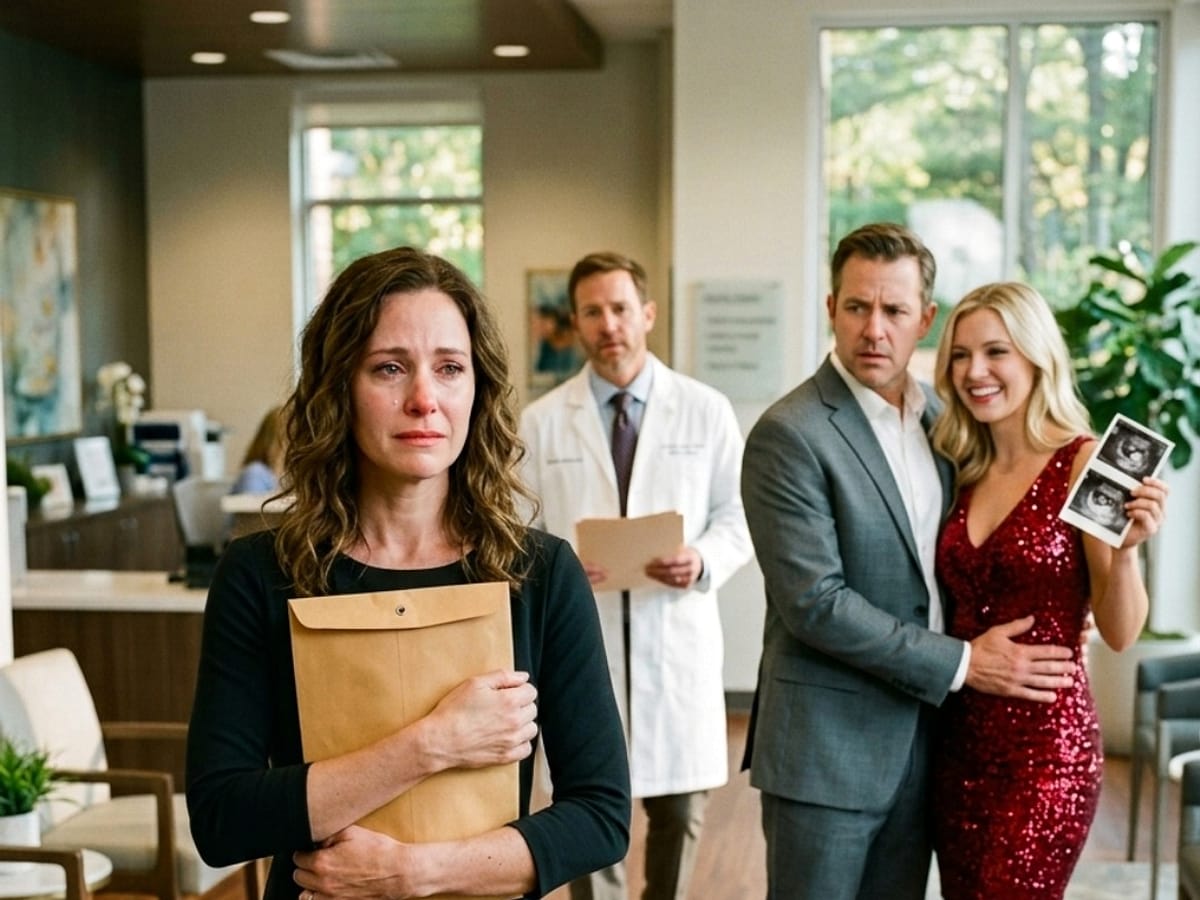
Tessa was beside him, one hand resting on the small curve of her stomach, the other holding a white envelope. Inside that envelope, I understood immediately, were ultrasound photographs. She was perhaps fourteen or fifteen weeks along, still in the stage where the images are shown to everyone, where the evidence of new life is carried like a trophy.
She saw me first. I watched her register who I was, watched something move across her face, and then watched her smile.
It was not a nervous smile. It was not the smile of a woman who felt any guilt or discomfort at the situation.
It was the smile of someone who believed she had won a competition and wanted the other contestant to know it. She held the envelope slightly forward, just slightly, the way you might display a ribbon at a county fair.
Mark took off his sunglasses. His face went pale in a way I recognized, the particular pallor of a man who has been caught between two realities and does not know which direction to run.
“Claire,” he said, and my name in his mouth sounded like the beginning of a sentence he had not finished writing.
“Mark,” I said. I looked at Tessa. “Congratulations.”
She tilted her head. “Thank you. We’re really excited.”
“I imagine you are,” I said.
There was a beat of silence. The kind that has weight.
I had my envelope under my arm. I had my keys in my hand.
I had spent the drive over reminding myself to stay calm, to say nothing I would regret, to be the woman I wanted to be when I looked back on this moment years later. I had practiced this in the bathroom mirror that morning the way an actor rehearses a difficult scene.
What I had not practiced was what happened next.
A nurse appeared at the door and called Tessa’s name, then corrected herself and said she actually needed to speak with both of them, if they had a moment. Her voice was professionally neutral in the way that medical professionals are trained to be when delivering information that requires a private room.
Mark looked at me once more, something flickering behind his eyes that I could not quite read, and then followed Tessa back inside.
I stood in the parking lot for a moment, the spring air cool and smelling faintly of the Bradford pear trees that lined the clinic entrance. Then I went inside to collect my own records.
The waiting room was arranged so that the consultation hallway was visible from the reception desk. I was signing a form when I heard it.
Not the words exactly, but the tone. A doctor’s voice, low and careful.
Then Tessa’s voice, rising. Then silence.
Then Mark’s voice, which I had not heard raised in years, saying something I could not make out but which carried the unmistakable register of a man whose entire constructed reality had just developed a crack straight through the center.
The receptionist glanced toward the hallway, then back at me, and handed me my envelope with the practiced calm of someone who had learned not to react to the sounds that came from behind those doors.
I thanked her and sat down to wait.
Part 4: The Thing the Doctor Said That He Could Never Take Back
Mark found me in the parking lot. Tessa was still inside.
I learned later that a nurse had stayed with her, brought her water and tissues, and sat with her while she processed what the doctor had explained. I did not know the specifics at the time.
I only knew what I could read in Mark’s face as he came through the glass doors and walked toward me.
He looked like a man who had been told the building he was standing in was not real.
I was leaning against my car, my envelope of records against my chest, watching him cross the parking lot. The Bradford pear blossoms were drifting in the light wind. It was an absurdly pretty morning for what was happening inside it.
“Claire.” He stopped a few feet away. “I need to talk to you.”
“All right,” I said.
He ran a hand through his newly cut hair. He looked at the ground, then at me, then at some middle distance between us.
“The doctor said,” he started, and then stopped. “There’s a question.
About the baby.”
I waited.
“The genetic panel,” he said. “There are markers.
The doctor said that given my — given the results from my previous testing — ” He stopped again. His jaw tightened.
“She said it’s not possible. That the baby can’t be mine.”
I held his gaze and said nothing.
“Did you know?” he asked.
His voice had gone strange, thin and tight. “Did you know about my — about the diagnosis?
Did you tell anyone?”
“I told no one,” I said. “For seven years, I told no one. You asked me not to, and I kept that promise even when it cost me.”
He looked at me then with an expression I had not seen before. Not anger, exactly.
Something more complicated. Something that might have been the beginning of understanding, if he had been the kind of man capable of it in that moment.
“She doesn’t know,” he said quietly. “About my diagnosis. I never told her.”
“I know you didn’t,” I said.
There was a long silence. A car pulled out of the row behind us. Somewhere across the lot, a woman was loading a stroller into a minivan, moving with the efficient tenderness of someone who had done it a thousand times.
“What are you going to do?” he asked.
I thought about the seven years. I thought about the baby shower where I cried in the bathroom.
I thought about the word “heavy” and the text message with three sentences and the smile Tessa had given me with the ultrasound envelope held slightly forward. I thought about Diane’s voice on the phone asking if there was something she should know.
I thought about Angela handing me the sealed envelope and saying “good” in that quiet, certain way.
“I’m going to go home,” I said. “And I’m going to let my attorney handle the rest.”
“Claire — “
“The records I’m holding,” I said, “document everything. My hormone levels, my cycle history, every appointment we attended together, and the specialist’s notes from the day you were diagnosed.
My attorney has copies. The court will have copies.
I kept your secret for seven years, Mark. I’m not keeping it anymore.”
He said my name again, but I was already opening my car door.
I drove home with the windows down and the radio off. I did not cry.
I had done my crying years ago, in guest bathrooms and parked cars and the quiet of the house after Mark had gone to bed. I had used up that particular well of tears a long time ago, and what was left in its place was something steadier.
Not happiness, not yet. But the specific relief of a woman who has finally stopped carrying something that was never hers to carry.
Bennett called that afternoon. He had received a message from Mark’s attorney requesting a conversation about the financial settlement. Mark, it seemed, was suddenly very motivated to resolve things quickly and quietly.
“He wants to settle,” Bennett said. “Quickly.”
“Of course he does,” I said.
“The house, the retirement accounts, the joint savings. He’s willing to be generous.”
I told Bennett to make sure generous meant what it was supposed to mean. He said he would handle it.
He also told me, in the careful way that attorneys deliver information they find personally satisfying, that Mark’s firm had a morality clause in its partnership agreement, and that certain information about the circumstances of the separation had apparently already reached the wrong ears. A senior partner named Diane — not Mark’s sister, a different Diane, a coincidence that I found quietly amusing — had asked some pointed questions at a recent team meeting.
I had not told anyone at Mark’s firm anything. I did not need to. The truth, once it is no longer being held down, has a way of surfacing on its own.
The settlement was finalized six weeks later. The house was mine.
The retirement accounts were divided fairly, which in this case meant more than fairly. Mark moved into an apartment in North Hills, not far from Tessa’s building, though I understood from Diane — his sister Diane — that things between them had become complicated in ways that were not entirely surprising.
Tessa’s baby was born in October. The father, as it turned out, was a former colleague of hers who had been in the picture longer than Mark had understood.
I did not follow the story closely. It was not my story to follow.
Part 5: The Family I Finally Let Myself Choose
The divorce took the better part of a year. People imagine divorce as a single dramatic moment, a signature on a document, a gavel coming down, a door closing. In reality it is months of paperwork and financial disclosures and emails from attorneys and court dates that get rescheduled and forms that require notarization and the slow, grinding work of separating two lives that have been tangled together for more than a decade.
I will not pretend it was easy. There were nights when the house felt enormous and the silence in it felt like a presence rather than an absence.
There were mornings when I woke up and lay still for a moment before remembering, and then remembered, and had to decide all over again to get up and keep going. Grief does not follow a schedule.
It arrives when it wants to, in the cereal aisle, in the middle of a Tuesday, when a song comes on the radio that you have not heard in years.
But there was also something else. Something I had not felt in a very long time.
Space. Room to breathe. The particular freedom of a woman who has stopped making herself smaller to fit inside someone else’s pain.
I went back to work full-time in the fall. I had been doing part-time bookkeeping for a small accounting firm for years, fitting my hours around Mark’s schedule and his moods and his need for the house to be a certain way when he came home.
Now I took on more clients. I stayed late when I wanted to.
I ate dinner at nine o’clock if that was when I was hungry. I left dishes in the sink overnight and did not apologize to anyone for it.
Small freedoms. But they accumulate.
Diane, Mark’s sister, called me three months after the divorce was finalized. She had heard the full story by then, or most of it.
She was quiet for a long time after I finished talking, and then she said, “I am so sorry, Claire. I am so sorry we let you carry that.”
I told her she had not known. She said that was not entirely an excuse.
I told her I appreciated the call. We have stayed in touch.
She sends me a card every Christmas and sometimes texts me photographs of her garden, which is spectacular in the summer, full of dahlias and climbing roses and the kind of cheerful disorder that means someone genuinely loves being in it.
In the spring after the divorce, I started volunteering at a literacy program for adults at the public library downtown. I had always loved books, had always found in them the particular company that does not require anything of you except attention. The program worked with adults who were learning to read for the first time, or returning to it after years away, and there was something about sitting across a table from someone who was working hard to decode a sentence and watching the moment it clicked that felt like the most useful thing I had done in years.
One of the other volunteers was a woman named Angela — not my doctor, a different Angela, though I have come to think there must be something in that name — who was recently retired from teaching middle school and had the kind of laugh that made everyone in the room feel welcome. We became friends the way women of a certain age become friends, quickly and without ceremony, over bad coffee in the library break room and long conversations that started about one thing and ended somewhere entirely different.
She asked me once, during one of those conversations, whether I had ever thought about fostering. She had fostered three children over the years and spoke about it the way people speak about something that changed the direction of their life.
I told her I had thought about it. That I had thought about it for years, actually, but that the person I had been married to was never ready.
She looked at me with the directness of a woman who has spent thirty years in a classroom and said, “Well. Are you ready?”
I sat with that question for a few weeks. I talked to a social worker.
I attended an orientation session at the county office, in a room with fluorescent lighting and folding chairs and a facilitator who spoke with the matter-of-fact warmth of someone who genuinely believed in what she was doing. I filled out forms.
I had a home study done. I painted the spare bedroom a color that was neither sage green nor pale yellow but a warm, quiet blue that I chose entirely by myself.
The first placement came in November, fourteen months after the divorce was final. A girl named Rosie, seven years old, with a gap in her front teeth and an opinion about everything and a way of falling asleep on the couch with a book open on her chest that made my heart do something I did not have a word for.
She was with me for four months before she was reunified with her grandmother, which was the right outcome, the one everyone had been working toward, and I was glad for it even as I missed her. That is the particular emotional complexity of fostering that nobody warns you about adequately: you love them knowing you might have to let them go, and you let them go because you love them.
By the following spring, I had completed the training to become a certified foster parent and had a second placement, a pair of brothers, ages five and eight, who ate everything in my refrigerator and left their shoes in the middle of every doorway and filled the house with the noise I had once imagined standing in an empty kitchen.
The kitchen island was covered with school backpacks. With half-finished bowls of cereal. With permission slips and library books and the particular beautiful chaos of children who are learning that a house can be a safe place.
Mark, I heard through Diane, had eventually moved to Charlotte. He was working for a smaller firm.
He was, by all accounts, fine. Not happy exactly, but fine, which is perhaps the most honest outcome available to a man who spent years choosing his own comfort over the truth.
I did not wish him harm. I had carried his secret for seven years, and I had let it go, and I found that once I let it go, there was not much left to feel about him at all.
Not anger, not grief, not the complicated love that had once made me try to be enough for both of us. Just the quiet, clean absence of something that had been taking up too much room for too long.
The $2,600 I had once spent on a single round of fertility treatments, back in the early hopeful years, was framed in my memory now as the cost of learning something important: that wanting something desperately does not mean you are meant to get it in the way you imagined. Sometimes the life you were supposed to have arrives through a different door, in a different shape, at a different time, with a seven-year-old who falls asleep with a book on her chest and two small boys who leave their shoes in every doorway.
I am not the woman I was when I stood in that clinic parking lot watching Mark walk toward me with his newly cut hair and his pale face and the weight of a truth he had never been willing to carry.
I am something better. Something quieter and more certain. Something that took a long time to become, and cost more than it should have, and belongs entirely to me.
Names and identifying details in this story have been changed. This is a dramatized account shared for entertainment and reflection, and any resemblance to real people is coincidental.
