Part 1: The Envelope on the Passenger Seat
Nathan Whitaker had been sitting in his own driveway for eleven minutes before he could make himself open the truck door.
He knew the exact number because he had watched the dashboard clock tick from 8:17 p.m. to 8:28 p.m.
without moving. The engine had been off since he pulled in.
The November cold in Franklin, Tennessee had already crept in through the vents, and his breath was beginning to show in faint clouds near the windshield, but he did not reach for the door handle.
On the passenger seat beside him sat a manila envelope from his attorney’s office. It was the kind of envelope that looked like nothing — flat, cream-colored, sealed with a simple metal clasp — but Nathan had been aware of its presence the entire forty-minute drive from Nashville the way you are aware of a bruise you keep accidentally pressing.
Inside were divorce papers. Not filed.
Not yet official. His attorney, Melissa Grant, had been careful to explain that distinction when she slid the envelope across her desk that afternoon.
“Take them home,” she had said, folding her hands in that measured way lawyers learn. “Read through everything again tonight.
If you still want to move forward tomorrow morning, call me before ten and we’ll get them filed.” She had paused.
“But make sure you’re certain, Nathan. Not just tired.”
He had told her he was certain.
Sitting in the driveway, he was no longer sure what he was.
The house in front of him was a two-story Craftsman on a maple-lined street that had looked like a promise when they bought it five years ago. There was a white porch swing Emily had lobbied for with the quiet persistence she applied to everything she truly wanted.
There was a small raised herb garden near the side steps, mostly dormant now in the cold, the rosemary gone woody and the basil long dead. There was a dent in the lower panel of the garage door from the morning Nathan had backed out too fast while arguing with a subcontractor on speakerphone.
Emily had laughed so hard she had to sit down on the porch steps. He had been furious for about four minutes and then laughed too.
He thought about that dent more than he probably should have.
Nathan was thirty-seven years old. He managed operations for a regional logistics company headquartered outside Nashville — trucks, routes, warehouse schedules, the kind of work that rewarded people who could locate a problem, name it clearly, and fix it before it compounded.
He was good at that. He had always been good at that.
It was the problems that couldn’t be located that undid him.
Emily was thirty-five. She worked as a school counselor in Williamson County, spending her days in a small office decorated with motivational posters and a bowl of individually wrapped peppermints, helping eight-year-olds find words for things that frightened them. She was patient in a way Nathan had once found grounding and had more recently found maddening, because that same patience seemed to extend to every struggling child in her care but not to the conversation he kept trying to start at home.
The last year had been a slow disappearance. Not dramatic.
No thrown dishes, no discovered texts, no screaming in the driveway. Just a gradual dimming, like a light on a faulty circuit — still technically on, but not illuminating anything.
Emily came home from work and went upstairs. Nathan stayed late at the warehouse because being needed by his logistics team felt less painful than being invisible in his own kitchen.
They talked about the water heater, the grocery list, whether the upstairs bathroom still had a mildew problem. They did not talk about what was happening to them.
They had tried therapy. Four months with a woman named Andrea whose office had soft chairs and a tissue box that Emily never once reached for.
Nathan had gone hoping for a diagnosis and a treatment plan. Emily had gone looking pale and careful, answering every question with words that were technically true but somehow hollow.
“I’m overwhelmed,” she would say. “With what?”
Nathan would ask, trying to keep the frustration out of his voice. “Everything,” she would say.
And everything had become the wall neither of them could get past.
By September they had stopped going. By October Nathan was sleeping in the guest room after a fight about something so minor he could no longer remember what had started it.
Emily had not asked him to come back. That silence — not the fight, but the silence after — was what had finally sent him to Melissa Grant’s office.
He picked up the envelope. Stepped out of the truck. Walked up the front steps and unlocked the door.
The house was mostly dark. The living room lamp was on.
The kitchen was quiet. He expected to find Emily on the couch with her laptop, or upstairs with the bedroom door closed, or maybe sitting at the kitchen table with that expression she had developed over the past year — composed, careful, unreachable.
He had prepared himself for all of those versions of her.
He had not prepared for the sound coming from behind the laundry room door.
It was muffled. Low.
The specific quality of crying that someone produces when they are trying very hard not to be heard — the kind that costs something to contain. Nathan stopped in the hallway.
The envelope felt suddenly wrong in his hand, like he had walked into the wrong scene carrying the wrong prop.
He moved toward the sound without deciding to.
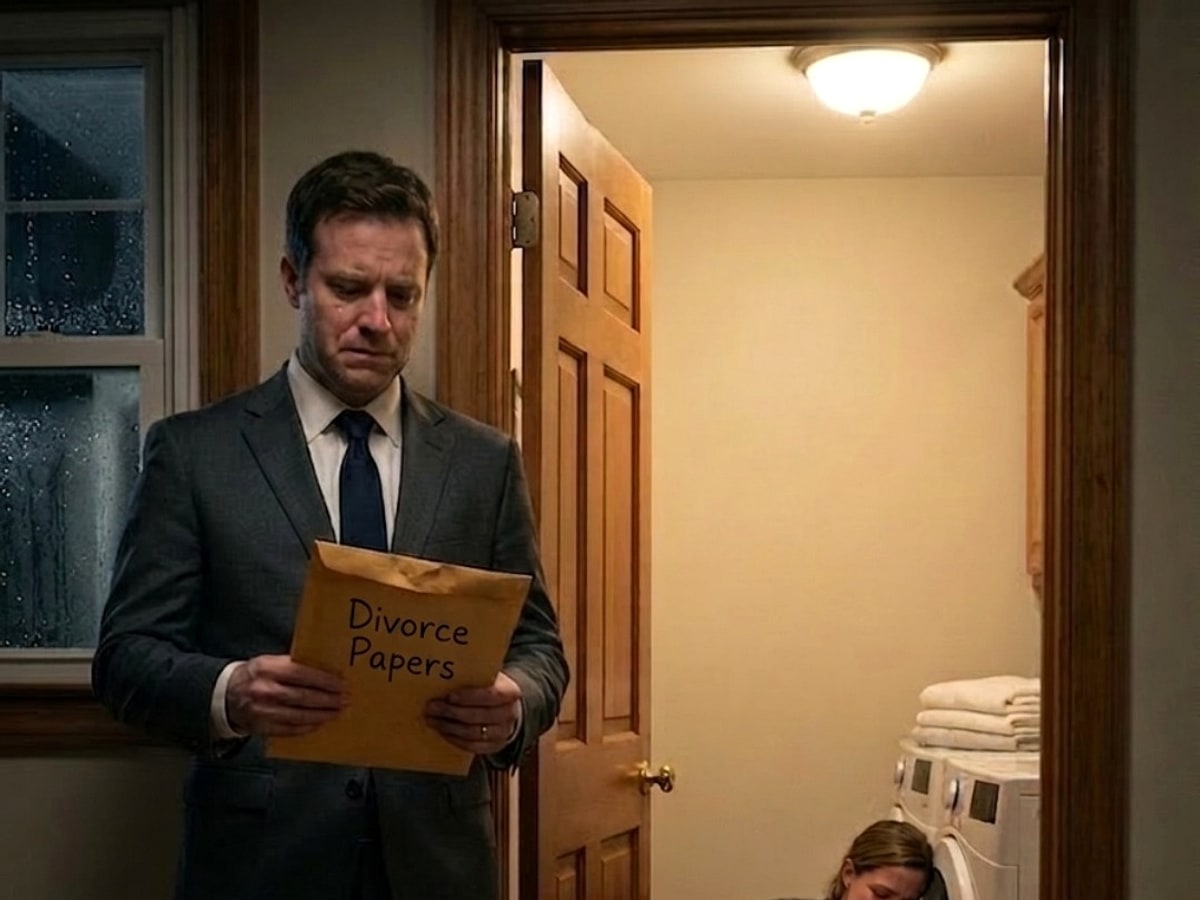
The laundry room was a narrow space off the hallway between the kitchen and the garage — pale blue walls, white cabinets, a stacked washer and dryer, and a small wooden bench where Emily kept a basket of unmatched socks she always said she would sort “when things calmed down.” The door was pulled almost shut. Through the gap, in the thin light from the utility bulb overhead, Nathan could see her.
Emily was on the floor. Knees drawn up, back against the cabinet, one hand pressed over her mouth.
Her hair had come loose from whatever she’d put it in that morning. A crumpled paper towel lay beside her knee.
Her whole body was shaking with the effort of keeping the sound in.
Nathan’s hand went to the doorframe.
Then Emily whispered something, and every thought in his head went still.
“I’m sorry, baby. I’m so, so sorry I couldn’t keep you.”
The word landed in his chest like something physical.
Baby.
He stood in the hallway with divorce papers in his hand while his wife sat on the laundry room floor apologizing to someone who was not there. He heard her press her forehead to her knees and whisper again, barely audible: “I didn’t know until it was already gone. I didn’t know in time.”
The manila envelope slipped from Nathan’s fingers and dropped onto the hallway rug without a sound.
He pushed the door open.
Emily startled so violently she knocked her shoulder against the cabinet. Her eyes found him, and in the space of two seconds Nathan watched four things move across her face in rapid succession — shock, shame, fear, and then that controlled blankness she had been wearing for months, rising up like a curtain trying to fall over all of it.
But the curtain was too slow this time.
“What baby?” Nathan asked. His voice came out in a register he didn’t recognize.
Emily looked at him. Then past him. Then down at the manila envelope on the rug.
Something in her expression broke open quietly, the way ice cracks before it gives way — not with noise, but with a shift you feel before you see it.
“Oh,” she said. Just that one word.
Not an accusation. Not a question.
A small, exhausted sound of recognition, as if she had been waiting for this exact moment and was only now allowing herself to believe it had arrived.
Nathan looked at the envelope on the floor, then back at his wife.
The papers inside it had stopped feeling like a decision. They felt like evidence of something he had nearly done without understanding what he was doing.
“Emily,” he said, and his voice had changed completely. “Tell me what happened.”
Part 2: What She Had Been Carrying Alone
Neither of them slept that night.
They moved from the laundry room to the kitchen because the tile floor had grown too cold and the space too small for what needed to be said. Nathan put the kettle on because he needed something to do with his hands.
He found two mugs, the chamomile Emily kept in the cabinet above the stove, and set them on the counter without asking if she wanted any. She sat at the kitchen table with her hands folded in front of her, watching him move around the kitchen the way you watch someone in a dream — present but slightly unreal.
He set a mug in front of her and sat down across the table.
“Were you pregnant?” he asked.
The silence answered first. Then Emily nodded, once, barely perceptibly, like the smallest possible confirmation of the largest possible thing.
Nathan put both hands flat on the table. The kitchen felt very quiet. Outside, the wind moved through the maple trees on the street, and somewhere down the block a dog barked twice and went still.
“When did you find out?”
Emily looked at her mug. “Three weeks ago.”
Three weeks ago. Nathan ran the timeline backward without meaning to.
Three weeks ago he had been sleeping in the guest room. Three weeks ago he had called Melissa Grant for the first time to ask about his options.
Three weeks ago, on a Tuesday evening he could still picture clearly, he had stood in this same kitchen and said to Emily, “I don’t know how much longer we can keep pretending this is a marriage,” and she had looked at the floor and said nothing to defend them.
She had known for three weeks. She had been carrying it through all of that.
“You didn’t tell me,” he said. It came out wounded, and he hated himself for it immediately, because she was the one who had been sitting on the laundry room floor.
Emily looked up. Her eyes were swollen, the skin around them raw and pink.
“I didn’t know how,” she said. “You were already in the guest room.
We had barely spoken in weeks. I didn’t know if you would think I was — ” She stopped.
Pressed her lips together. “I didn’t know what you would think.”
“What happened?”
She wrapped both hands around her mug. “I started feeling wrong in early October.
Tired in a way that was different. I thought it was stress.
I thought it was — us. I finally took a test on a Saturday morning when you were at the warehouse.”
She paused. “It was positive.”
Nathan waited.
“I made an appointment. The following week.
They did an ultrasound.” Her voice had gone very flat, the way voices go when the only alternative is falling apart.
“The pregnancy wasn’t viable. They told me it had already — that my body had already begun — ” She stopped again.
Swallowed. “They called it a missed miscarriage.
The baby had stopped developing, but my body hadn’t recognized it yet.”
Nathan’s throat tightened. “When?”
“Last week. Wednesday.”
She looked at the table. “I went alone.
I didn’t — I couldn’t ask you to come. I didn’t think you would want to.”
The sentence hit him somewhere behind the sternum. “Emily.”
“I know,” she said quickly. “I know that’s not fair.
I know I should have told you. I just — ” Her voice fractured.
“I had already lost the baby. I couldn’t lose you in the same week.
I wasn’t strong enough for both.”
Nathan stared at the table. He thought about her standing in this kitchen while he told her he didn’t know how much longer they could go on, and she had said nothing, and he had taken her silence as confirmation that she felt the same way. He had not considered that she might have been standing there holding something so enormous she couldn’t speak around it.
“There’s more,” Emily said.
He looked up.
She reached toward the counter behind her — she must have brought it in from the laundry room — and picked up a folded stack of papers. Her hands were trembling badly enough that the pages shifted against each other.
She held them against her chest for a moment, the way you hold something before you give it away for good. Then she set them on the table and slid them toward him.
Nathan unfolded them slowly.
They were medical documents. He recognized the Vanderbilt University Medical Center letterhead at the top. He read the first paragraph twice before the words assembled into meaning.
Cervical cancer. Early stage.
Caught during the same appointment where they had confirmed the miscarriage. The doctor — a name Nathan didn’t recognize yet, a Dr.
Shah — had noted that the diagnosis was early, that the prognosis with treatment was favorable, but that treatment needed to begin promptly.
Nathan set the papers down on the table.
He looked at his wife.
Emily was watching him with an expression he had never seen on her before — not the careful blankness of the past year, not the grief of the laundry room floor, but something older and more stripped down. She looked like someone who had been holding a very heavy thing for a very long time and had finally, at 2:38 a.m. in their kitchen, set it down on the table between them.
“How long have you known?” he asked.
“Eight days,” she said.
Eight days. She had carried a miscarriage and a cancer diagnosis for eight days without saying a word to him. And he had spent those same eight days finalizing paperwork with an attorney.
Nathan reached across the table and covered her hands with his.
She flinched slightly, as if she had forgotten what that felt like.
Then she turned her hands over and held on.
Part 3: The Drive to Vanderbilt
Monday morning arrived with the kind of cold clarity that November sometimes produces in middle Tennessee — a hard blue sky, frost on the windshields, the maple trees stripped down to their architecture. Nathan was up before six. He had not slept more than an hour or two, but he felt strangely alert, the way you feel after a night that has permanently rearranged something inside you.
Emily came downstairs at six-thirty in a gray sweater and dark jeans, her hair pulled back, looking like someone who had also not slept but had made a decision about how to carry that. She had her appointment at Vanderbilt University Medical Center at nine. She had made it herself, eight days ago, without telling him.
“I’ll drive,” Nathan said.
She looked at him across the kitchen. “You don’t have to.”
“I know.”
“I’m capable of driving myself.”
“I know that too.”
She was quiet for a moment. “Parking at Vanderbilt is a nightmare. The garages fill up early.”
“Then we’ll leave by seven-fifteen,” he said. “That gives us enough time.”
She looked at him for another moment, and something in her face shifted — not dramatically, not with tears, just a small, careful softening, like a door that had been locked for a long time being turned from the inside. “Okay,” she said.
They left at 7:15 a.m. The drive up I-65 was quiet, but it was a different kind of quiet than the silences of the past year.
Those silences had been full of things unsaid, pressurized and exhausting. This one had a different quality — something closer to two people sitting with a hard truth they had both finally agreed to look at.
Nathan drove. Emily sat in the passenger seat with the medical documents in her lap, reading through them again. He watched her from the corner of his eye — the way she turned each page carefully, the way she underlined something with her thumbnail, the way she occasionally pressed her lips together and looked out the window at the passing highway.
“Tell me about Dr. Shah,” he said.
Emily looked over. “She’s the gynecologic oncologist they referred me to.
She was the one who called me with the biopsy results.” She paused.
“She was very calm on the phone. I appreciated that.
Some doctors get this tone when they’re delivering bad news, like they’re bracing for you to fall apart. She just talked to me like I was a person who could handle information.”
“Do you like her?”
“I think so. I’ve only met her once.”
Emily looked back at the documents. “She said early-stage cervical cancer has very good outcomes with the right treatment.
She used the word ‘manageable.’ I’ve been turning that word over in my head for a week.”
“Manageable is a good word,” Nathan said.
“It is,” Emily agreed. “It’s a logistics word. You’d like it.”
It was the first thing either of them had said in months that sounded like the way they used to talk to each other. Nathan felt it land and didn’t say anything about it, because some things survive better when you don’t point at them.
The Vanderbilt campus was busy even on a Monday morning. Nathan found a spot in the parking garage on the second level after one full loop, which Emily acknowledged with a small nod that he understood to mean she was glad he had come. They walked into the medical center together, through the wide lobby with its high ceilings and the particular institutional smell of hospitals — antiseptic and recycled air and something faintly floral from a gift shop near the entrance.
Dr. Shah’s office was on the fourth floor.
She was a compact woman in her mid-forties with dark hair, wire-rimmed glasses, and the kind of unhurried manner that suggested she had learned long ago that rushing a frightened patient accomplished nothing useful. She shook Nathan’s hand when Emily introduced him and did not make any comment about his presence, simply pulled a second chair up to the desk as if it had always been expected.
The appointment lasted just over an hour. Dr.
Shah walked them through the diagnosis — early-stage, localized, caught because the miscarriage had brought Emily in for imaging that might otherwise have been delayed for years. She explained the treatment options with a whiteboard and a marker, drawing diagrams that Nathan photographed on his phone so he could look at them later.
She answered every question Nathan asked without making him feel like he was interrupting. She answered every question Emily asked without making her feel like she should already know the answers.
When they were done, she looked at Emily directly. “You caught this early,” she said.
“That matters enormously. I want you to hold onto that.”
Emily nodded. Her jaw was tight, but she was not crying.
“I’ll hold onto it,” she said.
In the elevator going down, Nathan stood beside his wife and looked at the floor numbers changing above the door. He thought about the manila envelope still sitting on the hallway rug at home, where it had fallen on Saturday night.
He had not picked it up before they left that morning. He was not sure what he was going to do with it.
He thought about Melissa Grant’s voice on the phone that afternoon: Make sure you’re certain, Nathan. Not just tired.
He had not called her that morning.
He was not going to call her that morning.
The elevator doors opened and they walked out into the lobby together, and Nathan reached over and took Emily’s hand, and she let him, and they walked out through the glass doors into the cold November air without either of them saying a word about what it meant.
Some things don’t need to be said to be true.
Part 4: The Marriage They Had to Learn Again
The weeks that followed did not transform Nathan into a different man. He wanted to be honest about that, even in the retelling.
He did not become effortlessly patient or intuitively wise. He still said the wrong thing sometimes — tried to solve feelings with calendars, turned fear into logistics, occasionally asked questions that sounded like interrogations when he was really just scared.
He overscheduled things. He researched treatment protocols at midnight and sent Emily links to clinical studies at 6 a.m.
with subject lines like “Thought this might be useful” that she would read and then gently set aside.
“I don’t need you to fix it,” she told him one evening in early December, not unkindly. “I need you to sit with me while I figure out how to live with it.”
He had to learn what that meant. It took longer than he would have liked.
But he stayed. He stayed in the bedroom instead of the guest room.
He drove her to every appointment — Vanderbilt became a place they knew the way you know a place you visit regularly, the parking garage rhythms, the fourth-floor waiting room with the window that looked out over the campus, the particular chair Emily always chose near the window because the light was better. He learned the names of the nurses.
He learned what questions to ask and when to stay quiet. He learned that sometimes the most useful thing he could do was bring coffee and sit beside her without speaking.
Emily, for her part, began to talk.
That was the change that mattered most, and Nathan recognized it as the harder work. She had spent a year building walls out of silence because she had not trusted him — or herself — with the truth of what she was feeling. Dismantling that took time and deliberate effort and more than a few evenings where she started a sentence, stopped, looked at the table, and had to start again.
She told him about the year. The real version, not the careful one she had offered in Andrea’s office.
She told him that the distance had begun after a pregnancy scare the previous winter — not this pregnancy, an earlier one, a false alarm that had lasted four days before a second test came back negative. She had felt relief and grief simultaneously and had not known how to explain either to him.
She had been afraid of what wanting a baby might mean for a marriage that was already showing cracks. She had been afraid of what not wanting one might mean.
She had said nothing and let the silence calcify around her.
She told him she had watched him move into the guest room and had not asked him to come back because some part of her had believed, by that point, that she did not deserve to ask. That she had already failed at too many things that year — the marriage, the pregnancy she hadn’t even known about yet, her own body — and that asking him to stay would have been one more thing she might fail at.
Nathan listened to all of it.
He did not interrupt. He did not defend himself.
He sat at the kitchen table where they had sat at 2:38 a.m. on that first terrible night and he listened to his wife tell him the truth about a year he had lived through without understanding it.
“I should have told you,” she said. “About all of it. I kept thinking I was protecting you, but I was really just protecting myself from having to watch you react.”
“I wasn’t easy to tell things to,” Nathan said.
She looked at him.
“I know I wasn’t,” he said. “I made everything a problem to be solved.
I made you feel like your feelings were inefficiencies.” He paused.
“I didn’t know I was doing it. That’s not an excuse.
I’m just — I’m telling you I know.”
Emily was quiet for a moment. “Andrea tried to tell you that.”
“I know. I wasn’t ready to hear it from her.”
He looked at his hands on the table. “I think I needed to nearly lose you first.”
The treatment began in December. Dr.
Shah had laid out a plan that was aggressive but targeted, and Emily responded to it with the same quiet determination she brought to everything she truly committed to. There were hard days — days when she came home from treatment exhausted and nauseated and went straight to bed, days when Nathan sat outside the bedroom door and felt completely helpless, which was a feeling he was still learning to tolerate.
There were days when she cried and he held her and didn’t try to tell her it would be okay, because she had asked him not to do that, because she needed to be allowed to be afraid without being managed.
There were also good days. Days when she felt well enough to sit on the porch swing in the thin winter sunlight and drink tea and talk about nothing important.
Days when they cooked dinner together and argued pleasantly about whether garlic should be minced or pressed. Days when Nathan made her laugh — really laugh, the kind that bent her forward — and he felt something in his chest that he recognized as the specific relief of a man who has been given back something he thought he had lost for good.
Rachel, Emily’s closest friend from college, flew in from Portland in January and stayed for a week. She was a tall, direct woman who had never particularly warmed to Nathan and made no effort to pretend otherwise, but she pulled him aside on her second day and said, “She told me what you did.
Staying. The appointments.”
She paused. “I was ready to hate you.
I want you to know that. I had a whole speech prepared.”
Nathan said he would have deserved it. Rachel looked at him for a long moment.
“Yeah,” she said. “But you didn’t make me use it.
So.” She went back inside without finishing the sentence, which Nathan understood to be the closest thing to approval he was going to get from Rachel, and he accepted it gratefully.
The manila envelope had been picked up from the hallway rug on the Sunday morning after that first night. Nathan had folded it in half and put it in the bottom drawer of his desk in the home office, under a stack of old tax documents.
He had not called Melissa Grant. He had sent her a brief email that Monday saying he needed to put things on hold indefinitely.
She had replied with two words: Understood. Take care.
He had not opened that drawer since.
Part 5: Before Sunrise, and the Morning After
By the following spring, the maple trees on their street had come back. Nathan noticed them one morning in late April when he was standing at the kitchen window with his coffee — the new leaves just beginning, that particular yellow-green that only lasts about two weeks before it deepens into summer. He stood there for a while just looking at them.
Emily came downstairs and found him there. She was in her robe, her hair loose, looking better than she had in months.
The treatment had ended in February. Dr.
Shah had used the word “clear” at the March follow-up, and Emily had cried in the car on the way home — not the contained, desperate crying of the laundry room floor, but something more open, more released, the kind of crying that is actually a form of relief so large the body doesn’t know what else to do with it. Nathan had pulled into a gas station parking lot and sat with her until it passed, his hand on her back, saying nothing.
She poured herself coffee now and came to stand beside him at the window.
“The trees are back,” she said.
“Yeah.”
She leaned against the counter. “I have my six-month check-in with Shah next week.”
“I know. It’s on the calendar.”
She smiled at that — a small, fond smile at his incurable need to put things on calendars. “I know it’s on the calendar, Nathan.”
“I’ll drive.”
“I know you will.”
They stood together in the kitchen in the morning light, and Nathan thought about the night he had sat in the driveway for eleven minutes with a manila envelope on the passenger seat. He thought about the hallway.
The thin line of light under the laundry room door. The sound of his wife’s voice, broken and quiet, apologizing to a baby she had lost alone because she had not believed she could tell him.
He thought about how close he had come to walking into that house, setting those papers on the kitchen table, and walking back out before he ever understood what was actually happening.
The thought still made his hands unsteady if he let it.
He had told his friend Marcus about it once, over beers in February, in the careful way men tell each other things they are still processing. Marcus had listened and then said, “So what changed?
That night?” Nathan had thought about it for a long time before answering.
“I heard her,” he said finally. “I actually heard her.
For the first time in a year, maybe longer, I stopped thinking about what I was going to say next and I just — heard her.” Marcus had nodded slowly.
“That’s it,” he said. “That’s the whole thing, right there.”
Nathan thought Marcus was probably right.
The marriage they had now was not the marriage they had planned when they bought the house with the porch swing and the herb garden. It was smaller in some ways — quieter, more careful, built on a clearer understanding of how badly they had both failed each other and how deliberately they had chosen to try again anyway.
It was also larger in ways Nathan hadn’t anticipated. More honest.
More willing to sit with discomfort instead of managing it away. More capable of silence that was actually peaceful rather than pressurized.
Emily had gone back to her school counseling job in March, part-time at first, then full hours by April. She had told Nathan one evening that the year had changed how she worked with her students — that she was better now at recognizing when a child was carrying something too large to say out loud, because she knew what that looked like from the inside. Nathan had thought about that for days afterward.
The herb garden came back too. Emily replanted it in late March — rosemary again, and basil, and a new addition, a small lavender plant she put near the corner of the raised bed. Nathan had built her a better frame for it over a weekend in April, a proper cedar box with drainage, because building something useful was still his primary love language and she had long since made her peace with that.
On a Saturday morning in late April, Nathan was in the garage when Emily came out through the side door and sat on the back steps near the herb garden with her coffee. The lavender was just beginning to show color.
The rosemary had gone thick and fragrant in the warm spell they’d had that week. She sat there in the morning sun with her eyes closed, her face turned up slightly, and Nathan stood in the garage doorway and watched her for a moment — this woman he had almost left, who had almost let him go, who had sat on a laundry room floor with a grief too large to speak and a diagnosis she had carried alone for eight days because she had not believed she was worth the asking.
He thought about the $180 he had paid Melissa Grant’s office for the initial consultation. He thought about 8:17 p.m.
on a November night and an engine going off in a driveway. He thought about 2:38 a.m.
at a kitchen table and medical documents passed across it with trembling hands. He thought about 7:15 a.m.
on a Monday morning and a drive up I-65 in the cold blue light.
He thought about how a marriage doesn’t end in one moment. It ends in a hundred small silences that compound, one after another, until the distance between two people becomes so habitual that it starts to feel like the truth of who they are to each other.
And he thought about how it doesn’t come back in one moment either. It comes back the same way — slowly, in small things, in a hand covered by another hand across a kitchen table, in a second chair pulled up to a doctor’s desk, in a cedar herb box built on a Saturday afternoon, in two people standing at a kitchen window watching the maple trees come back.
Emily opened her eyes and saw him in the doorway.
“You’re staring,” she said.
“I know.”
“It’s a little much.”
“Probably,” he said. He walked over and sat down on the step beside her.
She shifted to make room without being asked. The lavender smelled faintly sweet in the warm air.
Somewhere down the street, a lawnmower started up.
“Shah’s going to say everything looks good next week,” Emily said.
“I think so too.”
“But you’ll worry until she does.”
“Obviously.”
Emily leaned her head against his shoulder. “I know,” she said. “Me too.”
They sat there together in the April morning, in the house they had almost stopped living in together, while the lavender came in and the maple trees held their new leaves up to the light.
Some things you almost lose before you understand what they are.
Some things you have to nearly ruin before you know how to take care of them.
Nathan Whitaker had walked into his house one November night with divorce papers in his hand and walked out of that year with something he hadn’t known he was missing: the actual truth of his marriage, and the actual truth of his wife, and the hard-won knowledge that hearing someone — really hearing them — is not a passive thing. It is the most active choice a person can make.
He had almost made a different one.
He was grateful, every single morning, that he hadn’t.
Names and identifying details in this story have been changed. This is a dramatized account shared for entertainment and reflection, and any resemblance to real people is coincidental.
