Part 1
The first thing my father said when I stepped through the oak door of our old house in the suburbs of Boston was:
“Don’t make everything worse, Christopher.”
That was how I knew everything was already bad enough.
My parents’ house still gave off the exact same smell as it had the year I was sixteen — the scent of pine-scented floor cleaner, burnt coffee, and fine dust clinging stubbornly to the green velvet curtains my mother refused to replace. The late afternoon sun cut through the window blinds into sharp white stripes, falling across the carpeted floor like the bars of a cage.
My sister, Chloe, sat on the long sofa, one leg crossed over the other, the pendant of our grandmother’s heirloom sapphire necklace swinging at her throat.
I noticed that necklace before I noticed anything else.
It had been Grandma Eleanor’s most cherished possession — a deep blue sapphire pendant set in 18K gold, which she wore only on Christmas or when attending concerts at the city’s symphony hall. When I was a child, she used to press the cool stone into my palm and whisper, “Things don’t have to be expensive to become priceless, Chris. They only need to be given to the right person — someone who knows how to cherish the love behind them.”
Chloe touched the pendant lightly with her finger when she saw me staring.
“What?” she said, lifting her chin. “It was just sitting in a jewelry box.”
My stomach tightened.
I had come straight from the luxury apartment building downtown, still wearing my service jacket because I hadn’t even had time to go back to my hotel and change. I had just completed my duty and been discharged from the naval base in San Diego three days earlier — exhausted but full of anticipation, a duffel bag in one hand, a folder of discharge papers under my arm, carrying six years of waiting to finally walk into the place my grandmother had left just for me.
The penthouse apartment atop the Brickell Avenue building.
My apartment.
At least, that was what I believed until I stepped into the marble lobby, met the building manager — an older man with graying hair and a look of quiet unease in his eyes — and said:
“I’m Christopher Vance. I’m here to collect the keys to Penthouse 12A, which belonged to Eleanor Vance.”
The manager’s expression faltered for a moment.
“Oh,” he said hesitantly. “Unit 12A has had someone living in it for more than four months now.”
“I know,” I replied. “I was told my family was looking after it while I was in the service.”
He glanced down at the tablet on the counter, then looked back up at me.
“The current owner listed in our system is Ms. Chloe Vance.”
For a moment, the space around me seemed to freeze. An elevator bell chimed. Someone laughed loudly out on the sidewalk. A delivery man pushed a cart stacked with cardboard boxes past my feet.
I heard all of it, yet it felt as though the sounds were arriving from some distant world.
“That’s my sister,” I said.
The manager nodded, his eyes full of genuine regret, as if he wished I hadn’t said that.
I stood right there on the sidewalk, under an autumn downpour hammering against the awning, and pulled out my phone to call my father. He picked up on the fourth ring.
“Dad,” I said, trying to keep my voice from shaking. “Why does the building management say Chloe is the owner of Grandma’s penthouse?”
A long silence followed, long enough to be suffocating.
Then came his heavy sigh.
“Come home,” he said. “We need to talk as a family.”
And now, here I was, standing in the middle of this living room — the place where every ruthless family decision had always been wrapped in the word “family” to make betrayal feel gentler.
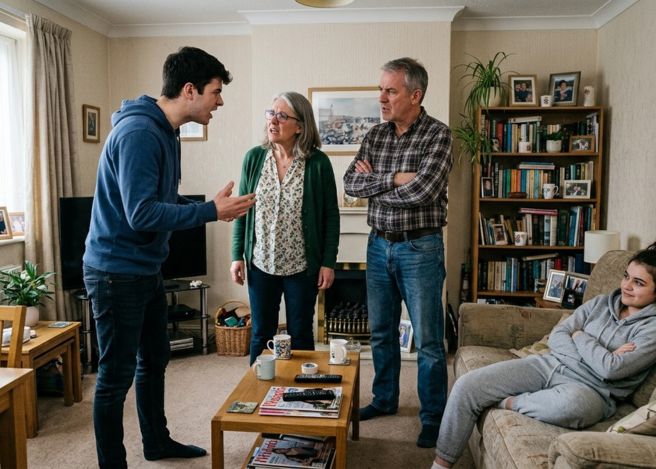
My mother sat in the armchair near the window. She refused to lift her eyes to meet mine. My father stood by the fireplace, his thumb rubbing endlessly against the handle of his porcelain mug. Chloe leaned back against the sofa with a calm expression, as if she already knew exactly how this afternoon’s script would play out.
I dropped my heavy duffel bag to the floor.
“Tell me this is just a clerical error from the property registry office,” I said.
My father cleared his throat. “Our family did what we believed was right.”
My mother whispered, her voice trembling: “Chloe needs stability, Christopher. She’s been through so much.”
My sister smirked.
And then my father delivered the sentence that tore through my eardrums and crushed whatever hope I had left:
“We transferred ownership of your inherited apartment to Chloe. She needs it more than you do.”
I stared at him.
For six years, I had eaten dehydrated rations in field tents, slept beneath the roar of aircraft engines on a warship, missed every birthday, every holiday, missed even my grandmother’s final breaths and the funeral where I should have been the one sitting in the front row, holding her frail hand.
For six years, I had told myself that apartment was still waiting for me, its doors wide open.
Not because of its multimillion-dollar value.
But because of the memories.
Because of the familiar scent of clove in the hallway’s built-in closet. Because of the view of the picturesque Charles River through the kitchen window. Because of the small dent in the wall near the pantry — where I had once dropped a hammer while trying to help her fix a bookshelf when I was nineteen.
“Grandma wrote a will leaving it to me,” I said. My voice dropped low, cold enough that even I found it strange.
My mother finally looked up, her eyes red and swollen with tears. “Son, you have a military pension, you have a stable job waiting for you. Chloe has nothing. She just lost her job and broke up with her boyfriend—”
Chloe tossed her hair back and sneered. “Besides, you’re not even here to use it anyway.”
I turned to look at her. “I was serving my country.”
“And I was the one who stayed here!” she snapped. “I’m the one who actually took care of everything in this house!”
That was a blatant lie. It dropped into the middle of the living room, bare and filthy.
During the last two years of Grandma Eleanor’s life, as she fought her illness, Chloe visited her exactly three times. Once to borrow money. Once to complain that her birthday dinner was held at a restaurant too far from downtown. And the last time — when the doctor announced her condition had worsened — she came only to ask how many underground parking spots came with the penthouse.
My father pulled a yellow folder from his briefcase and slid it gently across the glass coffee table.
“Everything was done legally,” he said. “Your mother and I had legal authority to act on your behalf while you were on active duty.”
At first I didn’t bother touching the folder.
It looked ordinary. Thin. Ivory-colored. Harmless. But I knew, with a soldier’s instinct, that if I opened it, the peaceful life I once knew would end forever.
I picked it up and opened it.
Inside were copies of a land-use transfer document, inheritance transfer forms, signatures, seals, and notary certifications. My name appeared on one page. Chloe’s name appeared on the next. Dates showed up in places where they should never have appeared.
Something about it was too neat.
Too rushed.
And too irregular.
“Did you use a Power of Attorney?” I asked.
My father nodded far too quickly. “To handle internal family matters.”
“Internal family matters?” I repeated, each word striking like metal against metal. “You’re calling the seizure of property Grandma legally left to me an ‘internal family matter’?”
My mother gasped. “Christopher! Don’t use a harsh word like ‘seizure’!”
“Then what should I call it? Theft?”
Chloe leaned forward, the sapphire pendant swinging at her collarbone with the motion. “Call it sharing! Call it being a decent brother for once! You always act so noble — why can’t you just give in to your sister this one time?”
I looked at her. Looked closely.
The penthouse’s electronic key fob hung from her bracelet. Grandma’s necklace hung from her neck. Her nails had just been done in an expensive dark red polish — the kind of service I knew perfectly well she could never afford on her own.
And right behind her, on the small side table, sat Grandma’s tiny bronze sparrow figurine.
The very figurine that always used to sit on the kitchen windowsill of Unit 12A.
The pain inside me froze solid into ice.
“I’ll see you and Chloe in court,” I said.
My father’s face darkened with fury. “You dare threaten your own parents?”
I picked up the folder and tucked it under my arm.
“I’m not threatening anyone,” I said, standing tall, my voice hard as steel. “I’m informing you.”
As I turned to walk out the door, Chloe shouted after me:
“The dead don’t get to control the living, Christopher!”
I stopped at the front door, my hand gripping the metal handle.
Because in that exact moment, I suddenly understood: this was not simply the story of a stolen apartment.
This was the story of everything else they had quietly taken from Grandma while I was too far away to protect her.
Part 2
I spent that entire night in a cheap roadside motel off the highway, sitting on the edge of the bed with the folder’s contents scattered across the sheets like evidence gathered from a crime scene.
Outside the window, trucks rumbled along the rain-slicked road. The neon light from the diner across the street cast red streaks across the ceiling. My uniform jacket hung over the back of the chair, still faintly smelling of jet fuel and autumn rain.
I read every line, every word, until my eyes blurred.
The property transfer document stated that my parents had acted under a limited Power of Attorney. The attached form declared that I — Christopher Vance — had granted my father, Calvin Vance, full authority to handle all assets belonging to Eleanor Vance’s estate while I served in the Navy.
I had never signed that piece of paper.
Not once.
But the irregularities didn’t stop there.
The notary’s certification date was four days before the court had officially accepted and recognized Grandma’s will. Chloe’s signature appeared on a document declaring her the “current resident” of Penthouse 12A a full six months before she had actually moved in. My mother’s name appeared as a witness, but her signature was cramped and shaky, nothing like her usual soft, flowing handwriting.
Six years of working with every kind of military paperwork had taught me exactly what a fraudulent document smelled like.
At 6:12 in the morning, after exactly one hour of sleep, I called the most highly rated estate litigation attorney in downtown Boston.
Her name was Talia Mercer.
Her assistant politely informed me that the attorney’s schedule was fully booked for the next two weeks.
I said flatly into the phone:
“My parents forged signatures and documents to transfer my inherited penthouse to my sister while I was on deployment overseas.”
There was three seconds of silence on the other end.
Then the assistant said, “Can you come to the office at 9 this morning?”
Talia Mercer’s office was on the twelfth floor of an old brick building with narrow windows and elegant polished concrete floors. She was younger than I’d imagined, somewhere in her late thirties, with eyes as sharp as a blade, wearing a navy blazer, and constantly tapping a silver fountain pen against her thumb.
She listened to my entire account from start to finish without interrupting even once.
That alone was enough to choke me up.
Because for the past twenty-four hours, every blood relative in my family had treated me like I was unreasonable, selfish, and out of my mind simply for realizing I’d just been robbed. Talia, on the other hand, listened, took careful notes, and asked precisely the right questions.
“Have you ever signed any power of attorney for your father?”
“Never.”
“Does your grandmother’s will clearly state that Penthouse 12A belongs to you?”
“Yes. Very clearly.”
“Do you have a copy?”
“Only a photo of the will that she emailed me before she passed.”
“Good. Send it to me right now.”
I did it from my phone. Talia reviewed the photo on her tablet, then slowly leaned back into her leather chair.
“Christopher,” she said gravely. “I’ll be direct with you. If what you’ve given me is accurate, this transfer isn’t merely a civil violation. It’s a serious act of fraud and document forgery.”
My hands went cold around the cup of coffee she’d just poured for me.
“Can we reverse it?”
“We’ll file for an Emergency Injunction with the court immediately. That will freeze the property, and it will bar Chloe from selling, mortgaging, leasing, renovating, or transferring the unit to anyone else. After that, we’ll file suit to void the deed.”
“What about my parents?”
Talia’s expression didn’t flinch. “If the forgery is proven, they could face very significant civil liability. And worse — criminal prosecution.”
The word criminal hung suspended in the stillness of the office.
I thought of my mother sobbing in that armchair. My father warning me not to make everything worse. Chloe wearing Grandma’s sapphire necklace with the smug look of a victor.
I should have felt satisfaction.
Instead, I only felt as if someone had punched a hole straight through my chest and let the winter wind rush in to tear at my heart.
“Do it,” I said, looking Talia straight in the eye.
That same afternoon, Talia sent formal preservation letters to my parents and to Chloe, demanding they preserve all property, documents, keys, emails, texts, and Grandma’s belongings exactly as they were. At the same time, she filed suit with the District Court.
My phone exploded before dinnertime.
My father called first.
I let it buzz until it stopped.
Then my mother. Then my father again.
Finally, a text from Chloe lit up the screen:
You’re really doing this? You want to push me to the edge?
I stared at the screen until it dimmed. Another text followed:
Are you going to make me homeless just because you’re jealous Grandma loved me less than she loved you?
I didn’t answer.
Talia had strictly advised me not to contact them directly except through counsel. And for the first time in my life, I chose to follow the advice of someone who genuinely wanted to protect my interests.
At 8:47 that night, my father left a voicemail.
His voice was no longer angry. That somehow made it worse.
“Christopher… this has gone too far, son. Your mother is crying herself sick. Chloe is panicking. You need to stop before you destroy this family completely. We made a hard decision. Maybe it wasn’t perfect, but we did it because your sister was drowning, and you were doing fine. You’ve always been the strong one in this family. Don’t punish everyone just because the family needs you to be strong one more time.”
I listened to that message twice.
Then I deleted it forever.
Because that was exactly how this family had always operated. Chloe failed out of college: I stayed up all night tutoring her. Chloe wrecked our mother’s car: I drove everyone around after. Chloe screamed at Grandma demanding money to party: I was the one who had to apologize to Grandma for upsetting her. Chloe needed, Chloe hurt, Chloe cried — and I became the child everyone felt free to disappoint, because they believed I would “always pull through on my own.”
But Grandma Eleanor was different. She had seen through all of that injustice.
That was why she left the penthouse to me alone.
Two days later, I drove back to the Brickell Avenue building. The manager let out a visible sigh of relief when he saw me walk in.
“Mr. Vance,” he said quietly. “I’m sorry about what happened the other day.”
“Not your fault.”
He glanced toward the elevators. “Your sister is up there.”
“Is she alone?”
“I believe so.”
Reason told me not to go up and confront her. I knew that. But some powerful force born of loss and fury pulled me straight toward that elevator.
The twelfth-floor hallway smelled of wood polish and damp rain. I had walked this hallway hundreds of times as a teenage boy, carrying heavy grocery bags while Grandma shuffled ahead of me, pointing out which neighbors were friendly and which ones liked to complain.
Outside Unit 12A, the elegant bronze nameplate engraved with Eleanor Vance had been removed.
In its place was a cheap, glossy black plastic sign etched with the words: Chloe Vance.
My vision blurred.
Before I could knock, the door swung open on its own.
Chloe stood there in yoga clothes, wrapped in Grandma’s old cashmere cardigan, her startled expression quickly hardening into spite.
“You’re not allowed here,” she said coldly.
Behind her, the penthouse looked completely foreign and wrong.
The elegant patterned curtains had been torn down. The living room walls, once a warm cream color, had been painted over in a harsh, cold, sterile white. Cardboard boxes were stacked near the hallway, and lying carelessly on the floor beside them was Grandma’s handmade quilt — folded sloppily, one corner dragging across the hardwood floor.
“You… you changed everything,” I whispered.
Chloe crossed her arms over her chest. “I upgraded it.”
“Where’s Grandma’s stuff?”
“In storage. Some of it.”
“Some?”
She rolled her eyes and snapped her fingers. “Christopher, stop acting like every dusty old thing in that place was some kind of treasure.”
And then I saw the black trash bag sitting right by the front door.
Poking through the thin plastic was the corner of a cracked wooden picture frame.
Grandma and Grandpa’s wedding photo.
The photo she had kept proudly displayed on her nightstand until the very end of her life.
I stepped forward without thinking.
Chloe immediately threw out her arm to block me.
“Get out of here!” she shrieked.
I looked at my own sister, standing in a stolen apartment, wearing a dead woman’s cardigan, guarding a trash bag that held the entirety of our grandmother’s memories.
And for the first time in my life, I no longer saw a helpless little sister who needed protecting.
I saw a thief.
Right then, my phone buzzed violently in my pocket.
Talia’s name lit up the screen.
Don’t go inside! Call me immediately! We just found something extremely important!
I looked up from the message to Chloe’s cunning face.
And suddenly, I understood that this penthouse was only the surface of what they had secretly done behind my back.
Part 3
Talia wouldn’t explain the details over the phone. That frightened me more than any piece of bad news delivered directly.
“Get to my office now,” she instructed. “And Christopher, do not say another word to your sister.”
I left Chloe standing dazed in the doorway, Grandma’s cardigan slipping off one shoulder. The elevator ride down to the ground floor felt like it lasted a century.
When I walked into the law office, Talia was already waiting with three printed pages spread across the large conference table.
“The probate court records include contact information for the attorney who originally drafted your grandmother’s will,” Talia began. “I reached out to him.”
“Attorney Harrison?”
“That’s right. He retired last year, but he remembers Eleanor Vance very clearly.”
My throat tightened. Grandma Eleanor had always had a way of making people remember her. She wore lavender perfume, always carried a few butterscotch candies in her purse, and had once publicly scolded a city council member right in the middle of a grocery store for parking in a way that blocked the elderly pedestrian path.
Talia slid the first page toward me.
“This is a letter your grandmother wrote to Attorney Harrison six months before she passed.”
I read the first line. Her familiar slanted handwriting rose off the page: “If anything happens to me before Christopher completes his military service and returns, please make certain that Calvin and Leona are not permitted to interfere with Penthouse 12A in any way whatsoever.”
The room seemed to tilt in front of my eyes. I had to grip the edge of the table just to sit down.
Talia lowered her voice. “Your grandmother knew, and she was deeply worried.”
I kept reading.
She had written that my parents repeatedly pressured her, trying to force her to reconsider dividing the apartment. Chloe had visited her twice in one week after vanishing for an entire year. My father suggested that “fairness within the family” mattered more than the cold, legal wording of a will. My mother had cried right there in Grandma’s kitchen, insisting Chloe would end up out on the street if Grandma didn’t step in to help.
Grandma had flatly refused.
At the bottom of the letter, in careful but resolute handwriting, she had written: “Christopher has always been by my side, caring for me when everyone else turned away. I want my home to become a safe haven for him when he finishes carrying the weight of his duty to his country.”
I pressed my fist against my mouth, trying to hold back a sob threatening to break loose.
There are different kinds of pain in this world. There is the sharp, sudden pain of hearing someone has died. And then there is the slow, gnawing kind of pain that creeps in when you realize that even while lying sick in bed, that person was quietly protecting you — while you were too far away to shield them in return.
“Why didn’t I know about this letter?” I asked, my voice shaking.
“Harrison sent a copy to your parents after she passed, because they claimed they were coordinating the estate proceedings together with you,” Talia explained.
A piece clicked into place in my mind.
“They never forwarded a single letter to me.”
“That’s right,” Talia sighed. “And that’s not all.”
She handed me the second page.
It was an email.
From my father, sent to Chloe.
Subject line: Timing. “Christopher will still be out at sea for months. If we quietly finalize the transfer before he gets back, he’ll be furious, but he’ll cool down eventually — that’s how he is. Your mother thinks we can just tell him it was meant to be temporary. Once you’re settled in, reversing the process will be nearly impossible.”
That email had been sent four months before Grandma died.
I couldn’t breathe.
“Before she died?” I said aloud.
Talia nodded. “Yes. Before she died.”
All this time, my parents had painted themselves as pitiable, desperate parents forced into a rash decision after Grandma’s passing. But the truth was that they had carefully plotted this while she was still alive! While she was fighting cancer! While I was calling home from my night shifts at sea, listening to her weakened voice whisper, “Don’t worry about me, sweetheart. Just do your duty well. I’m proud of you.”
They had been sitting there, calculating, waiting for her to die!
Talia slid the third page across the table.
“And this is Chloe’s response.”
I didn’t want to read it. But my eyes moved across the cruel words anyway: “If Christopher actually got that apartment, he’d probably just rent it out or act all superior about it. I’m the one who really needs it. Grandma’s just being stubborn because Christopher knows how to play the devoted grandson, carrying a few grocery bags a couple of years ago.”
My hands trembled violently.
Not out of anger.
But because of the memories flooding back.
I remembered carrying those heavy grocery bags up six flights of stairs when the elevator broke down. I remembered replacing every single battery in her smoke detectors myself because she was afraid of heights. I remembered rubbing lotion into her dry, cracked hands after each painful round of chemotherapy. I remembered the last weekend before I shipped out, sitting with her on the balcony, listening to her cry quietly into a dish towel as she confessed how afraid she was of being forgotten by her own family.
I never once pretended to be a hero.
I simply loved her.
Talia let the silence stretch before speaking again: “We’re going to request that the court order mandatory Discovery from your parents and your sister. Every text message, every email, every bank statement connected to this transfer will have to be turned over.”
“Can they delete them?”
“They can try. But destroying evidence after receiving notice from the court turns this into an even more serious criminal offense.”
Good, I told myself.
And then I immediately hated myself for thinking it.
That night, my mother called me from an unfamiliar number.
I answered because I was too exhausted not to, and because some weak, buried part of me still hoped the voice on the other end would sound like the mother I once knew.
“Christopher,” she sobbed. “Please, son… you have no idea how much this is destroying our family.”
I stood in the hotel bathroom, staring at my own reflection under the harsh white fluorescent light.
“What did Grandma’s letter to the lawyer say, Mom?” I asked.
There was dead silence on the other end.
Then a sharp, ragged breath.
“That lawyer had no right—”
“What did the letter say, Mom?” I pressed, my voice hardening.
She began sobbing harder. “Your grandmother was old by then! She was confused in her final months!”
That lie froze whatever feeling I had left inside me.
“Don’t ever insult her intelligence by calling her ‘confused’ just because she saw exactly who you really were!”
My mother’s crying suddenly twisted into anger. “What do you know! Do you have any idea what it feels like to watch one daughter struggle while the other has everything handed to her, everything working out?”
“Everything worked out for me because no one ever stepped in to carry anything for me!” I shot back.
“That’s not fair!”
“You’re right,” I said. “What you and Chloe did — that’s what’s not fair.”
Her voice dropped, shifting into a threat. “If you keep pushing this lawsuit, your father could end up in prison.”
There it was.
No “I’m sorry.”
No “We were wrong.”
Just a warning that the legal consequences were finally closing in on the people who had committed the sin.
“Then Dad should hire himself a good defense attorney,” I said.
“Christopher!”
“I have to go.”
“Your grandmother would hate you for this!”
That stopped me cold.
The bathroom exhaust fan hummed steadily overhead.
I thought of the last line in Grandma’s letter: I want my home to become a safe haven for him.
“No,” I said, my voice gentle but unyielding. “She hates what you and Dad did. That’s exactly why she had to write it all down.”
I hung up.
The next morning, Talia officially filed an amended complaint with the court.
Fraud. Forgery of documents and signatures. Breach of trust. Breach of fiduciary duty.
The legal terms looked so clean on white paper, but the truth behind them was filthy. My family hadn’t made an innocent mistake.
They had drawn up a calculated plan to seize what wasn’t theirs.
Part 4
The first preliminary hearing took place on a cold Thursday morning. I arrived forty minutes early — the disciplined habits of military life made me fear being late far more than I feared exhaustion.
The courthouse smelled of floor wax, printer ink, and cold coffee. People filed through the security checkpoint, belts sitting in plastic trays, panic hidden behind their eyes. Divorce, custody battles, evictions, debt, inheritance disputes — this building seemed to gather every private tragedy in the city and expose it beneath fluorescent light.
Talia met me near the elevators and handed me a copy of the case file.
“Remember,” she said, “today’s main goal is the injunction. We need the court to order Chloe to stop making any further changes to the unit and to vacate until ownership is officially settled.”
My parents arrived ten minutes later with their attorney — a gaunt man named Grant Vos, carrying an expensive leather briefcase, wearing a permanent look of irritation at the entire world. My father wore a gray suit. My mother wore a string of pearls — not Grandma’s, but close enough that my jaw clenched stubbornly at the sight.
Chloe walked in last.
She had cut her hair short and wore a cream-colored coat that I recognized immediately as having come from Grandma’s closet.
Talia rested a hand lightly on my sleeve. “Don’t react.”
I didn’t do anything. But Chloe spotted me and gave a mocking smile.
The courtroom was smaller than I had imagined. Judge Naomi Calder sat on the bench with reading glasses slipping down her nose. She looked like a woman who had heard a million human excuses and had become completely immune to deception.
My father’s attorney spoke first.
He called it “a painful family misunderstanding.”
He said my parents had acted “in good faith.”
He argued that Chloe had turned Penthouse 12A into “her only home” and that forcing her to leave would cause “unnecessary loss and hardship.”
He claimed that I had “stable military housing” and therefore suffered no direct harm.
Every phrase landed like a light slap across my face.
When it was Talia’s turn, she never raised her voice. She didn’t need to.
“Your Honor,” Talia began, composed and precise. “This is not a misunderstanding. The will is entirely legal and unambiguous. My client is the sole heir to Unit 12A. He never signed any power of attorney authorizing the transfer of this property. The power of attorney submitted by the defense contains serious date discrepancies, a forged signature, and a notary seal from an individual who has confirmed under oath that she never performed this transaction. Furthermore, we have documentary evidence proving the defendants discussed and planned the transfer of this property to Chloe Vance before the decedent passed away.”
Judge Calder’s head snapped up immediately.
“Before Eleanor Vance passed away?”
“Yes, Your Honor.”
My father shifted uncomfortably in his seat.
My mother squeezed her eyes shut.
Chloe tried to keep looking straight ahead, but the color had already begun draining from her face.
Talia continued: “Meanwhile, the defendant Chloe Vance has occupied the property, willfully damaged it, altered its structure, removed original fixtures, and shows signs of disposing of personal effects belonging to the estate. My client has not only been deprived of material value — he has been deprived of the home his grandmother deliberately chose to leave to him.”
Judge Calder turned to Attorney Grant Vos.
“Counsel Vos, does your client dispute the authenticity of these emails?”
He stood, clearing his throat. “We… we have concerns about their context.”
“That wasn’t my question,” the judge cut in sharply.
The courtroom fell so silent I could hear someone’s pen clicking behind me.
Grant Vos swallowed hard. “At this stage, we are not prepared to dispute that these emails were sent.”
Judge Calder leaned back in her chair. “I see.”
Three words. But they carried the weight of a thousand pounds.
The judge immediately issued an order barring Chloe from making any further alterations or repairs to the apartment. She ordered my family to seal and preserve all documents, keys, fixtures, and personal belongings. Then she paused, looking down at the file.
“As for occupancy,” the judge said firmly, “the court cannot allow Ms. Chloe Vance to continue residing in the unit given the substantial evidence of unauthorized entry and alteration of the property. Ms. Chloe Vance is ordered to remove all belongings and vacate the unit within thirty days.”
My sister let out a sound like something had just been slammed into her chest.
My mother broke down sobbing.
My father shot to his feet. “Your Honor, please, have mercy — she has nowhere to go—”
“Sit down, Mr. Vance!” the judge’s gavel came down.
My father sat, his face gone ash-gray.
My heart pounded relentlessly in my chest. This wasn’t the final victory yet, but it was the first time a legal authority had looked directly at my family’s story and called it exactly what it was: an unlawful act.
Out in the courthouse hallway after the hearing, my father charged toward me, his face flushed red.
“Are you happy now? You got what you wanted!”
Talia stepped between us. “Mr. Vance, I need you to stay away from my client.”
He ignored her, shouting over her shoulder.
“I don’t even recognize you anymore, Christopher!”
I looked at him and, strangely, felt the urge to laugh. Not because anything was funny, but because I realized a bitter truth: he had never actually known who I was at all.
Chloe pushed past our mother, sobbing so hard her mascara ran in black streaks down her cheeks. “You’re throwing me out on the street! You’re a monster!”
“You threw yourself out on the street the moment you moved into a stolen home,” I answered coldly.
She froze, her face twisting with rage.
“You always think you’re better than me, so much more noble!”
“No,” I said, looking her directly in the eye. “I just stopped pretending you were an innocent, harmless little sister.”
My mother whispered through her tears, “Christopher, please, son… don’t do this to our family…”
I looked at the three of them — my father raging, my mother pleading, my sister trembling with resentment inside our grandmother’s stolen coat.
“I’m not doing this to my family,” I said calmly. “I’m just bringing the truth into the light.”
I turned and walked away, giving them no chance to twist my pain into another fake “family meeting.”
Part 5
What we uncovered during the two weeks of Discovery that followed was even worse than anything that had happened in court.
The text messages between my father, my mother, and Chloe revealed a chilling, calculated scheme.
Dad: “We need to get Mom’s files before Christopher gets back to the country.”
Dad: “Don’t discuss this over the phone with your mother. She panics too easily.”
Dad: “If old Harrison pushes back, we’ll just say Christopher agreed to it verbally.”
Mom: “I hate having to do this. Christopher will never forgive us for this.”
Mom: “Maybe if Chloe just moves in first, Christopher will have to accept it as a done deal once he’s back.”
And then there was Chloe’s message — the one that drove me out of my hotel room to walk in the pouring rain because I couldn’t breathe:
Chloe: “He doesn’t even live here. He puts on that uniform and acts like some hero the whole world owes a reward to. Grandma only picked him because he knows how to perform the good grandson act. If Christopher really wanted Grandma’s apartment that badly, he should’ve been here watching her die.”
The cold rain lashed against my face.
I stood under the apartment’s awning, gripping my phone, listening to distant car horns and the relentless pounding of my own heart.
I had wanted to be with her.
I had submitted request after request for leave the moment I heard her condition had worsened. But the requests got tangled in red tape, delayed by mission schedules — all the cold gears of the military machine that never cared who was dying back home. I had called her from a hallway aboard the warship with the signal cutting in and out, one hand pressed over my other ear just to catch the sound of her labored breathing.
“You must never feel guilty, do you hear me, Christopher?” she had whispered into the phone. “You haven’t abandoned me. You’re fulfilling the sacred duty you promised to carry out. I am so proud of you.”
Chloe knew that. My parents knew that.
And yet they still used it as a weapon to stab straight through my heart.
The depositions took place in a glass-walled conference room at the law firm.
My father was the first to break.
When Talia asked: “Mr. Vance, did Christopher Vance sign this power of attorney himself?”
My father hedged. “I believed he had consented to let us handle it…”
“That’s not what I asked. Did he sign it himself?”
My father lowered his head. “No… not himself.”
“Then who signed Christopher Vance’s name?”
His attorney objected, but Talia pressed on relentlessly.
My father stared blankly at the table. “I… I don’t recall.”
My mother collapsed entirely.
She cried through the entire deposition, shredding a tissue in her lap.
“We thought Christopher would be fine… He’s always fine no matter what happens…” she sobbed.
Talia’s voice remained cold. “Did you know the will left the apartment to Christopher?”
“Yes…”
“Did you know Eleanor Vance objected to giving the unit to Chloe?”
My mother covered her face. “Yes…”
“And you still participated in forging the transfer documents?”
“I… I’m sorry…” she whispered.
The decisive blow came from the notary, Ms. Elise Moreno.
Appearing via video call, she stated firmly that she had never notarized that power of attorney. The seal did carry her registered number, but she had reported it stolen three years earlier.
Attorney Grant Vos went pale.
Talia asked, “In your professional opinion, is this notarization legally valid?”
“No,” Ms. Moreno said flatly. “It is a complete forgery.”
No one said another word.
My father dropped his head onto the table. My mother wept silently. Chloe sat slumped in her chair, hollow, like a body with no spirit left inside it.
For months, they had told relatives that I was greedy, cruel, corrupted by military life, obsessed with money, willing to destroy my own family over property.
But now, the truth had been laid bare, plainly, before the law:
They stole the apartment. They forged my signature. They lied about Grandma’s wishes.
And they expected me to silently bear the damage, simply because I had “always been the strong one.”
Part 6
My family didn’t collapse all at once. It shattered slowly, into small, bitter, noisy pieces.
The first apology came from my cousin Alina. She left a long voicemail:
“Chris, I’m so sorry… I believed Aunt Leona. She told everyone in the family that Grandma changed her mind before she died, and that you’re only suing the family because you want to sell the penthouse for money to party with. I had no idea about those forged papers. I am truly, truly sorry, Chris…”
Then there was Uncle Arthur — my mother’s older brother, a retired electrician:
“I owe you an apology, Christopher. I called you an ungrateful grandson, and I was completely wrong. Your mother and father were absolutely terrible. If Eleanor were still alive, she would have skinned Calvin alive!”
That was the first thing in months that made me laugh out loud.
Of course, not everyone apologized. A few distant relatives posted vaguely pointed statuses on social media about “kids these days caring more about money than family.” But I no longer cared.
When the thirty-day deadline expired, Chloe was forced to move out.
I wasn’t there when she packed up. The building manager and a court-appointed representative oversaw the entire process.
The next morning, I took the original key and rode up to the twelfth floor.
Penthouse 12A smelled of dust, half-finished paint, and spoiled food. Chloe had deliberately ripped the kitchen cabinet doors off before leaving. Two expensive chandeliers had been torn out of the living room, leaving bare wires dangling. In the bedroom, someone had deliberately gouged deep scratches into the hardwood floor with something sharp.
But the large window overlooking the Charles River was still intact.
Morning light still poured into the room, gilding the gray walls in gold.
I walked from room to room. In the built-in closet of the master bedroom, I found a cardboard box labeled in Chloe’s careless handwriting: OLD LADY’S STUFF.
Inside were Grandma’s scarves, her handwritten recipe notebooks, two chipped porcelain mugs, and a stack of letters carefully tied together with a faded yellow ribbon.
Letters addressed to me.
My parents had told me Grandma was too weak to write letters in her final months.
Another lie.
I sat down on the bare floor, my hands trembling as I untied the ribbon. The first letter, written six months before she died, read:
“My dear Christopher,
Your mother told me not to bother you while you’re on duty, but I’ve always believed love can cross any distance.
I know your parents think Chloe needs more support. Maybe she does. But need is never an excuse for greed, and your devotion should never be repaid with injustice. I am leaving this house to you — not because of its value, but because you are the only one who ever gave me your time, the one thing an old woman fears losing most. When you finish your duty and come home, come home without needing to apologize to anyone.”
I pressed the letter to my chest, tears falling freely onto the floor.
That was the moment the penthouse stopped being evidence in a legal case.
It officially became MY HOME.
The final hearing took place three weeks later.
Judge Calder delivered the final ruling:
- The transfer agreement was voided entirely. Full ownership of Penthouse 12A was restored, intact, to Christopher Vance.
- Calvin and Leona Vance were ordered to reimburse the plaintiff for all legal fees and court costs in full.
- Chloe Vance was ordered to pay damages for the unauthorized destruction and removal of property fixtures.
- The forged signature and seal documents were referred to the police investigative authorities for possible criminal prosecution.
Before bringing down her gavel, Judge Calder looked at my parents.
“This court cannot heal the wounds within your family. But this court does have a duty to enforce the law. Eleanor Vance’s wishes were entirely lawful, and they must be respected.”
After the hearing, my father dropped an envelope onto the bench beside me and walked away without a word.
Inside was a check covering part of the legal costs, along with a handwritten note:
“This is your blood money. Hope it was worth trading your whole family for a few stone walls.”
I tore the note into tiny scraps and threw it straight into the trash can out in the hallway.
Because I hadn’t lost my family that day.
I had simply let go of the people who had always seen me as the easiest target to use and rob.
One year later.
Penthouse 12A had been fully restored.
The hardwood floors were polished again, the kitchen cabinet doors repaired to their original state. Grandma’s little bronze sparrow figurine once again sat proudly on the kitchen windowsill. The wedding photo of Grandma and Grandpa was placed in a new gold frame, hung proudly in the living room.
I left the service, used my savings and benefits to enroll in a graduate program in real estate management, and took a part-time job with a property management firm.
On a clear autumn afternoon, I hosted a small dinner at the penthouse. My cousin Alina came bringing pastries. Uncle Arthur brought a toolbox, even though nothing needed fixing at all.
For the first time in years, laughter echoed through every room, with no hidden tension lurking beneath it.
Midway through dinner, Alina raised her glass: “To Grandma Eleanor!”
Everyone lifted their glasses together.
Uncle Arthur added, “And to Christopher — for having the courage to stand up for what’s right when the rest of us nearly went blind to it!”
After dinner, once everyone had gone home, I opened the living room window. The autumn breeze off the Charles River drifted in, cool and refreshing. The city lights shimmered on the surface of the water.
I sat down at the table and opened Grandma’s notebook.
My parents had secretly transferred my inherited penthouse to my sister while I was serving overseas.
They thought distance made me powerless.
They thought a soldier’s sacrifice meant I had to silently endure anything.
They thought the word “family” could cover for any act of theft.
They were wrong.
The court gave me back the LEGAL COMPENSATION.
But Grandma gave me back MYSELF.
And that is the most priceless inheritance no one on this earth can ever take away.
– THE END –
