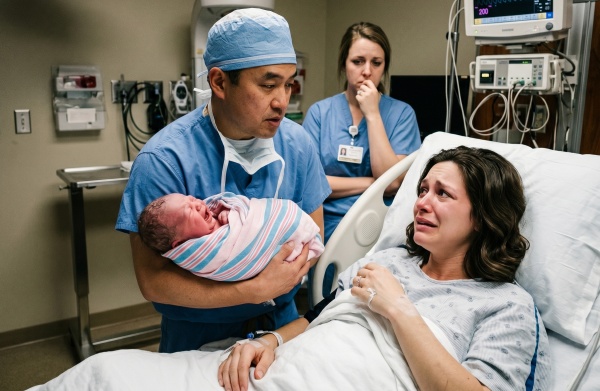
After Our Divorce, I Hid My Pregnancy From My Ex-Husband—Until the Doctor Delivering My Baby Lowered His Mask
I thought my marriage to Nathan was over the day we walked out of the courthouse as strangers. What he didn’t know was that three weeks later, I found out I was carrying the child we had prayed for during years of heartbreak. I kept the pregnancy quiet to protect my baby from his powerful family—until the night I went into labor, and the doctor in the delivery room lowered his mask.
Part 1: The Divorce That Was Supposed to Erase Me
The day my divorce became final, Boston was covered in dirty March snow. The sidewalks outside the Suffolk County courthouse were slick with ice, and the wind cut through my wool coat like it had somewhere personal to be. I remember standing on the courthouse steps with a folder in my hand, realizing twelve years of love had been reduced to signatures, stamped pages, and a judge saying, “So ordered.”
My ex-husband, Dr. Nathaniel Hayes, stood six feet away from me in a charcoal overcoat, looking handsome, tired, and unreachable. Everyone called him Nathan, except his mother, who called him Nathaniel in a tone that made even grown men straighten their backs. He was a pediatric cardiac surgeon at one of Boston’s most respected hospitals, the kind of man strangers trusted before he finished introducing himself.
I had loved him before the reputation. Before the magazine profiles, the charity galas, the hospital wing named after his grandfather, and the donors who spoke to him like he was made of marble. I loved him when he was a sleep-deprived resident eating vending machine dinners and falling asleep with medical journals open on his chest.
Back then, I was Emma Parker, a public school art teacher from Worcester with student loans, thrift store furniture, and a stubborn belief that love could be enough. Nathan said he loved that I was “real.” Later, I learned that some wealthy families admire real women only until those women start wanting real respect.
The Hayes family was old Boston money. Not loud money, not flashy money, but the quiet kind that lived behind brick townhouses, sat on hospital boards, and treated last names like currency. Nathan’s mother, Vivian Hayes, never forgave me for marrying her son without pedigree, connections, or a family trust.
She never said I was beneath them directly. That would have been too crude for Vivian. Instead, she asked where my parents vacationed, whether my father’s auto repair shop was “still operating,” and if teaching elementary school was something I planned to continue “after Nathan’s career expanded.”
Nathan always told me she meant well.
That became the first crack in our marriage.
The second crack came when we started trying for a baby. For three years, I tracked cycles, took vitamins, cried in bathrooms, and smiled through baby showers for other people. Nathan was kind at first, but grief wears differently on people.
I became quieter. He became busier. Vivian became crueler in ways that were hard to prove and impossible to forget.
At one dinner in Beacon Hill, after my second miscarriage, Vivian placed her wineglass down and said, “Some women are simply not built for the kind of legacy this family carries.”
Nathan heard it.
He said nothing.
That silence stayed married to me longer than he did.
By our sixth wedding anniversary, Nathan was barely home. He slept at the hospital, stayed late for surgeries, attended donor dinners, and returned to our brownstone smelling like antiseptic, expensive bourbon, and distance. When I asked if he still wanted our life, he said he did not know what life I meant.
Then, one November evening, he came home with a face I did not recognize. He stood in our kitchen while I stirred soup on the stove and told me we had become “too broken to repair.” He said he cared about me, but he could not keep living in sadness.
I asked if there was someone else.
He looked offended, which was not the same as looking innocent.
“There’s no one else,” he said. “There’s just no us anymore.”
The divorce moved quickly because neither of us had the energy to fight in public. I kept my retirement account, my car, and enough from the settlement to rent a small apartment near Cambridge. Nathan kept the brownstone, the social circle, the family name, and the version of our marriage that made him look noble and exhausted.
Vivian sent me a note two weeks after the papers were filed. It was written on thick stationery and delivered by courier, because apparently cruelty needed presentation.
Emma, I hope you find a life more suited to your expectations. Nathan deserves peace.
I tore it in half, then taped it back together and gave it to my attorney. Not because it mattered legally, but because I wanted proof that I had not imagined the way that family smiled while cutting.
On the day the divorce finalized, Nathan and I stood outside the courthouse without knowing how to say goodbye.
“I hope you’ll be okay,” he said.
I looked at him then, really looked. At the man I had loved, defended, and waited for. At the surgeon who could hold a child’s heart in his hands but could not hold mine with any courage.
“I already had to be,” I said.
He flinched.
Then I walked away.
Three weeks later, I fainted in the middle of my classroom while helping a second grader glue paper feathers onto a cardboard owl. The school nurse took my blood pressure, asked careful questions, and finally told me to take a pregnancy test. I laughed because the alternative was crying in front of twenty-two children and a half-finished bulletin board.
That evening, alone in my apartment bathroom, I watched two pink lines appear.
I sat on the tile floor for nearly an hour.
Pregnant.
After the divorce. After the miscarriages. After Nathan had decided our sadness was too heavy to carry. After Vivian had implied my body had failed her precious bloodline.
I was pregnant with Nathan’s child.
My first instinct was to call him.
My second instinct was to protect the baby from every person who had ever made me feel like my worth depended on producing one.
I did not call that night.
Instead, I placed both hands over my stomach and whispered, “If you’re here, I’m here too.”
Part 2: The Secret I Carried
I told my doctor first. Then my attorney. Then my best friend, Maya, who drove from Somerville with ginger tea, saltines, and the expression of a woman ready to commit several legal but emotionally satisfying acts on my behalf. She found me sitting on my couch, staring at the ultrasound referral like it might vanish if I blinked.
“You have to tell him eventually,” Maya said gently.
“I know.”
“But not today?”
I shook my head. “Not today.”
My OB, Dr. Patel, understood why I was cautious. Given my history of pregnancy loss, she said we would monitor everything carefully. There would be extra appointments, more scans, more bloodwork, and no unnecessary stress if we could help it.
Unnecessary stress had a name.
Several names, actually.
Nathan. Vivian. Hayes.
Legally, I knew I could not pretend Nathan did not exist forever. Massachusetts courts cared about paternity, child support, custody, parenting time, and the best interests of the child. My attorney, Laura Brennan, was clear about that during our first meeting after I told her.
“You are not required to make a dramatic announcement while you’re medically fragile,” Laura said. “But once the baby is born, paternity and parenting rights will need to be addressed properly. If you choose to notify him during pregnancy, do it through counsel. No emotional hallway conversations. No late-night calls.”
I nodded.
“What do you want, Emma?” she asked.
That question almost made me cry because for years everyone had asked what Nathan needed, what Vivian expected, what the Hayes family would think. Very few people had asked what I wanted.
“I want this baby safe,” I said.
“Good. Then every decision starts there.”
For the first trimester, I told almost no one. I went to work, taught art, graded projects, and threw up every morning before 7:15. My students noticed I was eating crackers constantly and decided I must really love crackers.
At ten weeks, I heard the heartbeat.
It was fast, stubborn, and real.
I cried so hard that Dr. Patel handed me tissues without saying anything. Some doctors know when silence is the most respectful response.
At twelve weeks, I wrote Nathan a letter.
Not a text. Not an email. A letter my attorney reviewed before sending. It said I was pregnant, the timing indicated he was the father, and I was receiving medical care. It said future communication should go through Laura’s office until I was ready for direct contact.
Laura sent it to Nathan’s divorce attorney by certified mail.
Two weeks later, it came back.
Not accepted.
Laura called his attorney’s office and was told he no longer represented Nathan in personal matters. She sent a second notice to the Hayes family office, which had handled certain settlement communications. That one disappeared into silence.
Then Vivian called me.
I almost did not answer, but some part of me wanted to know whether poison still sounded the same through a phone.
“Emma,” she said. “This is a very unfortunate attempt.”
I stood in my kitchen with one hand on the counter. “Attempt at what?”
“At remaining attached to my son.”
My stomach turned, partly from pregnancy and partly from rage.
“I’m pregnant, Vivian.”
“So your letter claims.”
“The medical records will support it.”
Her voice chilled. “Nathan is finally moving forward. I will not allow you to drag him back into instability because you are lonely.”
That was when I understood.
She had received the notice. Whether Nathan had seen it, I did not know. But Vivian had decided that if she controlled the doorway, she could control the truth.
“You don’t get to decide whether your son is informed,” I said.
“And you don’t get to use a pregnancy to regain access to a life that is no longer yours.”
I hung up shaking.
Laura documented the call. She sent another letter, this time to Nathan’s hospital office marked personal and confidential. I never received confirmation that he saw it. I also never received a response.
At sixteen weeks, Dr. Patel told me the baby was a boy.
I laughed through tears.
A son.
Nathan’s son.
For one painful moment, I imagined telling him in another life. The life where he would have pulled me into his arms, pressed his hand to my belly, and cried because we had survived the years of loss. The life where his mother’s voice was not louder than his conscience.
That life was gone.
So I built a different one.
I rented a larger apartment in Brookline near a good pediatric practice and a park with maple trees. Maya helped me assemble a crib while cursing at the instruction manual. My father drove in from Worcester with a toolbox and pretended not to cry while painting the nursery soft green.
My mother bought tiny socks in packs of twelve because she said babies lost socks like grown men lost common sense.
I worked as long as I could. My principal adjusted my schedule for appointments, and the school community protected my privacy with the fierce loyalty only teachers understand. No one posted photos. No one tagged me online. No one fed gossip to people who did not deserve a seat in my life.
But Boston is smaller than people think.
At twenty-four weeks, I saw Nathan across a hospital lobby.
I had gone to a maternal-fetal medicine appointment at the same medical center where he worked, because Dr. Patel wanted the best imaging team available. I was standing near the elevators, one hand on my belly, when the doors opened and Nathan stepped out in scrubs.
For three seconds, time stopped.
His eyes dropped to my stomach.
Then back to my face.
He looked stunned. Not angry. Not suspicious. Stunned in a way no actor could fake.
“Emma?” he said.
Before I could answer, another doctor called his name from down the hall. A nurse handed him a chart. The elevator doors began closing between us.
I could have stepped forward.
I could have said, “Yes, Nathan, this is your son.”
But my throat closed, and the doors shut.
That night, my phone rang from an unknown number.
I did not answer.
A voicemail appeared.
His voice was low, shaken, almost unrecognizable.
“Emma, it’s me. I saw you today. Please call me. If what I think is true, I need to know.”
I listened to it five times.
Then I sent it to Laura.
Her response was simple.
If you are ready, we can arrange a structured conversation. If you are not, we can respond through counsel. You do not have to be ambushed into vulnerability.
I was not ready.
Not because Nathan did not have a right to know. He did. But because I knew the moment he entered the pregnancy, Vivian would try to enter with him. I needed boundaries strong enough to survive them both.
Laura sent a formal response confirming the pregnancy and stating that paternity would be addressed legally. Nathan replied through a new attorney within forty-eight hours.
He wanted a conversation.
I agreed to one phone call with both attorneys present.
The call lasted twenty-two minutes.
Nathan’s voice broke when he asked, “Is the baby mine?”
“Yes,” I said.
Silence.
Then, softer, “How long have you known?”
“Since three weeks after the divorce.”
He inhaled sharply. “Why didn’t you tell me?”
“I tried through proper channels. Your mother intercepted at least one communication and called me to accuse me of manipulation.”
His attorney went quiet.
Nathan did too.
When he spoke again, his voice was colder, but not at me. “My mother called you?”
“Yes.”
Another silence.
Then he said something I had waited years to hear in different forms.
“I’m sorry.”
I closed my eyes.
The apology was too small for the damage, but it was the first honest thing he had given me in a long time.
We agreed to communicate through attorneys until after the birth. Nathan asked for updates. I agreed to provide basic medical updates through Laura, but no direct involvement at appointments. That boundary hurt him. It also protected me.
The pregnancy continued.
So did life.
I taught children how to mix colors, bought a rocking chair, argued with insurance, washed tiny onesies, and learned to sleep on my left side with three pillows. Every night, I placed my hand on my belly and talked to my son.
I told him about rain on classroom windows.
I told him about his grandmother from Worcester, who made the best blueberry pancakes in Massachusetts.
I told him he was wanted.
I did not tell him that his father was a man who saved children for a living and still had to learn how to show up for his own.
Part 3: The Doctor Who Lowered His Mask
I went into labor during a thunderstorm in late August.
Not gentle labor, not the cinematic kind where a woman grips a countertop and says, “I think it’s time.” It started with a sharp pain at 2:07 a.m., followed by a wave of pressure that made me sit straight up in bed and whisper a word my mother would have pretended not to hear.
I was thirty-six weeks and two days pregnant.
Close enough to hope. Early enough to worry.
My water broke ten minutes later.
Maya answered her phone on the first ring because best friends develop a sixth sense for disaster. She was at my apartment in twelve minutes, wearing sweatpants, rain boots, and the expression of someone prepared to fight nature itself.
“Hospital bag?” she asked.
“By the door.”
“Car seat?”
“Already installed.”
“Panic?”
“Trying not to.”
“Great. We’ll schedule that for later.”
By the time we reached the hospital, the rain was coming down so hard the emergency entrance looked blurred behind sheets of water. A nurse took one look at me and moved quickly. Within minutes, I was in a labor room, hooked to monitors, trying to breathe while thunder rolled over Boston.
The baby’s heart rate dipped once.
Then again.
Dr. Patel was not on call that night. The attending OB, Dr. Monroe, was calm but serious. She explained that they would monitor closely, but if the baby showed signs of distress, we might need to move fast.
Move fast.
Those two words are polite medical language for fear with shoes on.
I asked Maya to call my parents.
Then I looked at Laura’s contact in my phone.
“Do we call Nathan?” Maya asked quietly.
I closed my eyes through another contraction. “Not yet.”
Ten minutes later, the baby’s heart rate dropped again and stayed low long enough for the room to change. Nurses moved with purpose. Dr. Monroe’s voice became firmer. Someone adjusted my IV. Someone else called for the neonatal team.
“We need to go to the OR,” Dr. Monroe said. “Emma, we’re going to take good care of you and your baby.”
I nodded because nodding was easier than speaking.
The operating room was bright, cold, and full of people whose names I could not hold onto. A blue drape went up. Maya was allowed near my head in a cap and gown, her eyes wide but steady. I kept asking if the baby was okay.
“He’s coming,” someone said.
Then pressure.
Then a cry.
Small, sharp, furious.
My son’s first sound split the room open.
I started sobbing immediately.
“Is he okay?” I asked. “Is he okay?”
A masked doctor from the neonatal team stood near the warmer, leaning over my baby with focused hands. I could see only his profile at first, the cap, the mask, the protective shield, the posture of someone trained to move without wasting motion.
The room blurred with tears.
Then the doctor turned.
He looked at me.
For one second, everything stopped again.
Slowly, he lowered his mask.
Nathan.
My ex-husband.
The father of my child.
The man I had divorced, hidden from, missed, hated, loved, and tried desperately not to need was standing in the operating room holding a stethoscope near our newborn son.
His face had gone pale.
“Emma,” he whispered.
Maya’s hand tightened around mine. “Oh my God.”
Dr. Monroe looked between us, suddenly understanding something the chart had not prepared her for. Nathan immediately stepped back from the warmer, professional instincts fighting personal shock.
“I was called for neonatal support,” he said to the room, voice unsteady but controlled. “I need another attending to take over if available. Conflict of interest.”
That sentence mattered.
Even in the chaos, even with his eyes fixed on the baby, he knew the line. He knew he could not simply become my child’s doctor because fate had put him in the room.
Another neonatologist, Dr. Stein, stepped in within moments. Nathan gave a concise medical summary, then moved aside. He did not touch me. He did not ask personal questions. He did not turn my delivery into his emotional scene.
But his eyes never left the baby.
Our son cried again, louder this time.
“He’s breathing well,” Dr. Stein said. “A little small, but strong. We’ll take him to the NICU for monitoring.”
“Can I see him?” I asked.
A nurse brought him close for just a few seconds, wrapped in a blanket, face red and furious. He had a tiny crease between his brows, like he was already disappointed in hospital administration.
Nathan made a sound that was almost a laugh and almost a sob.
“He looks like my brother did,” he said softly, then caught himself. “I’m sorry.”
I looked at him through exhaustion, medication, fear, and the strange mercy of our son being alive.
“His name is Samuel,” I said.
Nathan closed his eyes.
When he opened them, they were wet.
“Samuel,” he repeated.
Then the nurse took the baby to the NICU, and the room became medical again. Stitches. Blood pressure. Warm blankets. Recovery instructions. The ordinary machinery of survival.
I did not see Nathan again until four hours later.
I was in a recovery room, trembling under heated blankets while Maya updated my parents. My body felt like it had been taken apart and reassembled by people in a hurry. My heart was somewhere down the hall in the NICU.
A soft knock came at the door.
Maya looked at me.
I nodded.
Nathan stepped inside, no mask now, still in scrubs. He looked wrecked. Not elegantly sad, not polished for donors or hospital boards. Wrecked like a man who had just watched the truth arrive six pounds and one ounce at a time.
“I’m not here as a doctor,” he said. “I’m here because Laura said you agreed I could come in for five minutes.”
Of course Laura had managed this already.
I nodded again.
He stood near the door, as if afraid moving closer would break some rule.
“How is he?” I asked.
“Stable,” he said quickly. “Dr. Stein is managing him. Mild respiratory support, mostly observation. He’s strong.”
The word strong moved through me like warmth.
Nathan swallowed. “Emma, I need to say something, and then I’ll leave if you want me to.”
I waited.
“My mother received the first letter,” he said. “I didn’t know until tonight. I called her after I saw you at the hospital weeks ago, and she denied everything. I believed there was confusion because I wanted to believe my life was still manageable.”
I stared at him.
“She admitted it tonight?” I asked.
“She admitted enough.”
There was something new in his voice. Not anger exactly. A breaking of loyalty in the place it should have broken years ago.
“I should have protected you from her,” he said. “Long before this. I should have protected our marriage from my own weakness.”
I looked toward the window where rain streaked the glass.
“I needed you to say that when we were married.”
“I know.”
“No,” I said, turning back to him. “You don’t get to know it neatly. You stood there while she made me feel defective. You let me grieve alone. You let me become the problem because it was easier than confronting your family.”
His face tightened, but he did not defend himself.
“You’re right,” he said.
Those two words were so unfamiliar from him that I almost did not recognize them.
“I’m not asking to be forgiven,” he continued. “I’m asking to be allowed to become Samuel’s father the right way. Legally, consistently, with boundaries. Whatever you and your attorney require.”
I studied him.
The old Emma would have softened immediately. She would have seen his tears and rushed to comfort him. She would have mistaken remorse for repair.
But the woman in that hospital bed had carried Samuel alone. She had survived morning sickness, fear, Vivian’s cruelty, legal letters, and labor under fluorescent lights. She had learned that love without accountability was just another kind of abandonment.
“You can start,” I said quietly, “by respecting every boundary I set.”
Nathan nodded.
“And by keeping your mother away from my son until I decide otherwise.”
His answer came without hesitation.
“Yes.”
That was the first time I believed something might truly have changed.
Not fixed.
Changed.
Part 4: The Family That Wanted a Legacy
Vivian Hayes arrived at the hospital the next morning.
She did not come to my room first. Of course she didn’t. Vivian went directly to the NICU waiting area wearing pearls, a cream cashmere coat, and the expression of a woman prepared to reclaim property. My father saw her before I did.
He had driven from Worcester at dawn and was holding a cardboard cup of bad hospital coffee when Vivian approached the NICU desk. According to Maya, he stepped in front of her with the calm menace of a man who had fixed engines for forty years and did not intimidate easily.
“I’m here to see my grandson,” Vivian said.
My father looked at her. “You must be confused. Grandmothers who deny babies don’t get automatic visiting hours.”
Maya told me later she nearly applauded.
The NICU followed the approved visitor list. Vivian was not on it. Nathan was, under specific conditions. My parents were. Maya was. Vivian Hayes, queen of Boston charity luncheons, was told by a twenty-five-year-old nurse with a clipboard that she could wait elsewhere.
By noon, Vivian had called Nathan six times.
He did not answer.
At 1:15, she appeared outside my room.
I was holding a breast pump instruction booklet, half-awake, sore, and in absolutely no mood for theater. Maya stood by the window, ready to become a legal problem if necessary.
Vivian looked past her and directly at me.
“Emma,” she said. “This has gone far enough.”
I almost laughed.
“My abdomen was opened less than twenty-four hours ago,” I said. “Choose your next sentence carefully.”
Her mouth tightened.
“I understand emotions are high,” she said. “But that child is a Hayes.”
“That child is Samuel,” I replied. “And you are not welcome here.”
Her eyes flashed. “You have no right to keep him from his family.”
“You mean the family that tried to keep his father from knowing he existed?”
She went still.
Maya quietly lifted her phone, not hiding the fact that she was recording. In Massachusetts, recording laws are strict, so she did not secretly record audio. She simply made it very clear that nothing Vivian did would happen in shadows.
Vivian noticed.
“You always did enjoy making scenes,” she said.
“No,” I replied. “I learned to document them.”
Nathan appeared behind her then.
For a second, he looked like the boy I had met years ago, caught between the woman who raised him and the woman he failed. Then he stepped beside my doorway, not behind his mother.
“Leave,” he said.
Vivian turned slowly. “Nathaniel.”
“No,” he said. “You don’t get to use that voice today.”
Her face changed. Just slightly. Enough.
“This woman hid your child from you.”
“She tried to notify me,” he said. “You interfered.”
“I protected you.”
“You protected yourself from embarrassment.”
The room went silent.
Vivian looked as if he had slapped her, though he had not moved. Maybe truth felt physical to people who had avoided it for decades.
“You are tired,” she said. “You are emotional.”
Nathan’s jaw tightened. “I’m a surgeon, Mother. I know the difference between exhaustion and clarity.”
I watched him closely.
This was the moment our marriage had needed years ago. Not a grand romantic apology. Not flowers, not promises, not charm. Just Nathan choosing the truth when his mother demanded loyalty to a lie.
Vivian looked at me, and for the first time, I saw something like fear beneath the polish.
“You have no idea what you are doing,” she said.
I touched the edge of my blanket.
“I’m protecting my son.”
“Our son,” Nathan said quietly.
I looked at him.
He did not take it back.
Vivian left without another word.
After she was gone, Nathan stayed in the hallway until I told him he could enter. He looked drained, but lighter in a way I did not fully trust yet. People can feel brave after one confrontation and still return to cowardice when the adrenaline fades.
“Thank you,” I said.
He nodded. “I should have done that years ago.”
“Yes.”
He accepted the answer.
That afternoon, Laura came to the hospital with paperwork. Not because I wanted drama, but because babies and boundaries both require documentation. We discussed birth certificate procedures, paternity acknowledgment, temporary communication agreements, and how visitation would work while Samuel remained in the NICU.
Nathan participated without argument.
He asked questions. He listened. He agreed that all decisions would go through me and the medical team, not his mother, not the Hayes family office, not any donor who thought influence could buy access.
When Samuel was two days old, Nathan held him for the first time.
I watched from the NICU recliner, trying to ignore the ache in my body and the deeper ache in my chest. Nathan scrubbed his hands carefully, sat down slowly, and took Samuel like he was afraid even his breathing might be too heavy.
Samuel opened one eye.
Nathan smiled through tears.
“Hi,” he whispered. “I’m late.”
That was the truest thing he could have said.
I looked away before my face betrayed me.
Over the next week, Nathan showed up every day. Not as a dramatic rescuer. Not as a man demanding credit. He came quietly, brought coffee for my parents, asked nurses respectful questions, and learned Samuel’s feeding schedule like it was the most important chart in the hospital.
He also started therapy.
He told me that on the fourth day, standing beside the NICU sink while washing bottles.
“I should have done it before,” he said. “I thought being functional meant I was fine.”
“That’s a very surgeon thing to say.”
He almost smiled. “Probably.”
I did not trust him yet.
But I noticed.
Trust, I learned, does not return because someone cries. It returns in fractions. One kept promise. One respected boundary. One moment of choosing discomfort over denial.
Vivian sent flowers.
I refused delivery.
Then she sent a letter.
Laura read it first and advised me not to respond emotionally. The letter contained phrases like “misunderstandings,” “family unity,” and “the importance of legacy.” It did not contain the words “I’m sorry.”
So I did not answer.
Nathan did.
He sent his mother a message and copied his attorney.
Until you acknowledge what you did and participate in family counseling, you will have no contact with Samuel. Do not contact Emma directly again.
He showed it to me before sending.
I read it twice.
Then I handed the phone back.
“Send it,” I said.
He did.
Part 5: The Life After the Mask Came Down
Samuel came home after twelve days in the NICU.
He was small, healthy, and furious about diaper changes. My apartment filled immediately with bottles, burp cloths, tiny socks, and the particular exhaustion of new motherhood. My mother stayed for two weeks and reorganized my kitchen in ways I still do not understand.
Nathan visited according to the schedule we agreed on.
At first, visits happened with my mother or Maya present. Then, slowly, as Samuel grew and Nathan kept showing up, we adjusted. He learned to change diapers, warm bottles, install a car seat, and accept that being a surgeon did not automatically make him an expert on onesies with impossible snaps.
One evening, when Samuel was six weeks old, Nathan stood in my kitchen holding the baby against his chest while I folded laundry at the table. It was raining outside, soft autumn rain tapping against the windows. The scene felt dangerously close to a life I had once wanted.
Nathan must have felt it too, because he said, “I miss you.”
I kept folding.
“You miss what you lost,” I said.
He was quiet.
“That’s different from missing me.”
He looked down at Samuel, who was asleep with one tiny fist tucked under his chin.
“I deserve that,” Nathan said.
“Yes,” I replied. “You do.”
The honesty did not destroy the room. That surprised me. In my marriage, truth had always felt like a match near gasoline. Now it felt more like opening a window.
The divorce had already happened, so there was no marriage to save in the legal sense. There was only the question of what kind of family we could build from the wreckage. Co-parenting was not romantic. It was schedules, diapers, pediatric appointments, sleep regressions, and lawyers making sure good intentions became enforceable agreements.
Nathan signed the paternity acknowledgment without hesitation.
He agreed to child support based on Massachusetts guidelines, though I earned my own income and did not need his money to survive. Laura reminded me that support belonged to Samuel, not my pride. I listened.
Vivian did not meet Samuel until he was five months old.
By then, she had attended four family therapy sessions with Nathan and had written a letter that, while imperfect, finally included the words “I was wrong.” I did not forgive her. Not then. Maybe not ever in the way people prefer.
But I allowed a supervised meeting in Laura’s office building, of all places, because neutrality has furniture and witnesses.
Vivian wore navy instead of cream. She looked older. When she saw Samuel in my arms, her face changed in a way I had not expected.
Not ownership.
Grief.
“He has Nathaniel’s eyes,” she whispered.
“He has his own eyes,” I said.
She nodded slowly. “Yes. Of course.”
It was not enough. But it was a beginning small enough to be believable.
Nathan never asked me to move back into the brownstone. He never asked me to forget. He asked, months later, if I would consider having dinner with him somewhere public after Samuel’s bedtime, not as his ex-wife, not as Samuel’s mother, but as Emma.
I almost said no immediately.
Then I thought about the man in the operating room lowering his mask, realizing fate had forced truth into his hands. I thought about the man who stepped away from treating his own son because ethics mattered even in shock. I thought about the man who finally told his mother to leave.
“I’ll have dinner,” I said. “But I’m driving myself.”
He smiled faintly. “I figured.”
We went to a small Italian restaurant in the North End on a Tuesday night. Nothing fancy. No donors, no family friends, no Hayes name echoing through the room. Just two people sitting across from each other with bread, olive oil, and too much history between them.
Nathan apologized again.
Not in one sweeping speech. In pieces. For the dinner where Vivian insulted me. For missing appointments. For letting grief become distance. For treating silence as peace. For believing his mother because it was easier than seeing me.
I listened.
Then I told him what my life had been like after he left. The fainting in my classroom. The two pink lines. The fear at every appointment. The letters. Vivian’s call. The loneliness of buying a crib for a baby whose father lived fifteen minutes away and did not know whether he was allowed to exist.
Nathan cried quietly at the table.
I did not comfort him.
But I did stay.
That became our pattern for a while. Honesty without rescue. Co-parenting without pretending. Small conversations that did not erase the past but stopped it from owning every room.
People asked if we got back together.
The answer is complicated, and real life usually is.
We did not remarry in a burst of music and forgiveness. We did not move back into the brownstone or pose for holiday cards as if pain were a misunderstanding. We remained divorced, attended therapy separately, co-parented carefully, and learned who we were without the pressure of saving a marriage that had already died.
But love did not vanish cleanly either.
Sometimes Nathan would arrive for Samuel’s visit and bring coffee exactly the way I liked it, though I had never reminded him. Sometimes I would watch him rock our son to sleep and see the man I once believed in, older now, humbled and trying. Sometimes Samuel would grab both our fingers at once, and the room would go quiet with everything we had lost and everything still possible.
A year after Samuel was born, Nathan asked me to walk with him along the Charles River after a pediatric appointment. It was late summer again, warm and golden, the kind of evening Boston gives you as an apology for February.
Samuel slept in his stroller between us.
Nathan stopped near the water.
“I used to think the worst day of my life was the divorce,” he said.
I looked at him.
“It wasn’t,” he continued. “It was the day I lowered that mask and realized you had carried our son alone because I had made myself unsafe to come to.”
The wind moved across the river.
“That was the day I understood what kind of man I had become.”
I gripped the stroller handle.
“And what kind of man are you now?” I asked.
He looked at Samuel, then at me.
“One who knows he doesn’t get to answer that with words.”
That was a good answer.
Not enough by itself.
But good.
I wish I could say everything became simple after that. It didn’t. Healing is not a straight road, and co-parenting with someone who once broke your heart requires patience sharp enough to draw blood. Some days I trusted Nathan. Some days a memory would rise up and knock the breath out of me.
But Samuel grew.
He learned to smile, then laugh, then clap whenever anyone said “yay.” He had Nathan’s serious brow, my stubborn chin, and a personality that suggested he had been unimpressed with all of us from birth. He loved ceiling fans, mashed sweet potatoes, and pulling Nathan’s hospital badge off his shirt.
The first time Samuel said “Dada,” Nathan looked at me like he had been handed mercy he did not deserve.
Maybe he had.
The first time he said “Mama,” I cried so hard Samuel started crying too, which made Nathan panic and Maya laugh until she had to sit down.
That is family, I think.
Not the polished version Vivian wanted. Not the broken version I feared. Something messier, humbler, built from truth instead of image.
When I think back to the operating room, I do not remember only fear. I remember the bright lights, the thunder outside, Maya’s hand in mine, and the tiny cry that changed everything. I remember Nathan lowering his mask and the shock on his face when he realized the child he had almost missed had arrived anyway.
People might think that was the moment he found out he was a father.
But that is not quite true.
That was the moment he found out fatherhood was not a title waiting for him.
It was a responsibility he would have to earn.
As for me, I used to think strength meant surviving quietly. I thought it meant carrying pain without making other people uncomfortable. I thought it meant being the kind of woman who could lose a marriage, hide a pregnancy, and still show up to work with glue sticks and construction paper.
Now I know strength can be louder than that.
Strength was calling an attorney. Strength was setting boundaries. Strength was telling the father of my child that tears were not enough. Strength was letting Samuel have a father without handing Nathan the keys to my peace.
After our divorce, I secretly carried his child because I was afraid the truth would be taken from me and turned into another Hayes family decision.
But the day I went into labor, the truth arrived on its own.
Six pounds, one ounce.
Crying under hospital lights.
And when the doctor lowered his mask, the past did not disappear.
It finally had to face us.
