I Left My Paralyzed Wife Alone for 7 Days to Be With Another Woman in Miami. When I Came Home to a Dark House and Drag Marks on the Floor, I Finally Understood What Kind of Man I Had Become.
Part 1: The Woman I Married and the Life We Lost
My name is Mark Callahan, and I am writing this from a studio apartment in Wicker Park that still has boxes I haven’t unpacked after three months, because unpacking would mean accepting that this is my life now.
I am thirty-two years old. I work — worked — as a senior account manager at a mid-size financial consulting firm in the Loop in downtown Chicago. I drive a four-year-old Audi that still has a parking pass for a garage I no longer have access to. I own exactly one houseplant, and it is dying, and I have not watered it, and I think that says everything that needs to be said about where I am right now.
I am writing this because I did something unforgivable, and I think the only honest thing left I can do is say it out loud.
My wife’s name is Sarah Callahan. She is thirty years old, and before the accident, she was the kind of person who made you feel like the room got brighter when she walked in. She was a Senior Marketing Executive at a healthcare technology company headquartered on Michigan Avenue. She ran the Chicago Half Marathon two years in a row. She hosted dinner parties on Friday nights where she cooked from scratch and remembered everyone’s dietary restrictions and made it look effortless. She was the person her friends called first when anything happened — good news, bad news, any news — because she had the rare gift of making people feel genuinely heard.
She was also, for six years, the person I called first.
We met at a mutual friend’s birthday party in Lincoln Park when we were both twenty-five. She was arguing with someone about a documentary she had just seen, completely unself-conscious, completely certain of her position, and I stood at the edge of the conversation for ten minutes just watching her think. I asked for her number before I left. She gave it to me with the specific confidence of someone who had already decided the outcome.
We dated for two years. We got engaged at Millennium Park on a Sunday morning in November, just the two of us, before the tourists arrived. We married at a small ceremony at a venue in Geneva, Illinois, with the Fox River behind us and about sixty people who genuinely loved us both.
I want you to understand who Sarah was before I tell you what happened to her, because I think the world has a way of reducing people to their circumstances, and Sarah deserves more than that.
The accident happened on a Friday evening in October, fourteen months before I am writing this.
She was driving home from work on I-90 near the Edens interchange when a driver in a pickup truck ran a red light at an on-ramp and struck her driver’s side door at approximately fifty miles per hour. The impact was catastrophic. The other driver walked away with a broken collarbone. Sarah was airlifted to Northwestern Memorial Hospital.
She survived.
But the spinal cord injury at the T10 level left her paralyzed from the waist down.
I was at the hospital before the helicopter landed. I remember standing in the waiting area with her mother and father, and the attending trauma surgeon coming out to speak with us, and the specific way the world narrows to a single point when someone tells you that the person you love will never walk again.
I held Sarah’s hand in the ICU and told her I loved her and that we would figure it out together.
I meant it when I said it.
I want to be clear about that, because what came after does not change what I felt in that moment. I meant every word. I just did not yet understand what “figuring it out together” would actually cost.
Part 2: The Weight of a Life I Didn’t Choose
The first three months after Sarah came home from the Shirley Ryan AbilityLab rehabilitation center were the hardest of my life.
We had the house modified — grab bars in the bathroom, a ramp at the front entrance, the bedroom furniture rearranged to accommodate the wheelchair. I watched YouTube tutorials on proper transfer techniques, on pressure sore prevention, on catheter care. I became, in the space of about ninety days, a person I had not planned to be.
I want to be honest about what that looked like, because I think people who have not done it do not fully understand the specific texture of full-time caregiving.
I worked fifty hours a week at the firm because we needed my health insurance, and Sarah’s medical bills in the first year exceeded $340,000, of which our insurance covered roughly seventy percent after deductibles and co-pays. I came home from work and made dinner, because Sarah could cook some things from her chair but the fatigue from her physical therapy and the medications made it difficult most evenings. I did the laundry, the grocery shopping, the household maintenance, the medication management, the insurance appeals — the endless, grinding administrative work of keeping a disabled person’s life functioning in a system that is not designed to make it easy.
At night, we lay in our king-sized bed in the dark, and the silence between us was the kind that has weight.
Sarah was depressed. Clinically, formally, documented by her psychiatrist at Northwestern. She had lost not just her mobility but her identity — the runner, the executive, the dinner party host, the woman who moved through the world with effortless confidence. She spent long hours in her chair by the window in the living room, looking out at the street, not watching anything in particular. She stopped calling her friends back. She stopped asking about my day.
I grieved for her. I genuinely did. But I also, and this is the part I am most ashamed of, began to grieve for myself.
I was thirty-one years old. I was healthy. I had a body that worked and a life that had been, until fourteen months ago, full of ordinary pleasures — weekend runs along the lakefront trail, dinners out in Andersonville, Saturday mornings with nowhere to be. All of that had been replaced by a schedule, a routine, a set of responsibilities that never paused and never acknowledged that I was also a person with needs.
I told myself I was not resentful. I told myself I was managing.
I was lying to myself on both counts.
The resentment built the way debt builds when you stop opening the statements — quietly, invisibly, until the number is so large it stops feeling real. I did not resent Sarah. I want to be precise about that. I resented the situation, the accident, the unfairness of it, the way our life had been taken from us by a stranger running a red light on a Friday evening. But resentment does not stay neatly in its lane. It spreads. And somewhere in the spreading, I stopped seeing Sarah clearly and started seeing only the weight of what her care required.
That was the crack in the foundation.
That was where Emily found her way in.
Part 3: The Escape I Told Myself I Deserved
Emily Dawson was a junior associate at my firm. She was twenty-eight, smart, ambitious, and completely unburdened by anything resembling the life I was living. She laughed easily. She asked questions about my work with genuine interest. She remembered small things I mentioned in passing and brought them up weeks later, which felt, to a man who had been largely invisible in his own home for over a year, like being seen for the first time in a long time.
It started with coffee. Then lunch. Then the kind of conversations in the parking garage after work that go longer than they should, where she would put her hand on my arm and say things like, You’re carrying so much, Mark. You’re allowed to need something for yourself too.
Those words were water to a man who had been telling himself he was not thirsty.
I knew what was happening. I am not going to pretend I didn’t. I am a grown adult with a functioning moral compass, and I knew exactly what those parking garage conversations were building toward. I made a choice, repeatedly, to keep walking toward it anyway. That is the truth, and I owe it to Sarah to say it plainly rather than dress it up in the language of weakness and circumstance.
The affair began in February. By March, Emily was suggesting what she called a “work trip” — a conference in Miami that was real, that I was actually registered for, but that she proposed we extend into a full week away together. Sun, ocean, distance from everything.
I stood in the living room one evening and looked at Sarah asleep in her chair, the television flickering, and I felt something I am deeply ashamed of: a surge of anger at her. Not at the accident. Not at the situation. At her. At the specific unfairness of being thirty-two years old and standing in a living room that smelled like medication and watching my wife sleep in a wheelchair and knowing this was my life indefinitely.
It was a selfish, ugly thought. I knew it was selfish and ugly in the moment I had it. I had it anyway.
I told Sarah I had a mandatory business trip. I stocked the refrigerator. I placed water bottles on the nightstand within her reach. I set up her weekly medication organizer. I told myself she could manage — she had been transferring herself to the bathroom independently using the grab bars we had installed, and she had her phone, and the neighbors were nearby.
I told myself it was just a week.
I told myself I deserved this.
I want to sit with that phrase for a moment, because I have thought about it every single day since I came home: I deserved this. The arrogance of it. The specific moral failure of a man who has a paralyzed wife at home and tells himself that a week in Miami with another woman is something he has earned.
I boarded the flight to Miami International Airport on a Sunday morning and turned my phone to do not disturb before the wheels left the ground.
For seven days, I was just Mark. Not a caregiver. Not a husband. Not a man drowning in obligation and grief and resentment. I sat by the pool at a hotel on Collins Avenue and drank rum cocktails and laughed at things that weren’t particularly funny and let myself believe, for one week, that the life I had left behind in Chicago was someone else’s problem.
I buried the guilt under the sand, the way Emily said.
I did not think about what Sarah was doing.
I did not let myself think about it.
That was the choice. Not the affair, not the trip — the deliberate, sustained decision not to think about my paralyzed wife alone in our house in Ravenswood while I ordered another drink by the pool.
That was the thing I cannot forgive myself for.
Part 4: What the Dark House Told Me
I flew back into O’Hare on a Tuesday evening. It was raining — the flat, gray, relentless kind of Chicago rain that feels personal. I took an Uber from the terminal, and somewhere on the Kennedy Expressway, the guilt that I had successfully suppressed for seven days began to surface. Not dramatically. Just a low, persistent unease, like a sound you can’t quite identify.
The house was dark when we pulled into the driveway.
I told myself Sarah had gone to bed early. I told myself the darkness meant nothing.
I unlocked the front door and called out. “Honey? I’m home.” My voice sounded wrong even to me — too bright, too practiced, the voice of a man performing normalcy.
Silence.
The air inside the house was stale in a way that told me immediately that no windows had been opened in days. I walked through the living room. Empty. I walked to the bedroom and turned on the light.
My suitcase dropped from my hand.
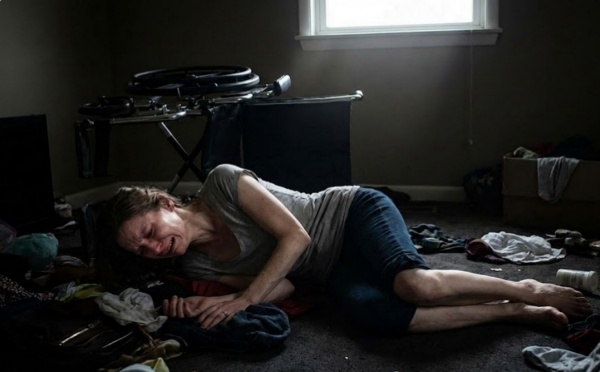
The bedsheets were half on the floor, twisted and tangled. Sarah’s wheelchair was tipped against the dresser, one wheel caked with what looked like dried mud from the back patio. The water jug on the nightstand was overturned and empty. A bottle of her pain medication was on its side, pills scattered across the carpet.
I ran to the bathroom. Empty. The kitchen. Empty.
The back door to the patio was open. Rain had been blowing in for what looked like hours, soaking the hardwood floor in a dark, spreading stain.
I looked down at the floor.
There were scuff marks leading from the hallway toward the back door. Not footprints. Drag marks. The faint, heartbreaking scratches of someone who had pulled themselves across the floor on their hands, inch by inch, because they had no other way to move.
I fell to my knees in the middle of my own kitchen and could not breathe.
My phone buzzed. Unknown number.
The man on the other end identified himself as Mr. Gerald Henderson, seventy-one years old, who lives in the brick two-flat directly across Hermitage Avenue from our house. His voice was the voice of a man who had decided what he thought of me before he dialed.
“Your wife is at Northwestern Memorial,” he said. “I found her yesterday morning. She had pulled herself out onto the back porch. She was hypothermic and severely dehydrated. She’d been out there for hours.”
I could not speak.
“She told me you were on a business trip,” he said. The word business carried everything he was not saying directly. “I called the ambulance. I thought about calling the police for caregiver abandonment, but I decided to let the hospital make that call. You should know they’ve already notified social services.”
He hung up.
I do not remember the drive to the hospital. I have a vague memory of the parking garage, of the elevator, of a nurse directing me to a room on the fourth floor. I remember the doctor intercepting me in the hallway — a tall man in his fifties who looked at me with the specific expression of a physician who has decided not to pretend.
“She has a severe kidney infection secondary to dehydration,” he said. “She fell attempting to transfer to the bathroom on day two and could not get back into the chair. She was on the floor for approximately eighteen hours before she was able to pull herself to the back door.” He paused. “The physical injuries are treatable. The social services referral is already in process. I need you to understand the seriousness of what we’re looking at legally.”
Under Illinois law, leaving a disabled adult without adequate care or supervision can constitute vulnerable adult abuse or neglect, a Class 3 felony under the Illinois Adult Protective Services Act. The social worker who met with me that evening was professional and thorough. She documented everything. She told me the investigation would determine next steps.
I stood in the hallway of Northwestern Memorial Hospital and understood, for the first time with complete clarity, what I had done.
While I was on Collins Avenue ordering another cocktail, my wife was dragging her paralyzed body across a cold hardwood floor, screaming for help that did not come, for eighteen hours.
There is no version of that sentence that I can soften.
There is no context that changes it.
Part 5: What She Said and What I Carry
I walked into her room.
Sarah looked smaller than I had ever seen her. The pallor of her skin under the fluorescent light, the IV line in her arm, the monitor beside the bed — all of it hit me simultaneously, and I crossed the room and fell to my knees beside her bed and reached for her hand and said her name and told her I was sorry in the broken, useless way that people say they are sorry when they know the word is not sufficient for what they have done.
She let me hold her hand for a moment.
Then she pulled it away.
“I know about Emily,” she said.
Her voice was quiet. Not angry — something past anger, something that had already moved through anger and come out the other side into a kind of terrible clarity.
“You left your iPad at home,” she said. “The messages kept coming through on the lock screen. I couldn’t reach it from the floor.”
She turned her head toward the ceiling.
“For the last year,” she said, “I hated myself every single day. I felt like a burden. I felt guilty for what the accident had done to your life. I used to lie awake at night thinking about how unfair it was to you, that you were stuck with me, that you deserved better than this.” Her voice was steady. Devastatingly steady. “When I was on that floor, waiting, I had a lot of time to think. And I realized something.”
She looked at me.
“You aren’t a victim, Mark. You made choices. Every single day for months, you made choices. And then you made the choice to leave.”
“I will fix this,” I said. “I will hire a full-time nurse. I will never leave again. I will spend the rest of my life—”
“I’ve already signed the papers,” she said.
I stopped.
“My parents are driving up from Columbus tomorrow. I’m being transferred to a rehabilitation facility near them in Ohio when I’m medically stable. I’ve retained an attorney. I’m filing for divorce on grounds of abandonment and cruel treatment under Illinois law.”
“Sarah—”
“On the day of the accident,” she said, and her voice cracked for the first and only time, “I lost my legs. I grieved that. I’m still grieving it. But last week—” She stopped. Collected herself. “Last week I lost my husband. And I think that is the loss I will carry longer.”
I stayed in the hospital for two more hours. I said things that did not matter. She listened with the patience of someone who has already made a decision and is simply waiting for the conversation to end.
Her parents arrived the next morning. Her father did not speak to me. Her mother looked at me with an expression I will carry for the rest of my life — not hatred, which would have been easier. Grief. The grief of a woman looking at the person who was supposed to protect her daughter and understanding completely what he had chosen instead.
The divorce was filed in Cook County Circuit Court six weeks later. Under Illinois law, abandonment and mental cruelty are recognized grounds for divorce, and the social services investigation, the hospital records, and the police report Mr. Henderson ultimately filed provided documentation that Sarah’s attorney used effectively. The settlement was not favorable to me. It should not have been.
The social services investigation resulted in a formal finding of neglect. I was not criminally charged — the Cook County State’s Attorney’s office reviewed the case and determined that the circumstances, while serious, did not meet the threshold for criminal prosecution given that Sarah had ultimately received medical care and was expected to make a full recovery from the acute injuries. I am aware of how fortunate I am in that specific regard, and I do not take it lightly.
My firm’s HR department learned about the affair and the circumstances surrounding Sarah’s hospitalization through the combination of the social services investigation, the divorce filing, and the particular speed at which information travels in corporate Chicago. I was terminated for conduct unbecoming a company representative. Emily ended things the week the story circulated through the office. She said it had gotten “too complicated.” I did not argue.
I am currently living in a 600-square-foot studio in Wicker Park. I have a new job — less senior, less money, a long commute on the Blue Line every morning. I have a therapist I see on Thursday evenings, a man in Ukrainian Village who has the specific gift of asking questions I do not want to answer and waiting patiently until I do.
I heard from a mutual friend last month that Sarah is at a rehabilitation center outside Columbus and that she has begun working with a new physical therapy protocol that has shown real results for patients with her level of injury. She is learning to use a standing frame. She is fighting, the way she always fought, the way I forgot she was capable of fighting when I was too busy drowning in my own resentment to see her clearly.
She is going to be all right.
I do not know yet if I am.
I stare at the ceiling of my studio apartment most nights and replay the moment I opened the front door to a dark house. I replay the drag marks on the floor. I replay her voice saying you aren’t a victim, Mark, you made a choice. I replay the expression on her mother’s face.
I thought I was trapped. I thought I was the one suffering. I thought the weight of caregiving entitled me to something — a break, an escape, a week of not being responsible for anyone but myself.
What I did not understand, and what I understand completely now, is that the weight I was carrying was also a privilege. It was the privilege of being needed by someone who trusted me with her life. It was the privilege of being the person she counted on when she had no one else to count on.
I threw that away for seven days on Collins Avenue.
And I will spend a long time — maybe the rest of my life — understanding the full cost of that.
There is a version of this story where I am the sympathetic figure. The burned-out caregiver, the lonely husband, the man who cracked under impossible pressure. I understand why that version is tempting, because it is easier than the truth.
The truth is simpler and harder: I had someone who loved me and trusted me and needed me, and I chose myself instead. Not once — every single day for months, and then for seven days in Miami, and then in the moment I walked out the front door with a packed bag and told myself she would be fine.
She was not fine.
And the man I was when I walked out that door is not a man I recognize or want to be.
I do not know what comes next for me. I know what comes next for Sarah, and it is something hard and brave and entirely her own, built without me, which is exactly what she deserves.
If you are reading this and you have someone who loves you — someone who trusts you with their vulnerability, their fear, their worst days — I am asking you to hold that carefully. Not because it is easy. Not because caregiving is not genuinely, crushingly hard. But because the moment you decide that your comfort matters more than their safety, you have already lost the thing you were trying to protect.
Loyalty is not a fair-weather commitment. It is not something you practice when it costs you nothing.
It is exactly what you do on the days when it costs you everything.
I know that now.
I learned it too late.
