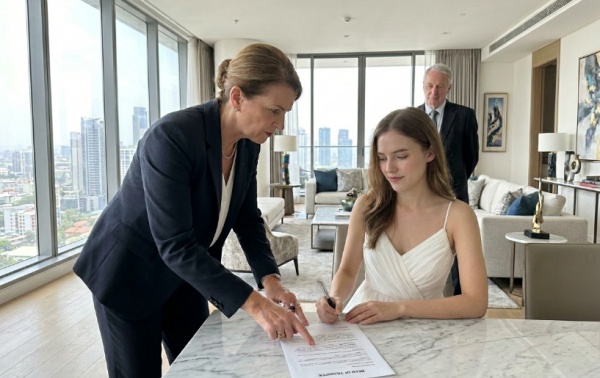
Before My Wedding, My Mom Pressured Me to Transfer My $2 Million Condo Into Her Name and Told Me to Keep It Secret. I Thought She Was Overreacting — Until My Mother-in-Law Grabbed the Microphone in Front of 200 Guests and Announced It Was Going to Be Her Retirement Home.
Part 1: The Apartment, the Pressure, and the Secret I Almost Didn’t Keep
There are moments when the people who love you see something you cannot yet see, and the gap between what they know and what you are willing to believe is exactly wide enough for a disaster to walk through.
My name is Vivian Chen. I am thirty-four years old, a senior software engineer at a tech company in San Francisco, California, and I am writing this from the living room of a condominium in the South Beach neighborhood that is, as of fourteen months ago, legally and entirely and irrevocably mine — a fact that I did not fully appreciate until the evening of my engagement party, when a woman I had known for eight months picked up a microphone in front of two hundred people and announced that my home was going to be hers. I am telling this story because I believe that the women who are navigating the specific, complicated terrain of family pressure and financial decisions in the context of a new relationship deserve to hear what happened when someone listened to her mother, and what would have happened if she hadn’t. And because my mother, who is sixty-one years old and was born in Chengdu and has lived in the Sunset District of San Francisco for thirty years and who has always understood things about people that I have been slower to understand, deserves to have the record reflect that she was right.
She was completely, entirely, one hundred percent right.
The condominium is a two-bedroom unit on the fourteenth floor of a building in the South Beach neighborhood, with views of the Bay Bridge that change with the light and that I have never once taken for granted since the morning I closed on it four years ago. I purchased it for $1.87 million in a market that had briefly softened enough to make it accessible to a thirty-year-old software engineer with a strong salary, a substantial down payment accumulated over six years of disciplined saving, and a fixed-rate mortgage that my financial advisor had helped me structure in a way that was aggressive but manageable. It was the largest financial decision of my life, and I had made it alone, with the specific, grounded confidence of a woman who had worked for everything she had and who understood, at a cellular level, that the apartment was not just a home — it was the foundation of her financial future, the physical embodiment of a decade of choices, the thing that no one could take from her.
I had been engaged to a man named Eric Huang for four months when my mother called me on a Tuesday evening in February and asked me to come to her house in the Sunset District the following Saturday morning.
Eric and I had met two years earlier at a mutual friend’s birthday dinner in the Mission District, and he was — I want to say this carefully, because the story is not about Eric being a villain, and accuracy matters — a genuinely good person in many respects. He was thirty-six, a financial analyst at an investment firm in the Financial District, and he was kind and funny and attentive in the early months of our relationship in the specific, effortful way of a man who is serious about a woman and wants her to know it. We had gotten engaged in October at a dinner in Napa Valley, and the engagement had been received by both families with the specific, celebratory energy of two Chinese-American families in San Francisco who are glad that their children have found each other and who are looking forward to the wedding with the particular enthusiasm of people for whom weddings are significant community events.
My mother had met Eric’s family — his parents, Frank and Helen Huang, and his younger brother Kevin — at a family dinner in November, three months before she called me to come to the Sunset District on a Saturday morning.
She had been quiet about them since.
Not in the way she was quiet about things she approved of — in the specific, watchful way she was quiet about things she was still assessing, still turning over, still looking at from different angles before she decided what she thought.
I had noticed the quiet.
I had not asked about it.
On the Saturday morning in February, I drove to the Sunset District and sat at my mother’s kitchen table with tea, and she told me what she had been thinking about since November.
Part 2: What My Mother Saw That I Didn’t
My mother’s name is Patricia Chen, and she is a woman who has spent thirty years in San Francisco navigating the specific, complicated terrain of immigrant life with the practical intelligence of someone who has learned that the world does not always announce its intentions and that the people who survive it well are the people who pay attention to what is not being said as carefully as they pay attention to what is.
She sat across from me at her kitchen table and told me, in the direct, unvarnished way that is her particular form of love, what she had observed about the Huang family at the November dinner and in the conversations that had followed.
She had noticed the way Helen Huang talked about Eric’s future — not as a future that Eric was building, but as a future that the family was building together, with the specific, collective framing of a woman who has a very clear idea of how the resources of the next generation are going to be organized and who has been thinking about it for a long time. She had noticed the way Frank Huang had asked, with the specific, casual precision of a man who asks important questions in the register of small talk, about the South Beach condominium — its location, its size, its approximate value, the terms of the mortgage. She had noticed the way Helen had said, at one point in the evening, that she and Frank were thinking about their retirement years and that they hoped to stay in San Francisco, which was becoming increasingly expensive, and that it was so important for families to support each other.
She had noticed all of it.
And she had spent three months turning it over before she called me.
“I want you to transfer the condo into my name before the wedding,” she said.
I looked at her.
“Mom—”
“Not permanently,” she said. “I will hold it in trust for you. After the wedding, after you understand what you are walking into, we can transfer it back. But I want it out of your name before you are legally joined to this family.”
I want to tell you what I felt in that moment, because the feeling is important. I felt the specific, uncomfortable resistance of a woman who loves her mother and trusts her mother and who is also thirty years old and engaged and does not want to believe that the family she is marrying into is something she needs to be protected from. I felt the pull of the story I had been telling myself about Eric and our future and the life we were going to build together, and the way my mother’s words were creating friction with that story, and how much easier it would be to dismiss the friction than to sit with it.
“Mom,” I said. “You’re being paranoid. Eric is not like that. His family is not like that.”
My mother looked at me with the specific, patient expression of a woman who has been right about things before and who understands that being right is not the same as being heard.
“I am not asking you to believe me,” she said. “I am asking you to be careful. There is a difference.”
She also said: “Do not tell Eric. Do not tell his family. If I am wrong, you transfer it back after the wedding and no one ever knows. If I am right, you will understand why the secret mattered.”
I drove home to South Beach that afternoon and sat in my living room with the Bay Bridge view and thought about what my mother had said for a long time.
I thought about the November dinner.
I thought about Frank Huang’s questions about the condominium.
I thought about Helen’s comment about retirement and family support and the cost of staying in San Francisco.
I thought about the specific, ambient quality of those conversations — the way they had felt slightly more pointed than ordinary small talk, the way the questions had been a degree more specific than casual curiosity warranted, the way Helen had looked at my apartment when I had shown photographs at the dinner with an expression that I had read as admiration but that I was now, sitting alone with the Bay Bridge in the window, reading differently.
I called my attorney the following Monday.
Her name was Sandra Lim of Lim & Associates in the Financial District, and she had handled the purchase of the condominium four years earlier and knew the property’s legal history completely. I told her what my mother had proposed. Sandra was quiet for a moment and then said, with the specific, measured directness of an attorney who is giving advice she believes in: “Your mother is not wrong to be cautious. In California, property owned before a marriage is generally separate property, but the lines can blur over time, particularly if marital funds are used for mortgage payments or improvements. A transfer to your mother now, properly documented, would create a clean, unambiguous record of separate ownership.”
She also said: “It’s a significant step. Make sure you trust your mother completely.”
“She’s my mother,” I said.
“Then let’s do it properly,” Sandra said.
The transfer was completed in March, six weeks before the engagement party, with a formal trust agreement that Sandra drafted and that specified the terms under which my mother held the property and the conditions under which it would be transferred back to me. It was legally clean, properly documented, and entirely private.
I did not tell Eric.
I did not tell his family.
I felt, in the weeks between the transfer and the engagement party, the specific, slightly uncomfortable feeling of a person who is keeping a secret from someone they love and who is not entirely sure the secret is necessary.
I found out it was necessary on the evening of the engagement party.
Part 3: The Engagement Party and the Microphone
The engagement party was held on a Saturday evening in April at a restaurant in the Embarcadero neighborhood of San Francisco — a private event space on the second floor with floor-to-ceiling windows overlooking the waterfront, rented for the evening by the Huang family, who had insisted on hosting and who had organized the event with the specific, elaborate attention of a family for whom social occasions are also statements.
Two hundred guests.
Both families, extended social circles, colleagues, friends from college and graduate school and the specific, layered social geography of two Chinese-American families who have been in San Francisco for decades and whose networks overlap in the way of communities that have been in the same city for a long time.
It was a beautiful evening. The food was excellent, the room was full of people who were genuinely happy for us, and Eric was beside me with the specific, warm presence of a man who is proud and glad and present in the moment. I felt, for most of the evening, the specific, uncomplicated happiness of a woman who is celebrating something real with the people she loves.
Helen Huang had been warm and gracious all evening — moving through the room with the practiced ease of a woman who is comfortable hosting, who knows how to work a crowd, who understands that a party is a performance and who is very good at the performance. She had hugged me when I arrived and told me I looked beautiful and said how happy she was that Eric had found me, and I had received all of it with the genuine warmth of a woman who wants to believe in the family she is marrying into.
Dinner was served. Toasts were made. Eric’s brother Kevin gave a speech that was funny and affectionate and that made the room laugh. My father, who had flown in from Portland, gave a toast that made me cry in the specific, good way of a daughter who knows she is loved.
Then Helen picked up the microphone.
She was standing at the front of the room, in a red dress, with the composed, confident bearing of a woman who has something to say and has been planning to say it. She thanked the guests for coming. She talked about Eric’s childhood, about the kind of man he had become, about how much the family had hoped he would find the right partner. She talked about me — about my career, my independence, my accomplishments — in the specific, slightly proprietary way of a woman who is describing an acquisition rather than a person.
And then she said it.
“As Eric and Vivian begin their life together,” she said, her voice carrying clearly across the room, “our family is so grateful for the foundation they have. Vivian’s beautiful condominium in South Beach — which, as many of you know, is a truly spectacular property worth nearly two million dollars — will be such a wonderful asset for their future together. Frank and I have been talking, and we feel that as we think about our own retirement years here in San Francisco, it would be such a natural and beautiful thing for that property to become the home base for our family’s next chapter. A place where we can all be together.”
She smiled.
She raised her glass.
“To family,” she said.
The room raised their glasses.
I did not raise mine.
I was sitting at the head table, completely still, with the specific, physical sensation of a woman who has just heard something in a public room that has confirmed, in front of two hundred witnesses, everything her mother had told her six weeks earlier.
I looked at Eric.
His expression was not the expression of a man who has just been surprised.
It was the expression of a man who has just heard something said out loud that had previously only been said in private, and who is now watching his fiancée’s face to see how she is receiving it.
I looked at my mother, who was sitting three tables away.
She was looking at me with the specific, quiet expression of a woman who has been right and who takes no pleasure in it.
I looked at Helen Huang, who was still smiling, still holding her glass, still performing the warm, gracious ease of a woman who has just said something generous and is waiting for the room to receive it as generosity.
I picked up my glass.
I smiled.
I said nothing.
I had learned, from my mother, that the most important thing you can do when you receive information in a public room is to receive it privately — to not react, to not perform, to hold what you know until you are in a position to act on it rather than respond to it.
I held it all evening.
I held it through the rest of the toasts and the dancing and the goodbyes and the car ride home.
And when Eric and I were alone in the South Beach condominium — the condominium that was, as of six weeks ago, legally held in my mother’s name and therefore entirely outside the reach of anything Helen Huang had just announced to two hundred people — I sat down on the couch and looked at the Bay Bridge and asked Eric a question.
Part 4: The Conversation That Ended the Engagement
“Did you know?” I said.
Eric sat down across from me.
He was quiet for a moment — the specific, careful quiet of a man who is deciding how much of the truth to tell and in what order.
“She mentioned it,” he said. “A few weeks ago. She said she thought it would be a good solution for their retirement situation.”
“She mentioned it,” I said.
“She gets ideas,” he said. “I didn’t think she was actually going to say it tonight. I was going to talk to you about it privately.”
I looked at him.
“Eric,” I said. “Your mother announced to two hundred people that my home was going to be her retirement residence. That is not an idea. That is a plan. And the fact that you knew about it and did not tell me means that you were, at some level, considering it.”
He was quiet.
“It’s a big apartment,” he said. “We talked about whether we’d even stay in San Francisco long-term, and my parents—”
“Your parents,” I said, “do not live in my apartment. I live in my apartment. I bought it. I pay the mortgage. It is mine.”
“When we’re married,” he said, carefully, “things are shared.”
“California is a community property state,” I said. “Property owned before the marriage is separate property. My condominium, which I purchased four years before I met you, is my separate property. It is not a shared asset. It is not a family asset. It is mine.”
Eric looked at me with the specific, slightly surprised expression of a man who had not expected this level of legal specificity from the woman he was engaged to and who is recalibrating.
“I’m not saying it wouldn’t be yours,” he said. “I’m saying that families support each other, and my parents—”
“Have a retirement plan,” I said, “that involves living in my home. Without asking me. And you knew about it. And you said nothing.”
He did not have an answer for that.
We talked for two more hours — the specific, exhausting conversation of two people who are trying to determine whether what has just been revealed is something that can be addressed or something that is structural, something that exists at the level of values and assumptions and the fundamental question of whose life this is and who gets to make decisions about it.
By midnight, I had my answer.
The issue was not Helen’s announcement. The announcement was a symptom. The issue was that Eric had known about his mother’s plan, had been considering it at some level, and had not told me — had not looked at me and said, “My mother has this idea and I want you to know about it and I want to hear what you think.” He had managed the information the way people manage information when they are not sure their partner will agree with them and they are hoping the situation will resolve itself before the disagreement has to be confronted.
That was not a partnership.
That was a man who was going to spend our marriage managing the space between his family’s expectations and my life, and who was going to do it by managing information rather than having conversations.
I could not build a life on that foundation.
I called Sandra Lim the following Monday morning.
I told her the engagement was over.
I told her to begin the process of transferring the condominium back into my name.
Sandra was quiet for a moment.
“Your mother is going to be very relieved,” she said.
“I know,” I said. “I’m going to call her next.”
Part 5: What My Mother Knew and What I Know Now
My mother cried when I called her.
Not dramatically — my mother is not a dramatic person. She cried in the specific, quiet way of a woman who has been worried about her daughter for six weeks and who has just been told that the thing she was worried about has been addressed and that her daughter is okay. She said she was sorry it had happened this way. She said she had hoped she was wrong. She said she loved me.
I told her she had saved me.
Not from Eric specifically — Eric was not a bad person, and I want to be clear about that, because this story is not about a villain. He was a man who loved his parents and who had not yet done the specific, necessary work of understanding where his family ended and his own life began, and who had not yet developed the specific, difficult skill of saying to the people he loved: This is not yours to decide. That work was his to do, and whether he has done it since is not something I know or need to know.
My mother had saved me from a marriage that would have required me to spend years fighting for the basic recognition that my life was my own — that my home, my finances, my decisions were mine to make, and that the people who loved me did not get to announce my assets to two hundred guests as part of their retirement planning without my knowledge or consent.
That fight, conducted from inside a marriage, would have been exhausting and corrosive and ultimately unwinnable, because the people who believe they are entitled to something do not stop believing it simply because you tell them they are wrong. They recalibrate. They find new angles. They wait.
My mother had understood that.
She had understood it from the November dinner, from Frank’s questions and Helen’s comments and the specific, ambient quality of a family that had been thinking about the South Beach condominium as a resource rather than as my home.
The condominium was transferred back into my name in May, two months after the engagement party, with the same legal precision that Sandra Lim had applied to the original transfer. The trust agreement was dissolved. The title was clear. The property was mine, as it had always been mine, and the fourteen months since the engagement party have not changed that fact in any way.
I have thought, many times in those fourteen months, about what would have happened if I had not listened to my mother.
If I had dismissed her concern as paranoia and proceeded with the wedding without the transfer, the condominium would have been in my name on the day of the engagement party when Helen made her announcement. It would have been in my name on the day of the wedding. And in California, while separate property remains separate in principle, the practical reality of a marriage in which one spouse’s family has publicly claimed an interest in the other spouse’s primary asset — and in which the other spouse knew about the claim and said nothing — is a reality that would have required years of legal and personal navigation to manage.
The transfer had cost me nothing except a few weeks of discomfort about keeping a secret.
The secret had cost me nothing except the specific, temporary guilt of a woman who was not being fully transparent with her fiancé.
What I had gained was the clean, unambiguous protection of an asset that represented a decade of my work, and the specific, clarifying information about my fiancé’s relationship with his family that I needed before I could make an informed decision about whether to marry him.
I had made the informed decision.
I had chosen myself.
The South Beach condominium is still mine.
I repainted the second bedroom in January — a warm, soft terracotta that I had been wanting to use for years and that makes the room feel like it has always been exactly what it is. I have a reading chair in the living room that faces the Bay Bridge, and I sit in it on weekend mornings with coffee and the specific, uncomplicated pleasure of a space that is entirely mine, organized entirely on my terms, answerable to no one.
My mother comes for dinner on the first Sunday of every month.
She brings dumplings that she makes from scratch, and we sit at my kitchen table and talk about everything and nothing with the specific, easy honesty of two women who have been through something together and who understand each other at a level that does not require explanation.
Last month, over dumplings, she said: “I’m glad you listened.”
I looked at her across the table — this woman who had seen something I couldn’t see, who had asked me to do something I didn’t fully understand, who had been right in the specific, quiet, undemonstrative way that she is right about things, without drama and without the need to be acknowledged for it.
“Me too,” I said.
“You would have figured it out eventually,” she said. “You’re smart.”
“I would have figured it out after the wedding,” I said. “That’s a different situation.”
She nodded.
She picked up another dumpling.
“Eat,” she said. “They’re getting cold.”
I ate.
The Bay Bridge was doing what it does in the early evening — catching the last of the light in a way that makes the water look like something worth looking at forever, which it is, which it always has been, which it will continue to be from the fourteenth floor of a building in South Beach that belongs to me and to no one else and that I will never, for as long as I live, take for granted.
My mother was right.
She was right about all of it.
And I am, in the specific, grounded, unshakeable way of a woman who listened to the person who loved her most and acted on what she heard, completely and entirely okay.
More than okay.
I am home.
