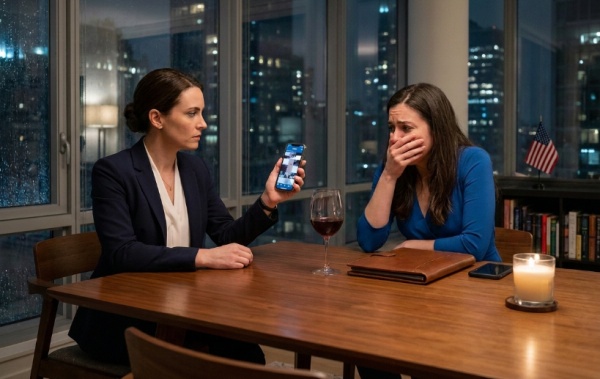
My Best Friend Sat Across From Me and Confessed She’d Been Seeing My Husband — So I Smiled, Said “I Know,” and Opened My Phone…. She came to that lunch table thinking she was ending my world. She had no idea I had already built a new one.
Part 1: The Best Friend I Thought I Knew
Her name was Serena Walsh, and for eleven years she had been the kind of friend people write about in toasts at weddings and eulogies at funerals — the kind you call at 2 a.m. when the world falls apart, the kind who shows up with wine and no judgment, the kind whose name you give as an emergency contact because she feels as permanent as family.
We met during freshman orientation at the University of Texas at Austin, standing in the same registration line, both of us wearing the same brand of white sneakers, both of us pretending we were not terrified. She laughed first. I laughed second. By the end of that afternoon we had exchanged numbers, shared a dining hall table, and started a friendship that would outlast three apartments, two cross-country moves, one broken engagement on her side, and my entire marriage.
Or so I believed.
Serena was my maid of honor when I married Daniel Hartley in a ceremony at a vineyard outside Austin six years ago. She gave a speech that made everyone cry, including Daniel, including me, including his mother who had not cried at anything since the 2004 World Series. She talked about loyalty, about the rare gift of watching someone you love find their person, about how she had never seen me as happy as I was standing next to Daniel.
I have thought about that speech many times in the past fourteen months.
I wonder now whether she was performing grief for something she had already decided to take.
Daniel was a commercial real estate developer, thirty-nine, with an easy smile and the kind of confidence that fills a room without demanding it. We lived in a four-bedroom house in Westlake Hills, a quiet neighborhood west of Austin with good schools and wide streets and neighbors who waved from driveways. We had a daughter named Hazel who was four years old and believed firmly that strawberries were a food group and that every problem could be solved with a bandage and a hug.
From the outside, we were fine.
From the inside, we had been drifting for about two years — the slow, quiet drift that happens when two people stop choosing each other deliberately and start just coexisting inside a shared routine. Daniel worked long hours. I ran a small interior design studio from a converted garage behind our house. We were polite, functional, and increasingly separate in the way that busy people tell themselves is temporary.
I told myself it was temporary.
I was wrong about that, and I was wrong about why.
The first sign was so small I almost dismissed it entirely. In January of last year, I borrowed Daniel’s laptop to print a client proposal because mine was updating. His email was open, and a thread at the top of the inbox was from an address I did not recognize — a Gmail account with a name that was clearly not a client or a colleague. The preview line read: Last night was exactly what I needed. Thank you for—
The email cut off there.
I printed my proposal.
I closed the laptop.
I stood in the kitchen for four minutes doing nothing.
Then I opened my own laptop, opened a new document, and typed the Gmail address from memory before I could second-guess myself. I did not confront Daniel. I did not search the address online. I just wrote it down, closed the document, saved it in a folder labeled “Studio Invoices 2024,” and went back to work.
That was the beginning of fourteen months of paying very close attention.
Part 2: What I Found When I Started Looking
I want to be clear about something: I am not a suspicious person by nature. I am not someone who checks phones or reads through emails or sets up hidden cameras out of insecurity. I had never done any of those things in six years of marriage because I had never felt the specific, quiet dread of a preview line that ends mid-sentence.
But once I felt it, I could not unfeel it.
I started small. I paid attention to patterns — the late client dinners that happened on the same nights every week, the gym bag that came home smelling like a restaurant instead of a locker room, the way Daniel’s phone screen always tilted slightly away from me when a notification arrived. None of it was proof. All of it was signal.
In March, I hired a private investigator named Carl Briggs, who operated out of a small office in South Austin and had the demeanor of a man who had long ago made peace with the worst of human behavior. He was methodical, discreet, and expensive in a way that felt worth every dollar. I paid him from my business account, which was separate from our joint finances, and I told no one.
Carl’s first report came back in April.
Daniel had been meeting someone regularly at a short-term rental property in the Bouldin Creek neighborhood — a two-bedroom house listed on a vacation rental platform under a name that was not his. They met on Tuesday evenings, occasionally on Saturday mornings when I took Hazel to her gymnastics class. The meetings had been happening for at least eleven months by the time Carl began documenting them.
Carl did not identify the woman in his first report.
He identified her in his second.
I remember sitting at my studio desk on a Thursday afternoon in late April, opening the PDF Carl had sent through an encrypted file transfer, and seeing a photograph taken from a public sidewalk. It showed Daniel walking toward the rental house. Beside him, laughing at something he had said, was a woman I had known for eleven years.
Serena Walsh.
I sat very still for a long time.
Outside my studio window, a mockingbird was doing its thing in the oak tree — cycling through a dozen borrowed songs, none of them its own. I had always found mockingbirds charming. That afternoon I found them unbearable.
I did not cry. I want to say I cried, because crying feels like the appropriate human response to seeing your best friend’s face in a private investigator’s surveillance photograph. But what I actually felt was something colder and more structural — the sensation of a load-bearing wall revealing itself as hollow. Everything I had built my understanding of my life on had been resting on something that was not there.
I closed the PDF.
I texted Serena: Thinking of you. Coffee this week?
She replied within four minutes: Yes!! Thursday? I miss your face.
I replied: Thursday works. The usual place.
Then I opened a new folder on my laptop, labeled it “Studio Expenses Q2,” and began saving everything Carl sent me.
Over the next three months, I built a file that would have impressed a paralegal. Phone records obtained through legal channels. Credit card statements showing charges at restaurants I had never been invited to. A receipt from a jewelry store on South Congress Avenue for a bracelet I had never received. Photographs. Timestamps. A timeline that covered thirteen months and left very little room for alternative interpretation.
I also consulted an attorney named Margaret Osei of Osei Family Law in Austin, who had twenty years of experience in Texas divorce cases and the calm, precise energy of someone who had heard every version of this story and was still capable of outrage on her clients’ behalf. Texas is a community property state, meaning assets acquired during the marriage are generally split equally, but fault — including adultery — can be considered in property division under Texas Family Code. Margaret explained my options with the thoroughness of someone who understood that information was the only thing standing between me and a decision I might regret.
I listened to everything.
I decided to wait.
Not forever.
Just until I had everything I needed and the moment was mine to choose.
Part 3: The Confession I Already Knew Was Coming
Serena asked to meet for lunch on a Saturday in late September at a restaurant on South Lamar that we had been going to since our mid-twenties — a place with good tacos, loud music, and the kind of comfortable familiarity that makes hard conversations feel slightly less impossible.
I knew before she called that something had shifted. Daniel had been quieter than usual for two weeks, the specific quiet of a person rehearsing something. Serena had canceled two plans in a row with excuses that were slightly too detailed, the way lies are always slightly too detailed because the truth does not need to explain itself.
I arrived first and ordered coffee and sat in the corner booth where we always sat.
When Serena walked in, she looked like she had not slept. Her hair was pulled back in a way that was not quite intentional, and she was wearing no jewelry, which was unusual for her. She sat down across from me and ordered water and did not look at the menu.
We talked about small things for about ten minutes.
Her job. Hazel’s gymnastics. A renovation project I was working on for a client in Tarrytown. The easy, practiced rhythm of a friendship that had survived a decade of ordinary life.
Then Serena put both hands flat on the table.
I recognized the gesture. She did it when she was about to say something she had been rehearsing.
“I need to tell you something,” she said.
“Okay,” I said.
She looked at the table. Then at me. Her eyes were already filling.
“I’ve been seeing Daniel.”
She said it simply, the way people say things they have been holding so long that the weight has worn the words smooth.
“For about a year. I know that’s — I know there’s nothing I can say that makes it okay. I know I’ve been lying to you. I know what I’ve done to our friendship and to your marriage and I am so sorry, Nora. I am so sorry.”
Her voice broke on the last word.
The restaurant noise continued around us — dishes clattering, music playing, a child at the next table arguing about something with great conviction.
I looked at Serena for a long moment.
Then I smiled.
Not a cruel smile. Not a performance. Just the quiet, settled expression of a woman who had been waiting for a door to open that she had already mapped from the other side.
“I know,” I said.
Serena blinked.
“What?”
“I know,” I said again, calmly. “I’ve known for about fourteen months.”
The color left her face in a way that was almost clinical — a visible, rapid draining, like watching a tide go out faster than physics should allow.
I picked up my phone from the table.
I opened the folder.
I turned the screen toward her.
The first photograph was from Carl’s second report — the two of them walking toward the Bouldin Creek rental house, Daniel’s hand at the small of her back, Serena laughing at something he had said. It was timestamped. It was clear. It was undeniable.
I swiped.
The next image was a screenshot of a text thread from a number I had traced to a prepaid phone Daniel purchased at a Walmart on Ben White Boulevard in February. The messages were not explicit, but they were intimate in the specific, careless way of people who believe they are invisible.
I swiped again.
Credit card receipt. Restaurant on East Sixth Street. Two entrées, one bottle of wine, one dessert. A Tuesday evening when Daniel told me he had a client dinner in Round Rock.
I swiped again.
The jewelry receipt from South Congress.
I swiped again.
A photograph of the vacation rental listing, with the booking history Carl had obtained through legal research, showing reservations that aligned precisely with the Tuesday evenings and Saturday mornings in my timeline.
Serena had not spoken.
She was staring at the phone with an expression I had never seen on her face before — not guilt exactly, not fear exactly, but the specific, hollow look of a person watching the architecture of their own deception become visible all at once.
I put the phone down.
“I didn’t come here to hurt you,” I said. “I came here because you called this meeting, and I thought you deserved to know that the confession you prepared wasn’t going to land the way you expected.”
Part 4: What Happens After the Silence
Serena cried.
I want to be honest about that because the story is not satisfying if I pretend she was cold or unaffected. She cried genuinely, the kind of crying that is not performance — ugly and quiet and full of the specific grief of someone who has finally been forced to see themselves clearly.
She said she was sorry eleven times. I counted, not out of cruelty, but because I was paying attention to everything in that moment the way you pay attention to a room you are leaving for the last time.
She said she had not planned it. She said it started at a work event Daniel attended where she happened to be a guest, that it was one night that became two and then became something she did not know how to stop. She said she had ended it three weeks ago. She said she had been trying to find the courage to tell me for months.
I listened to all of it.
I did not interrupt.
When she finished, I said: “I believe that you’re sorry. I also believe that sorry doesn’t restructure what happened. And I need you to understand that this conversation is not the beginning of a reconciliation. It’s the end of something.”
She nodded. More tears.
“Is there anything I can do?” she asked.
“No,” I said. “There isn’t.”
I paid for my coffee, left cash on the table, and walked out into the September heat of South Lamar. The sun was bright and indifferent. A food truck on the corner was doing brisk business. A dog tied to a parking meter watched me pass with the calm, non-judgmental attention that only dogs can manage.
I sat in my car for a few minutes.
Not crying.
Just breathing.
Then I called Margaret Osei.
“It’s Nora,” I said. “I’m ready.”
The divorce filing happened the following Tuesday.
Daniel was served at his office in downtown Austin at 2:15 in the afternoon. His assistant called me seventeen minutes later, which told me she had been instructed to monitor for exactly this kind of development. Daniel called four minutes after that. I let it go to voicemail.
His message was composed, which told me he had also been preparing. He said we needed to talk, that things had gotten complicated, that he wanted to handle everything respectfully and without involving lawyers more than necessary. He used the word “amicably” twice, which is the word people use when they want the other party to be cooperative without acknowledging why cooperation might be difficult.
I forwarded the voicemail to Margaret.
Then I picked up Hazel from preschool, took her to get ice cream on Burnet Road, and listened to her explain at length why strawberry was objectively the best flavor and anyone who disagreed was simply mistaken.
“You might be right,” I said.
“I am right,” she said, with the serene confidence of a four-year-old who has not yet learned to doubt herself.
I wanted to bottle that confidence and save it for harder days.
The legal proceedings moved the way Texas divorce proceedings move when one party has documentation and the other party has exposure. Daniel’s attorney, a man named Phillip Garrett who operated out of a glass-fronted office on Congress Avenue, was skilled and expensive and very good at finding procedural angles. But procedural angles are less useful when the opposing side has fourteen months of organized evidence and a forensic financial summary showing that marital funds had been used to finance the affair.
The credit card charges. The vacation rental bookings. The jewelry. The prepaid phone purchased with a joint debit card.
Texas law allows fault — including adultery — to be considered in the division of community property. It does not guarantee a punitive outcome, but it creates leverage, and leverage in a negotiated settlement is worth more than most people realize until they are sitting across a conference table watching the other side’s attorney do math.
We did not go to trial.
Most divorces do not.
We settled after three months of negotiation, and the settlement reflected the documentation I had spent fourteen months building.
Part 5: The House I Rebuilt From the Foundation
The divorce was finalized on a Wednesday in January, seven months after the lunch on South Lamar.
I remember the date because Hazel had a dentist appointment that morning and declared the entire experience deeply unfair, and I remember thinking that her outrage at a routine cleaning was the most honest emotional response I had witnessed in months. Everything else had required translation.
The settlement gave me the Westlake Hills house, which I had wanted not for its value but because Hazel’s room had a mural on the wall that I had painted myself during her first year — a garden full of animals, each one doing something slightly absurd, a rabbit reading a newspaper, a fox wearing a hat, a bear attempting yoga. I was not willing to leave that mural behind. Some things are worth more than their square footage.
I received primary custody of Hazel with a structured parenting schedule that gave Daniel regular time and gave Hazel the stability of knowing both her parents were present and functional, even if they were no longer in the same house. That was the part I cared about most. Children do not need their parents to be happy together. They need their parents to be reliable separately.
Daniel moved into a rental in the Mueller neighborhood. He and Serena did not last, which I heard through the peripheral social network that survives most divorces — the mutual acquaintances who feel obligated to update you on things you did not ask about. I received that information with the same neutrality I had been practicing for months. What happened between them after the marriage ended was not my story to carry.
Serena sent me a letter in February.
It was handwritten, four pages, and it said everything she had not been able to say at the restaurant — about the shame, the self-examination, the therapy she had started, the friendship she knew she had destroyed and was not asking to rebuild. She said she hoped someday I could think of the eleven years before the last one without the last one ruining all of it.
I read the letter twice.
Then I put it in a drawer.
Not the trash.
A drawer.
Because I am not sure yet what I think about eleven years of genuine friendship and one year of genuine betrayal, and I have decided I do not need to be sure right now. Some things can stay unresolved without becoming emergencies.
My design studio grew in the months after the divorce in the way that things sometimes grow when you stop dividing your energy between building something and managing someone else’s comfort. I took on three new residential clients, hired a part-time project coordinator named Becca who had just finished her design degree at UT and reminded me of myself at twenty-four — talented, slightly overwhelmed, and very good at pretending otherwise. I gave her real work. She did not disappoint.
I repainted my studio in February.
Not because it needed it, but because I wanted to choose the color for myself without consulting anyone. I chose a deep, warm terracotta that my former self would have called too bold and my current self called exactly right. Hazel came in on the first morning after it dried and stood in the doorway with her juice box and said, “Mama, it looks like a sunset in here.”
“That’s what I was going for,” I said.
“I like it,” she said, with the authority of someone whose opinion matters.
I liked it too.
People have asked me, since the story made its way through the social circles that these stories always make their way through, why I waited so long. Why I spent fourteen months gathering evidence instead of confronting Daniel the moment I saw the email preview. Why I sat across from Serena at that restaurant and let her deliver a confession I had been holding in my pocket for months.
The honest answer is that I needed to know the full shape of what I was dealing with before I decided how to respond to it. A confrontation in the early months, before I had documentation, before I had legal counsel, before I understood the financial landscape of my own marriage, would have given Daniel and Serena the advantage of controlling the narrative. They would have minimized, explained, apologized strategically, and I would have been making decisions from a position of emotional chaos rather than informed clarity.
I had spent six years watching Daniel negotiate real estate deals. The first thing he always said was: never negotiate before you know what the other side has.
He taught me that.
I used it.
The other honest answer is Hazel.
Every decision I made during those fourteen months was filtered through the question of what kind of mother I wanted to be when this was over. Not a perfect mother. Not an unbroken one. But a steady one — a mother who modeled the difference between being hurt and being destroyed, between losing something and losing yourself.
The night the divorce was finalized, after Hazel was asleep, I sat on the back porch of the Westlake Hills house with a glass of wine and looked at the oak trees in the yard. The same mockingbird, or one exactly like it, was still cycling through borrowed songs in the dark.
I had found it unbearable the afternoon I opened Carl’s PDF.
That night, I found it almost beautiful.
Not because the songs were its own.
Because it sang them anyway, fully, without apology, into the dark.
I thought about the girl who had stood in a registration line at UT Austin wearing white sneakers, terrified and pretending otherwise. I thought about the woman who had smiled across a restaurant table and said I know with a phone full of evidence and a heart full of something that was not quite anger and not quite grief but was entirely, completely hers.
I thought about Hazel’s mural — the rabbit with the newspaper, the fox in the hat, the bear attempting yoga — and how I had painted every animal slightly imperfect on purpose because I wanted her to grow up in a room that told her imperfect things could still be joyful.
I finished my wine.
I went inside.
I checked on Hazel, who was sleeping with one arm thrown over her face in the dramatic fashion of someone who takes rest very seriously.
I stood in the doorway of her room for a long moment.
“I’ve got you,” I whispered.
The same words I had whispered to myself on the worst nights of the past fourteen months.
The same words that had been true every single time.
We were going to be okay.
Not because nothing bad had happened.
Because something real had survived it.
And that, I had learned, was the only foundation worth building on.
