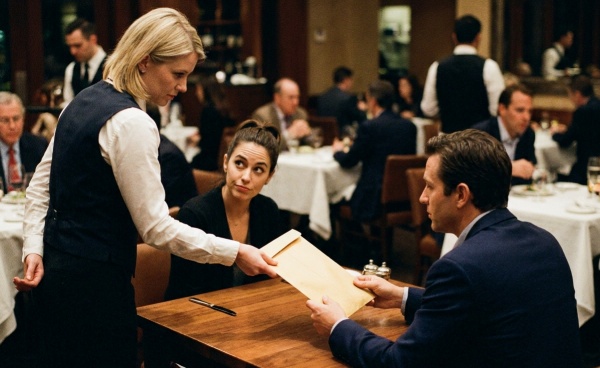
He Took His Mistress to a Fancy Chicago Steakhouse—Then the “Waiter” Handed Him Divorce Papers
Daniel told his wife he was driving to Milwaukee for a late client meeting. Instead, he walked into an expensive Chicago restaurant with another woman and ordered wine like his double life was still under control. What he didn’t know was that Emily had stopped begging for the truth weeks ago. When the “waiter” placed a black folder beside his glass and said, “You’ve been served,” Daniel finally froze.
Part 1 — The Table by the Window
At 7:18 on a Thursday night, my husband walked into one of the most expensive restaurants in Chicago with another woman on his arm. The place was called Marlowe’s, a dimly lit steakhouse in River North where a glass of wine cost more than the weekly grocery budget he had recently told me we needed to cut. He thought no one from our real life would see him there.
He was wrong.
My name is Emily Carter, and for eleven years, I was married to Daniel Carter. To the outside world, Daniel was the kind of man people trusted immediately: clean haircut, tailored navy suits, polished brown shoes, and a laugh that made clients feel like they were the only people in the room. He worked in commercial real estate, sold confidence for a living, and had become very good at making lies sound like plans.
For months, he told me he was working late. For months, he told our two kids, Ava and Mason, that Daddy had another client dinner, another last-minute meeting, another deal that could change everything. For months, I sat across from him at breakfast and watched him check his phone under the table like our marriage was an interruption.
That Thursday night, he told me he had to be in Milwaukee.
He even kissed the top of my head before leaving.
“Don’t wait up,” he said.
It was such a small sentence. Ordinary. Domestic. The kind of thing husbands say when they expect dinner leftovers in the fridge and clean towels in the bathroom when they come home. I stood in our kitchen in Naperville, holding a sponge, and wondered how many times a life can insult you before you finally stop calling it love.
Daniel did not know that I had stopped believing him three weeks earlier.
He did not know I had already met with a family law attorney downtown.
He did not know I had spent the last month gathering bank statements, hotel receipts, screenshots, and the quiet courage required to stop asking a liar for the truth.
Most importantly, Daniel did not know that the man approaching his table at Marlowe’s was not just a waiter.
He was a licensed process server.
His name was Marcus Reed, and he had been hired by my attorney to serve Daniel properly under Illinois law. Marcus had coordinated with the restaurant manager, who agreed only after being assured there would be no scene, no harassment, no recording, and no interference with other guests. Marcus wore a white shirt and black apron because he was helping clear tables that night as paid event support, but his real job was to hand Daniel the papers and confirm service.
I was not in the restaurant.
That mattered to me.
I did not want a public screaming match. I did not want to throw wine, slap anyone, or become a viral clip for strangers to judge over lunch the next day. I wanted the marriage to end with the one thing Daniel had avoided for months: accountability in writing.
Later, Marcus told me Daniel looked relaxed when he sat down.
The woman with him was named Vanessa Blake. She was thirty-two, worked in marketing for one of Daniel’s client firms, and apparently believed his version of our marriage: distant wife, dead bedroom, staying only for the kids, divorce “basically already happening.” That last phrase made me laugh when I first heard it.
Divorce was not “basically happening.”
I made it actually happen.
Daniel ordered a $92 ribeye, truffle mashed potatoes, and a bottle of California cabernet. Vanessa ordered salmon and laughed at something Daniel said while touching his sleeve. Marcus waited until appetizers arrived.
Then he walked over with a small black check presenter.
Daniel barely looked up.
“Already?” he joked. “We haven’t even had dinner.”
Marcus placed the folder beside Daniel’s wine glass.
“Mr. Daniel Carter?”
Daniel’s smile thinned. “Yes?”
Marcus kept his voice low and professional. “You’ve been served.”
For one full second, Daniel did not move.
Then he opened the folder.
Inside were the petition for dissolution of marriage, temporary parenting proposals, financial disclosure requests, and a notice from my attorney. At the top of the first page, in clean black letters, was my name.
Emily Carter, Petitioner.
Marcus said Daniel’s face drained so fast it looked like someone had pulled a plug.
Vanessa leaned over. “What is that?”
Daniel closed the folder too quickly. “Nothing.”
But it was not nothing.
It was eleven years of marriage, two children, a mortgage, a college savings account, a joint checking account he had treated like a private wallet, and every lie he thought I was too tired to question.
It was the end of me waiting at home.
It was the beginning of him answering in court.
Part 2 — The Marriage I Tried to Save
Daniel and I met when I was twenty-six and working as a project coordinator for a small design firm in downtown Chicago. He came in for a consultation wearing a gray suit and carrying coffee for everyone, even though he had never met us before. He remembered my name after one introduction.
That was how it started.
Not with fireworks.
With attention.
Daniel made you feel chosen. He noticed when I changed my hair. He remembered that I hated olives, loved old bookstores, and cried every time I watched the end of “Field of Dreams.” On our third date, he drove me to Lake Michigan after dinner because I mentioned I had always loved the skyline at night.
Back then, I thought kindness meant character.
Now I know charm can be a costume.
We married two years later in a small ceremony in Oak Park. My mother cried, his father gave a speech about loyalty, and Daniel promised to “build a life honest enough for both of us to rest in.” I believed him completely.
For a while, we were happy.
We bought a modest house in Naperville with a cracked driveway, a maple tree out front, and a kitchen that needed updating. Ava was born the next year, Mason three years after that. Our life became school drop-offs, Target runs, backyard birthday parties, and arguments about who forgot to take the chicken out of the freezer.
Daniel was ambitious, and I admired that.
He worked long hours, but I told myself he was doing it for us. When he missed dinner, I saved him a plate. When he missed Ava’s kindergarten music night, I filmed the whole thing and texted him the video. When he forgot our anniversary one year, he showed up the next day with diamond earrings and a speech about pressure, and I forgave him because forgiveness had become part of my routine.
The first real crack appeared after Mason turned five.
Daniel started guarding his phone.
Not openly.
Subtly.
Face down on the table. Password changed. Notifications hidden. He began taking calls in the garage, the backyard, even the driveway with the engine running.
When I asked, he said, “Client confidentiality.”
I wanted to believe that because the alternative made my chest hurt.
Then came the new habits.
A gym membership he suddenly used every morning. A cologne I had never bought him. Dress shirts from a boutique in the Loop that appeared on our credit card as “professional wardrobe expenses.” He became impatient with ordinary family life, as if our children asking for help with homework were delaying him from the life he deserved.
One night, while folding laundry, I found a hotel key card in his suit pocket.
The hotel was in downtown Chicago.
Daniel said a client had booked a conference room there.
“Why was the key in your pocket?” I asked.
He looked at me with disappointment, as if my question embarrassed him.
“Emily, do you hear yourself?”
That became his favorite defense.
Not an answer.
A mirror angled back at me.
If I asked why he came home at 1:00 a.m., I was insecure. If I asked about a $418 dinner charge, I was controlling. If I asked why he had started deleting text threads, I was “looking for problems because I was unhappy with myself.”
Gaslighting sounds dramatic when people talk about it online.
In real life, it is quieter.
It makes you apologize for noticing smoke.
I did apologize.
Many times.
I apologized after crying in the bathroom because I found lipstick on a wine glass in his car. I apologized after confronting him about a weekend “conference” that did not appear on his company calendar. I apologized when he said my distrust was damaging our marriage, even though he was the one carrying matches.
Then, one Sunday morning, Ava asked why Daddy’s phone kept showing hearts from someone named V.
Daniel had left it charging on the kitchen counter.
I froze.
Mason kept eating cereal.
Daniel walked in two seconds later, saw the screen, and grabbed the phone so fast Ava flinched.
That was the moment something inside me stopped begging.
Not because I had proof of everything.
Because my daughter had seen enough to ask.
I could tolerate being lied to longer than I should have.
I could not tolerate my children learning that love meant confusion, secrecy, and watching their mother shrink at breakfast.
I did not yell that day.
I did not confront him in front of the kids.
I packed their lunches, drove them to school the next morning, and called an attorney from the parking lot after drop-off.
Her name was Rachel Stein, a family law attorney in Chicago with a calm voice and zero interest in revenge. She told me to document, not dramatize. She told me not to empty accounts, not to post accusations online, not to contact the other woman, and not to threaten Daniel.
“Protect yourself,” she said. “Protect the children. Let the process do what the process is for.”
So I did.
Quietly.
For once, I stopped asking Daniel for honesty and started gathering facts.
Part 3 — The Plan That Wasn’t Revenge
People imagine that the moment a wife discovers betrayal, she becomes fire. They picture smashed plates, shouted insults, and a woman standing in the rain demanding answers. Maybe that happens in movies.
In my real life, I became organized.
I opened a folder on my laptop called “Home Repairs” because Daniel never clicked anything related to housework. Inside were screenshots, bank statements, credit card charges, phone records from our shared plan, and a note timeline of nights he claimed to be traveling. I learned that heartbreak can make you efficient when crying stops being useful.
The hotel key was not enough.
The hearts from “V” were not enough.
The $600 dinner at a restaurant he said he had never visited was not enough by itself.
But together, the pattern became hard to ignore.
Rachel explained that Illinois is a no-fault divorce state, so I did not need to prove adultery to end the marriage. That surprised me at first. Some part of me wanted the legal system to care that my husband had lied while I packed school lunches and clipped coupons.
Rachel was sympathetic but clear.
“The court cares about property, parenting, support, and the best interests of the children,” she said. “The affair may matter if marital money was spent on it. But your freedom does not require him to admit he was wrong.”
That sentence helped me more than I expected.
My freedom did not require his confession.
For months, I had been waiting for Daniel to say the truth out loud because I thought that would make it real. But the truth was already real. His admission was not the gatekeeper to my life.
Serving him at Marlowe’s had not been my first idea.
Rachel’s office tried to arrange service at his workplace, but Daniel was rarely at his desk and had developed a talent for being “in meetings” whenever anyone unfamiliar arrived. They tried the house, but I did not want him served in front of the children. They tried by appointment through his attorney, except Daniel claimed he had not retained one yet.
Then I received an email that changed everything.
It was from a hotel rewards account linked to our shared email years earlier. Daniel had forgotten to remove me. The confirmation showed a reservation for Thursday night at a boutique hotel near the Chicago River and a dinner reservation at Marlowe’s for two.
Rachel did not smile when I showed her.
She simply said, “That gives us a location.”
I hesitated.
“Is that legal?”
“If handled properly, yes,” she said. “A process server can serve someone in a public place as long as there is no trespassing, harassment, or impersonation of law enforcement. We will keep it professional.”
Professional.
That word mattered.
Because I was angry enough to want humiliation, but I was also a mother. I did not want my children reading one day that their parents’ divorce began with a spectacle. Daniel had created enough damage with secrecy. I wanted my side of the story to be clean.
Marcus Reed came recommended.
He was a retired sheriff’s deputy turned process server, polite and careful. He asked whether Daniel had a history of violence. I said no. He asked if I wanted to be nearby. I said absolutely not.
“Good,” Marcus said. “That usually makes things worse.”
Instead, I stayed home.
I made mac and cheese for Ava and Mason. I helped Mason tape cardboard wings onto a shoebox for a school project. I listened to Ava explain the complicated social politics of sixth grade with more seriousness than the United Nations.
At 7:00, Daniel texted me.
Just got to Milwaukee. Long night ahead. Don’t wait up.
I looked at the message while standing in my kitchen, the same kitchen where I had once believed our life was ordinary and safe.
I typed back:
Okay.
One word.
No anger.
No suspicion.
No performance.
Then I put my phone face down and helped Mason find the blue marker.
At 7:29, Marcus texted Rachel, and Rachel called me.
“He’s been served,” she said.
I sat down at the kitchen table.
For a moment, I could not speak.
“Emily?” Rachel asked gently.
“I’m here.”
“It went smoothly. No confrontation. Marcus will file proof of service.”
I looked across the room at my children. Mason was coloring cardboard wings. Ava was sneaking shredded cheese from the bag even though she thought I could not see her. Their father was sitting in a restaurant with another woman, holding proof that the life he had been managing in secret was officially over.
I expected to feel victorious.
Instead, I felt sad.
Deeply, physically sad.
Not because I wanted Daniel back.
Because endings are heavy even when they are necessary.
Ava looked up. “Mom? Are you okay?”
I smiled, but my eyes filled.
“Yes, honey,” I said. “I’m going to be.”
And for the first time in months, I believed myself.
Part 4 — When He Froze
Daniel came home at 11:46 p.m.
I know because I was sitting at the dining room table when the garage door opened. The kids were asleep upstairs. Cooper, our old Labrador, lifted his head from the rug but did not get up, as if even the dog knew Daniel had lost the right to a welcome.
He walked in holding the black folder.
His tie was loosened. His face was pale. He looked less like the charming man from restaurants and more like someone who had discovered gravity applied to him too.
“Emily,” he said.
I closed my laptop.
“Daniel.”
He placed the folder on the table like it might explode.
“You served me in a restaurant?”
I folded my hands.
“You were difficult to serve elsewhere.”
His jaw tightened. “That was humiliating.”
I looked at him for a long moment.
There were so many answers I could have given.
So many sharp, satisfying sentences.
I could have said it was humiliating to be lied to for months. Humiliating to check credit card statements like a detective. Humiliating to watch our daughter read hearts from another woman on his phone. Humiliating to sleep beside a man who had already moved part of himself somewhere else.
Instead, I said, “It was legal.”
That bothered him more than anger would have.
Daniel sat across from me, then stood again, too restless to pretend calm. “You made me look like a criminal.”
“No,” I said. “I made you a respondent in a divorce case.”
He laughed bitterly. “You’ve been planning this.”
“Yes.”
The honesty struck him.
He was used to me explaining, apologizing, softening.
I did none of those things.
“For how long?” he asked.
“Since Ava saw the hearts on your phone.”
His face changed.
Just slightly.
Not guilt, exactly.
Fear.
“You told the kids?”
“No. You involved the kids when you left your phone on the counter.”
He looked away.
For the first time, Daniel had no immediate comeback.
I had imagined this conversation for weeks. In some versions, I screamed. In some, I cried. In one, I dramatically threw a suitcase down the stairs, which was satisfying in fantasy but impractical because the suitcase was mine.
Reality was quieter.
I slid a printed sheet across the table.
“This is a temporary household schedule,” I said. “Rachel drafted it. You can have your attorney review it. Until we have a formal agreement, I want consistency for Ava and Mason.”
Daniel stared at the paper.
“You already decided custody?”
“No. We are proposing a parenting schedule. The court decides if we cannot agree.”
He looked up sharply. “So that’s how it is? Court? Lawyers? You’re going to take my kids?”
My stomach twisted.
There it was.
The sentence I had feared.
I kept my voice steady because Rachel had prepared me.
“I am not taking the children from you. I am asking for a stable parenting plan that protects them from adult conflict.”
“You think I’m a bad father?”
“I think you have been an absent husband. I think we need to make sure you don’t become an inconsistent father.”
He flinched.
Good.
Some truths should hurt enough to wake a person up.
Then his expression shifted, and I saw the salesman return.
He sat down slowly. His voice softened.
“Emily, I know this looks bad.”
I almost smiled.
Looks bad.
As if betrayal were a lighting issue.
“I made mistakes,” he continued. “But divorce? Really? After everything we built?”
I looked around the dining room.
The framed family photos. The school art. The table with scratches from years of homework and birthday cakes. The room held proof that we had built something. It also held proof that building something does not give someone permission to burn it from the inside.
“Daniel,” I said, “you took another woman to dinner after telling me you were in Milwaukee.”
He rubbed his face. “Vanessa and I—”
“Do not say her name like I asked for details.”
He stopped.
“I don’t need your confession tonight,” I said. “I don’t need your excuses. I need you to sleep in the guest room and contact an attorney.”
He stared at me.
“You’re serious.”
“Yes.”
“What if I end it?”
I felt the old pain move through me, but it no longer controlled my hands.
“You should end it because it’s wrong,” I said. “Not because you were served.”
His eyes reddened.
For a second, I saw the man I married, or maybe just the man I had hoped he was. That is the cruel thing about divorce. The person who hurt you does not transform into a cartoon villain. Sometimes he stands in your dining room looking broken, and your heart remembers loving him before your mind reminds you why you stopped being safe.
“I don’t want to lose my family,” he whispered.
“You already risked us,” I said. “Now we find out what is left.”
He reached across the table.
I moved my hand away.
Not dramatically.
Just enough.
His face fell.
That small movement said what months of conversations had failed to say.
Access to me was no longer automatic.
Part 5 — What the Papers Couldn’t Do
The next morning, Daniel made pancakes for the kids.
He had not made breakfast on a weekday in years.
Mason was thrilled. Ava was suspicious. I stood by the coffee maker and watched Daniel overcompensate with chocolate chips and forced cheer while the divorce papers sat upstairs in his briefcase.
Children know more than adults think.
Ava looked at me twice during breakfast.
Mason asked why Dad was home if he had been in Milwaukee.
Daniel froze with the spatula in his hand.
I answered before he could lie again.
“Dad’s schedule changed.”
It was not the full truth, but it was not a false story designed to protect him. Rachel had told me children need honest, age-appropriate information, not adult details. There would be a conversation soon, but not over pancakes before school.
After drop-off, Daniel tried to talk again.
This time, he was different.
Less angry.
More afraid.
“I called an attorney,” he said.
“Good.”
He looked wounded by my calmness. “Do you want me to move out?”
“I want you to discuss that with your attorney. I also want us to avoid fighting in front of the kids.”
He nodded.
Then he said, “Vanessa didn’t know everything.”
I picked up my coffee.
“That is between you and Vanessa.”
“She thought we were separated.”
I looked at him.
“Were we?”
He looked down.
“No.”
That was the first clean answer he had given me in months.
It did not fix anything.
But clean truth, even late, is different from another layer of fog.
The weeks that followed were not cinematic. There were no dramatic courtroom speeches, no judge slamming a gavel, no mistress arriving at my door begging for forgiveness. Real divorce is mostly paperwork, calendar conflicts, financial disclosures, and moments where grief catches you in the produce aisle because you remember buying strawberries for someone who no longer comes home for dinner.
Daniel moved into a short-term apartment in Oak Brook after consulting with his attorney. We told the children together with guidance from a family therapist. Ava cried quietly and asked if it was because of “the woman with the hearts.”
Daniel covered his face.
I wanted to protect her from that knowledge.
But children notice patterns, and secrets have edges.
“We are separating because of adult problems,” I told her gently. “You and Mason did not cause this, and both of us love you.”
Mason asked if he would still have his room.
Daniel finally spoke.
“Yes, buddy. You’ll always have your room.”
His voice broke.
I looked away because his pain was not my job to manage anymore.
That was one of the hardest lessons.
For years, I had organized my emotions around Daniel’s comfort. If he was stressed, I softened. If he was guilty, I reassured. If he was angry, I shrank. Divorce did not instantly change that instinct, but it gave me a legal and emotional structure to practice being separate.
Rachel remained practical.
She helped me understand marital assets, temporary support, parenting schedules, and how spending on an affair might factor into financial discussions. She reminded me not to use the kids as messengers. She reminded me not to post details online, even when I wanted people to know I had not simply “given up.”
That was hard.
Because Daniel’s public image survived longer than our private marriage did.
People at church asked if we were “going through a rough patch.” A neighbor said Daniel looked devastated, as if devastation automatically meant innocence. One of his coworkers told me, in the grocery store of all places, that “marriages take work.”
I looked at her cart full of yogurt and paper towels and said, “They also take honesty.”
Then I walked away.
Vanessa disappeared from the story faster than I expected. According to Daniel, she ended things after realizing the divorce had not been as mutual or as advanced as he had claimed. I did not celebrate that. I did not contact her. I did not need her apology to move forward.
Daniel wrote me one long email three months after being served.
It was the first apology that did not contain the word “but.”
He admitted he had lied. He admitted he had used work as cover. He admitted he had let me carry the household and the emotional labor while he chased admiration elsewhere. He wrote that seeing the papers in the restaurant had felt like being exposed, but that exposure was not the same as injustice.
I read it twice.
Then I replied with four sentences.
Thank you for acknowledging this. I hope you continue working on your relationship with the kids. Please send your proposed edits to the parenting schedule by Friday. I am not ready for any personal conversation beyond logistics.
It felt cold when I typed it.
Then it felt peaceful.
Boundaries often feel cold to people who benefited from their absence.
Six months later, the divorce was not final, but life had begun rearranging itself around the truth. The kids had two homes. I had a new budget, a reliable therapist, and a bedroom where I slept diagonally because no one was there to complain. Cooper stayed mostly with me but visited Daniel on weekends, which seemed to please everyone except Cooper, who believed all humans should live in one pack and share snacks.
Daniel became more consistent with the children.
I will give him that.
He attended Mason’s soccer games. He took Ava to the bookstore. He learned how to pack lunches without putting yogurt next to warm chicken nuggets, which the kids treated as a major sign of growth.
He also stopped trying to charm me.
That helped more than any apology.
At mediation, we sat across from each other in a conference room downtown while lawyers discussed retirement accounts, home equity, child-related expenses, and holiday schedules. Daniel looked tired, older, humbled in a way that seemed real but no longer belonged to me to evaluate.
During a break, he said, “Do you ever think about that night at Marlowe’s?”
I looked at him.
“Yes.”
He gave a sad laugh. “I froze when that guy handed me the papers.”
“I heard.”
“I was angry at you for months because of where you served me.”
I waited.
He looked down at his coffee.
“Then my therapist asked why I was more focused on being embarrassed than on what I had done to get there.”
I did not respond immediately.
The old Emily would have praised his insight, softened the silence, rewarded him for basic accountability.
The new Emily took a sip of water.
“That sounds like a useful question,” I said.
He nodded slowly.
“It was.”
That was all.
No reunion.
No dramatic forgiveness.
No promise that pain had made us better people in some tidy inspirational way.
Just a man beginning to understand that humiliation is not always something done to you. Sometimes it is the moment your private choices meet public reality.
The divorce became final the following spring.
I kept the house for the children’s stability, refinancing with support terms negotiated through the settlement. Daniel kept his retirement accounts after an agreed division, his car, and the consequences of his choices. We created a parenting plan that was imperfect but workable.
On the day I signed the final documents, I did not feel triumphant.
I felt tired.
Then light.
That night, Ava, Mason, and I ordered pizza, watched a movie, and let Cooper sit on the couch even though he was absolutely not allowed on the couch. Halfway through the movie, Mason fell asleep against my arm. Ava leaned her head on my shoulder.
“Mom?” she whispered.
“Yeah?”
“Are we going to be okay?”
I looked around the room.
The same house. Different life. Fewer lies.
“Yes,” I said. “We are.”
And I meant it.
Sometimes people ask whether I regret serving Daniel at the restaurant. The answer is no, though not for the reason they expect. I do not look back on it as revenge. Revenge would have kept him at the center of my story.
Serving him there was simply the moment the performance ended.
He had taken his mistress out in secret, believing he could keep one life hidden from another. Then a man in a black apron placed legal papers beside his wine glass, and Daniel froze because the truth had finally arrived with his name on it.
But the papers did not save me.
I saved me.
The papers were just proof that I had stopped waiting for a liar to become honest before I gave myself permission to leave. They were the first official page of a new life, one where I no longer confused loyalty with silence.
Daniel thought he was having dinner in secret.
Instead, he was served the truth.
And for once, I was not the one left swallowing it alone.
